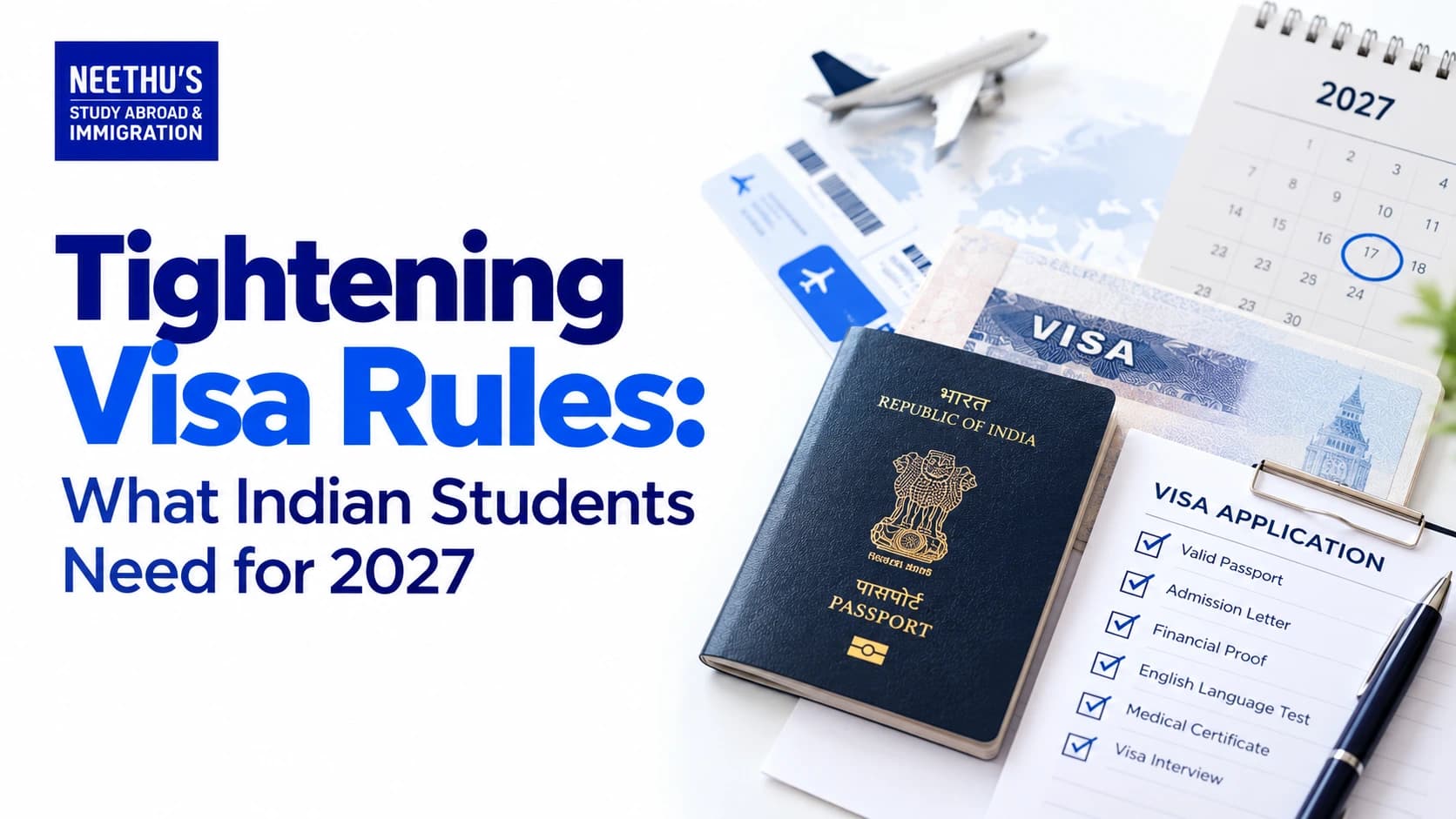
Tightening Visa Rules: What Indian Students Need for 2027
Studying abroad continues to attract Indian students who want internationally recognised qualifications, practical learning opportunities and exposure to different cultures. However, securing admission to a foreign university is only one part of the journey. Students must also satisfy immigration requirements, demonstrate sufficient financial resources and explain their academic intentions clearly.
As countries review their immigration policies, students planning to begin their studies in 2027 should prepare for a more careful application process. Understanding study abroad visa rules 2027 early can help applicants avoid unnecessary delays, prepare stronger documentation, and make informed decisions about their education.
The important point is that stricter immigration policies do not mean every student will face the same requirements. Rules differ between countries, universities, courses, and individual circumstances. Therefore, applicants should focus on the specific requirements of their intended destination rather than relying on general information shared online.
Why Are Student Visa Rules Becoming Stricter?
Governments want to ensure that international students genuinely intend to study, have sufficient financial support, and enrol at legitimate educational institutions. Immigration authorities are also concerned about fraudulent documents, unauthorised employment and people using education visas for purposes unrelated to their approved studies.
Consequently, the new student visa rules may require applicants to provide clearer financial evidence, demonstrate their academic progression, and submit additional documentation, depending on the destination country. Universities and education providers may also face stronger compliance obligations.
For Indian students, this means preparing an application carefully instead of treating the visa process as a final administrative task after receiving an admission letter.
Students preparing their study abroad application 2027 should stay informed about updated visa requirements and processing procedures, as changes may affect their preparation and application timelines.
Major Changes Students Should Understand Before 2027
1. Financial Proof Must Be Clear and Credible
Financial documentation is one of the most important parts of many student visa applications. Applicants may need to demonstrate that they can cover tuition fees, accommodation, food, insurance, transportation, and other living expenses.
Simply showing a large bank balance may not be sufficient if the source of funds is unclear or the supporting documents are inconsistent.
Students should prepare bank statements, education loan sanction letters, scholarship confirmations, and sponsor documents according to the destination country's requirements. If parents or other family members are financing the education, applicants should also be prepared to establish the relationship with their sponsors and explain the source of the money when required.
For example, Canada requires eligible study permit applicants to demonstrate sufficient funds for tuition, living expenses, and return transportation. The exact evidence and financial thresholds should be checked against the current official guidance before applying.
2. Genuine Student Intentions Matter
Immigration officers need to understand why an applicant has selected a particular course and institution. A vague explanation about wanting better opportunities overseas may not adequately demonstrate a well-considered academic plan.
Students should be able to explain how the chosen programme relates to their previous education, career objectives and future plans.
Applicants should research the course curriculum, specialisation options, teaching approach and career relevance before preparing statements or attending an interview. Their answers should reflect their actual intentions rather than memorised scripts.
If an applicant has changed academic direction or has a study gap, they should prepare a truthful explanation supported by relevant documents where appropriate.
3. English Language and Academic Requirements Need Attention
English language requirements vary between universities and immigration routes. Some institutions require recognised proficiency tests, while others may accept alternative evidence under specified conditions.
Students should confirm whether IELTS, PTE Academic, TOEFL or another qualification is accepted by both their chosen institution and the relevant immigration authority, where applicable.
Academic documents must also be consistent. Differences in names, dates, marksheets or educational histories can lead to additional questions and processing delays.
Students should organise their certificates, transcripts, passport details and admission documents well before submitting an application.
4. Country-Specific Rules Can Affect Your Plans
There is no single visa policy that applies to every destination. Students must understand the rules of the country where they intend to study.
United Kingdom: Applicants generally need an offer from a licensed student sponsor, evidence of sufficient funds, and the required English language ability. Another important consideration is the Graduate visa: applications made on or after 1 January 2027 are generally subject to an 18-month post-study period for eligible non-doctoral graduates, while eligible doctoral graduates can receive three years. Students should distinguish post-study work rules from the requirements for obtaining a Student visa.
Canada: Most international students need a study permit and a letter of acceptance from a designated learning institution. Additional requirements may apply depending on the applicant, programme and current policy. Canada's published 2026–2028 immigration plan also sets a target of 150,000 new international student arrivals in 2027, reflecting its approach to managing temporary resident numbers. This target is not an individual visa quota or a guarantee of approval.
Australia: Students generally need to satisfy the requirements for a Student visa (subclass 500), including enrolment and relevant supporting evidence. Changes effective from 2 October 2026 affect where certain applications can be lodged and whether family members can be included. Students planning for 2027 should check which provisions apply to their circumstances.
Germany and other European destinations: Applicants may need admission documentation, proof of sufficient financial resources, health insurance, and other country-specific evidence. Requirements differ by destination, so students should check the relevant embassy or immigration authority before making financial commitments.
These examples demonstrate why applicants should verify the latest requirements instead of assuming that a rule announced for one country applies everywhere.
Documents Indian Students Should Prepare
A well-organised application can reduce avoidable errors and make it easier to respond to requests for additional evidence.
Depending on the destination, course and applicant's circumstances, the following documents may be required:
-
A valid passport and completed visa application.
-
An official admission letter or other required enrolment confirmation.
-
Academic certificates, transcripts and relevant educational records.
-
Accepted English language test results, where required.
-
Bank statements, education loan documents or sponsorship evidence.
-
Scholarship letters or tuition fee payment receipts, where applicable.
-
A statement of purpose or other explanation of study intentions, if requested.
-
Health insurance, medical examination or police clearance documents, where applicable.
-
Proof of accommodation or travel arrangements, if required.
-
Biometrics and photographs meeting the official specifications.
This is a general checklist rather than a universal document list. Applicants should follow the official checklist for their particular visa category and avoid submitting unnecessary or inconsistent documents.
A Real-Life Scenario: Preparing for a September 2027 Intake
Consider a hypothetical student named Ananya from Kerala who plans to pursue a postgraduate degree in business analytics in the UK in September 2027.
She receives an offer from a university and initially assumes that paying the deposit and submitting her visa application will be enough. However, when she reviews the requirements, she realises that she must also organise financial evidence, confirm the applicable maintenance requirements and ensure that her educational history supports her choice of programme.
Her parents are funding most of her education, so she gathers the necessary sponsor evidence and checks whether the source of funds can be documented clearly. She also reviews the course modules and prepares an honest explanation of how the qualification relates to her previous studies and career plans.
Rather than waiting until the last few weeks, Ananya checks the official visa guidance, arranges the required documents and leaves time to correct any discrepancies.
Her preparation does not guarantee visa approval. However, it helps her identify potential problems earlier and submit a more complete application.
The lesson is straightforward: planning ahead gives students more time to address genuine concerns before they become urgent.
How to Prepare for the 2027 Application Process
Students should begin by selecting a realistic destination, course, and institution based on their academic background, budget, and long-term goals.
Next, they should prepare a financial plan that accounts for tuition, living costs, insurance, visa charges, and other expenses. Exchange-rate fluctuations and unexpected costs should also be considered.
The next step is to check official immigration guidance and create a deadline calendar for admission, deposits, language tests, financial documents and visa submission. Students should avoid booking non-refundable travel before confirming the relevant visa conditions.
It is also wise to keep digital and physical copies of important documents. Every detail should be reviewed for accuracy before submission, including dates, names, funding information and previous immigration history.
Most importantly, applicants must provide truthful information. Fabricated bank statements, misleading sponsorship claims or false academic documents can have serious immigration consequences.
How Education Consultants Can Help
Students managing applications independently may find it difficult to track admission deadlines, documentation requirements and changing immigration policies across several countries.
The Best study abroad consultants in kerala can help students compare destinations, identify suitable programmes, organise application documents and understand the steps involved in preparing a visa application.
A reliable consultant should explain the process transparently, provide realistic guidance and direct students to official sources for current requirements. Students should ask about service charges, refund policies and the exact services included before signing an agreement.
Consultants cannot guarantee visa approval or override an immigration officer's decision. Applicants remain responsible for ensuring that their submissions are accurate and complete.
Common Mistakes to Avoid
One frequent mistake is depending on outdated social media posts or advice from friends whose applications were processed under different rules.
Other mistakes include choosing a course without researching its relevance, underestimating living expenses, submitting inconsistent financial records and waiting too long to arrange mandatory documents.
Students should also avoid selecting a destination solely because they expect to obtain a post-study work visa or permanent residency. Immigration pathways can change, and eligibility depends on the rules in force when the relevant application is made.
Instead, students should evaluate the quality of education, total cost, career relevance and available opportunities together.
Conclusion
Preparing for overseas education in 2027 requires more than securing admission. Students must understand destination-specific visa requirements, demonstrate genuine academic intentions, organise credible financial evidence and allow sufficient time for documentation.
The study abroad for Indian students journey becomes more manageable when applicants begin early, verify information through official immigration websites and make decisions based on their individual circumstances.
Although governments may introduce or revise immigration measures, careful preparation remains a practical way to reduce avoidable mistakes. By staying informed and approaching each stage responsibly, Indian students can make better decisions about their international education plans.
FAQs
1. What are the new student visa rules for Indian students in 2027?
Student visa requirements depend on the destination country. Applicants may need to meet financial requirements, provide valid admission documents, demonstrate language proficiency, and satisfy other immigration conditions. Students should check official government websites for the latest rules before applying.
2. Why are countries tightening student visa requirements?
Governments aim to prevent immigration fraud, verify students' financial capacity, and ensure that applicants intend to pursue genuine educational programmes. Some countries are also adjusting international student numbers and strengthening oversight of educational institutions.
3. Which documents are required for a student visa in 2027?
Common documents include a valid passport, university admission letter, academic certificates, financial statements, proof of sponsorship, and language test results, where applicable. Medical records, insurance, and biometric information may also be required depending on the country.
4. How much bank balance is required to study abroad in 2027?
There is no single bank balance requirement for every destination. The amount depends on the country's immigration rules, tuition fees, living expenses, and individual circumstances. Students should confirm the applicable financial threshold through the official immigration website.
5. Can a student visa be rejected because of insufficient financial proof?
Yes. A visa application may be refused if the applicant cannot demonstrate sufficient funds or provide acceptable supporting evidence. Students should prepare genuine financial documents and ensure that the source of their funds can be explained when required.
6. Are IELTS or other English language tests mandatory for studying abroad in 2027?
Language requirements vary by country, institution, and visa category. Some universities accept IELTS, PTE Academic, TOEFL, or alternative evidence, while others may have specific testing requirements. Students should verify the rules applicable to their chosen programme.
7. How early should Indian students apply for a 2027 student visa?
Students should begin researching admission and visa requirements several months before their intended intake. They should account for university deadlines, document preparation, financial arrangements, and visa processing times, which vary by country and season.
8. Can students work part-time while studying abroad in 2027?
Many countries permit eligible international students to work under specified conditions. However, permitted working hours, employment restrictions, and eligibility requirements differ. Students should check the current rules before accepting employment.
9. Can students apply for a post-study work visa after completing their course?
Some countries offer post-study work opportunities to eligible graduates. The duration and conditions depend on the destination, qualification, institution, and immigration rules in force when the application is made. Students should not assume that eligibility will remain unchanged until graduation.
10. Can study abroad consultants help with the 2027 visa application process?
Yes. Experienced study abroad consultants can help students shortlist suitable universities, organise documents, understand application procedures, and identify relevant deadlines. However, consultants cannot guarantee visa approval, and students should verify important requirements through official immigration sources.

























































































_03-12-2025_01-17-26%20PM.webp&w=3840&q=75)
_02-12-2025_03-07-49%20PM.webp&w=3840&q=75)

_27-11-2025_04-06-24%20PM.webp&w=3840&q=75)
_25-11-2025_04-38-18%20PM.webp&w=3840&q=75)
_24-11-2025_03-20-26%20PM.webp&w=3840&q=75)
_22-11-2025_12-44-47%20PM.webp&w=3840&q=75)
_21-11-2025_04-17-47%20PM.webp&w=3840&q=75)
_20-11-2025_03-55-26%20PM.webp&w=3840&q=75)
_18-11-2025_04-00-40%20PM.webp&w=3840&q=75)
_15-11-2025_10-48-43%20AM.webp&w=3840&q=75)
%20(1)_14-11-2025_03-52-25%20PM.webp&w=3840&q=75)
_13-11-2025_03-02-38%20PM.webp&w=3840&q=75)
_08-11-2025_04-15-36%20PM.webp&w=3840&q=75)
_05-11-2025_04-01-50%20PM.webp&w=3840&q=75)
_05-11-2025_03-46-26%20PM.webp&w=3840&q=75)
_03-11-2025_03-31-09%20PM.webp&w=3840&q=75)
_04-11-2025_.webp&w=3840&q=75)
_04-11-2025_.webp&w=3840&q=75)
_29-10-2025_04-52-52%20PM.webp&w=3840&q=75)
_28-10-2025_04-09-08%20PM.webp&w=3840&q=75)
_24-10-2025_05-10-31%20PM.webp&w=3840&q=75)
_24-10-2025_04-55-51%20PM.webp&w=3840&q=75)
_22-10-2025_04-40-20%20PM.webp&w=3840&q=75)
%20(1)_21-10-2025_03-05-46%20PM.webp&w=3840&q=75)
_21-10-2025_02-43-15%20PM.webp&w=3840&q=75)
_17-10-2025_05-08-52%20PM.webp&w=3840&q=75)
_17-10-2025_04-54-54%20PM.webp&w=3840&q=75)
_15-10-2025_03-46-47%20PM.webp&w=3840&q=75)
_14-10-2025_03-42-40%20PM.webp&w=3840&q=75)
_14-10-2025_03-29-48%20PM.webp&w=3840&q=75)
_13-10-2025_03-48-51%20PM.webp&w=3840&q=75)
_11-10-2025_04-28-42%20PM.webp&w=3840&q=75)
%20(1)_09-10-2025_04-12-08%20PM.webp&w=3840&q=75)

_07-10-2025_02-55-25%20PM.webp&w=3840&q=75)
_07-10-2025_02-39-51%20PM.webp&w=3840&q=75)
_06-10-2025_03-42-37%20PM.webp&w=3840&q=75)
_03-10-2025_04-42-59%20PM.webp&w=3840&q=75)
_01-10-2025_11-12-12%20AM.webp&w=3840&q=75)
%20(1)_29-09-2025_02-54-12%20PM.webp&w=3840&q=75)
_26-09-2025_12-14-18%20PM.webp&w=3840&q=75)
_24-09-2025_04-44-26%20PM.webp&w=3840&q=75)
_23-09-2025_04-14-36%20PM.webp&w=3840&q=75)
_22-09-2025_04-08-09%20PM.webp&w=3840&q=75)
_20-09-2025_03-26-03%20PM.webp&w=3840&q=75)
_17-09-2025_04-06-42%20PM.webp&w=3840&q=75)
_15-09-2025_04-43-43%20PM.webp&w=3840&q=75)
_13-09-2025_12-17-49%20PM.webp&w=3840&q=75)
_12-09-2025_04-31-36%20PM.webp&w=3840&q=75)
_12-09-2025_04-17-03%20PM.webp&w=3840&q=75)
_10-09-2025_03-59-59%20PM.webp&w=3840&q=75)
_09-09-2025_04-11-16%20PM.webp&w=3840&q=75)
_09-09-2025_03-53-52%20PM.webp&w=3840&q=75)























_12-06-2025_03-40-35%20PM.webp&w=3840&q=75)