Canada Proof of Funds for Indian Students 2026: How Much Money Do You Need for a Study Permit?
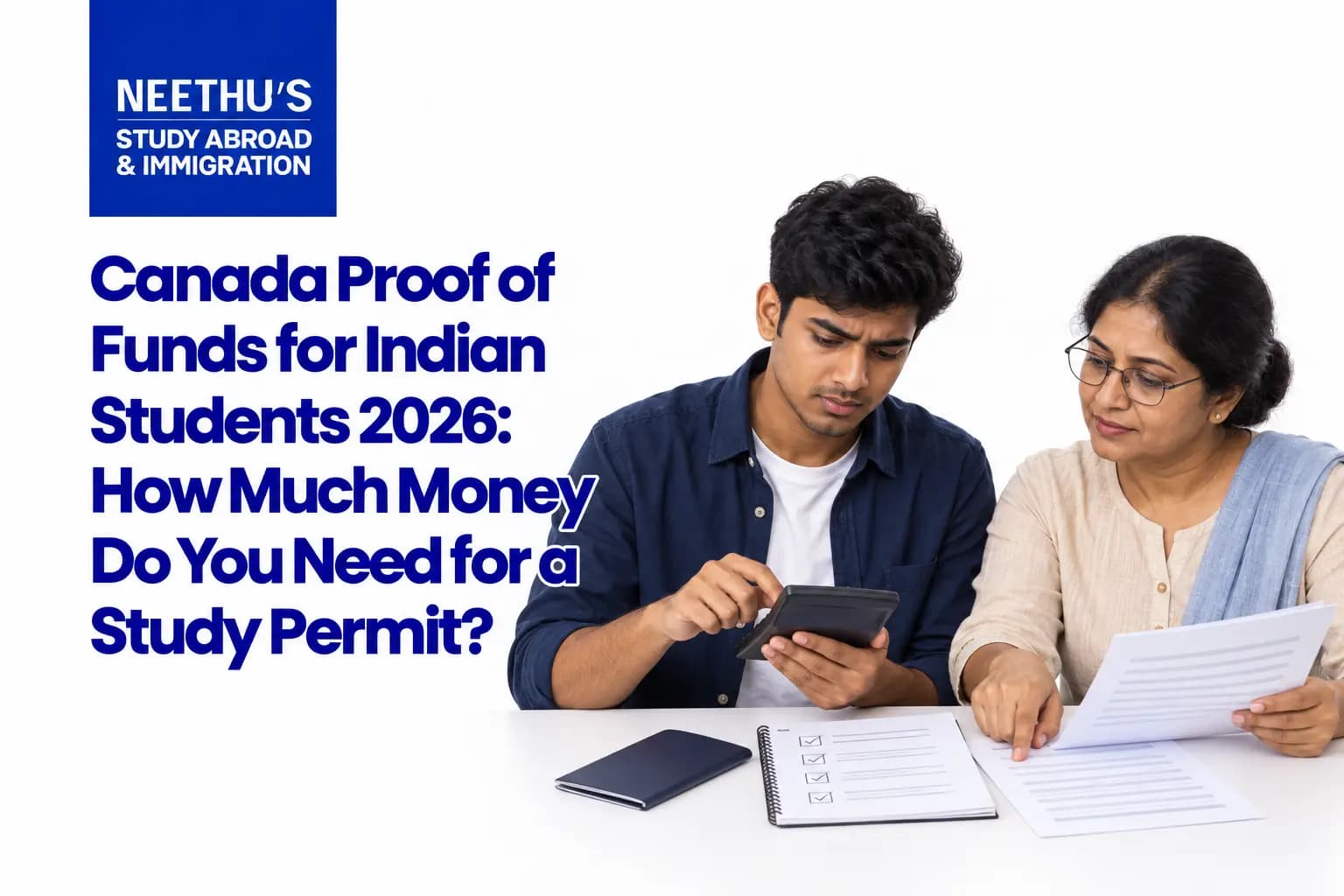
Planning to study in Canada involves more than securing admission to a college or university. Indian students also need to demonstrate that they have sufficient financial resources to pay for their education and support themselves during their stay. The Canada study permit financial requirements are an important part of the application because students must show that they can cover their tuition, living expenses, and transportation without depending on employment in Canada.
The amount required for living expenses is updated annually, so students applying in 2026 need to use the latest figures when preparing their financial documents. For a single student applying to study outside Quebec on or after September 1, 2026, the required amount for one year of living expenses is CAN$23,448, excluding tuition and transportation costs.
Understanding the Canada proof of funds for student visa 2026 requirement can help Indian students plan their finances, organise supporting documents, and present a clear picture of how they intend to fund their education in Canada.
What Is Proof of Funds for a Canadian Study Permit?
Proof of funds is evidence that shows you have access to enough money to support your education and stay in Canada.
Your financial plan should generally account for three major areas:
-
Tuition fees
-
Living expenses
-
Transportation expenses
If family members are accompanying you, their expenses may also need to be considered.
One common misunderstanding is that meeting the published living-expense figure means the applicant has demonstrated the complete amount required for studying in Canada. This is not the case. The living-expense requirement is separate from tuition and travel costs.
Students should therefore calculate their expected total expenditure before preparing their financial documents.
How Much Proof of Funds Is Required in 2026?
For a single student studying outside Quebec, the living-expense requirement for applications submitted on or after September 1, 2026 is:
CAN$23,448 for one year
Using an illustrative exchange rate of approximately ₹64.50 for CAN$1, this is around ₹15.1 lakh.
The following table gives a clearer picture:
|
Expense |
Amount in Canada |
Approximate Amount in INR |
|
One-year living expenses |
CAN$23,448 |
₹15.1 lakh |
|
Tuition |
Depends on programme and institution |
Varies |
|
Travel to Canada |
Depends on airfare and destination |
Varies |
|
Total financial planning |
Tuition + CAN$23,448 + travel |
Depends on individual circumstances |
INR figures are approximate and can change according to the CAD-INR exchange rate.
Example of a Student's Financial Requirement
Consider an Indian student whose first-year tuition is CAN$20,000.
The student would need to account for:
-
CAN$20,000 – tuition
-
CAN$23,448 – living expenses
-
Additional amount – transportation
That gives a minimum planned amount of CAN$43,448, before adding travel expenses.
At an illustrative rate of ₹64.50 per Canadian dollar, CAN$43,448 is approximately ₹28 lakh.
This example makes one thing clear: students should not prepare their finances around the living-expense figure alone.
What Expenses Should Students Include in Their Budget?
The financial requirement provides a baseline, but your actual spending will depend on your lifestyle and where you live in Canada.
Tuition Fees
Tuition is likely to be one of your largest expenses. Costs differ depending on whether you are studying at a university, college or another eligible institution.
The programme you select, its duration and the institution's fee structure can all affect the amount.
Students should refer to their official admission documents to determine the applicable tuition amount. If tuition has already been paid, the payment receipt should be retained as part of the financial documentation.
Accommodation
Rent can represent a substantial portion of a student's monthly budget. Costs can vary considerably between cities and between different types of accommodation.
Students may choose university residences, shared apartments, private rooms or other housing arrangements. Before travelling, research the expected accommodation cost and include any required deposits in your budget.
Food and Daily Expenses
Food, groceries, mobile services, clothing and personal necessities also contribute to the overall cost of living.
While students may be able to manage these expenses carefully, it is better to prepare a realistic budget than to underestimate them.
Transportation
Transportation should be considered separately from the living-expense requirement.
Students should budget for their journey from India to Canada as well as local transportation after arrival. Airfare can change depending on the season, airline, departure city and destination.
Initial Settlement Expenses
The first few weeks in Canada can involve expenses that are higher than a normal monthly budget.
Students may need to purchase winter clothing, household essentials, bedding, study materials, or other necessities. An emergency reserve can also provide additional financial security during the initial transition.
What Documents Can Be Used as Financial Evidence?
Students can use different types of documents to demonstrate their financial capacity, depending on their individual circumstances.
Common forms of evidence may include:
-
Bank statements
-
Education loan documentation
-
Scholarship letters
-
Fixed-deposit records
-
Proof of income
-
Tax documents
-
Sponsor's financial records
-
Proof of tuition payment
-
Documents showing the source of funds
The documents should provide a consistent picture of your financial situation.
For example, if your account suddenly shows a significant increase shortly before you submit your application, you should have appropriate evidence explaining where those funds came from.
Simply displaying a large balance without establishing its source may not provide the complete financial picture an officer needs.
Can Parents Provide the Funds?
Parents frequently contribute towards the education expenses of Indian students studying abroad.
If your parents are sponsoring your studies, their ability to provide financial support should be backed by suitable evidence.
Depending on the circumstances, documents may include:
-
Bank statements
-
Salary slips
-
Employment letters
-
Income-tax records
-
Fixed-deposit documents
-
Business income records
-
Other evidence of legitimate income
The application should make the financial relationship clear and show how the available funds will contribute towards your education and living expenses.
It is also important that the sponsor's income and financial circumstances reasonably support the amount being provided.
Is an Education Loan Accepted as Financial Support?
An education loan can be an important component of a student's financial plan.
Students who have obtained an education loan should provide the relevant sanction or approval documentation. The documents should clearly show the approved amount and, where applicable, the purpose for which the funds are being provided.
However, students should not automatically assume that the loan will cover every expense.
For instance, if your loan primarily covers tuition, you may still need to demonstrate how accommodation, food, transportation and other expenses will be paid.
A combination of an approved education loan and documented family funds can therefore provide a more complete financial picture.
Understanding Canada Student Visa Funds
The phrase Canada student visa funds should not be interpreted simply as a particular amount that needs to sit in a bank account.
Financial credibility also matters. Immigration authorities need to understand whether the applicant has genuine access to the money and whether the funds can reasonably support the proposed period of study.
Students should therefore maintain proper records for their savings, loans, sponsorship and other sources of funding.
Large deposits should not be left unexplained. If money has been transferred from another account, received from a family member or obtained through the sale of an asset, appropriate supporting evidence may help establish its source.
How Much Does Studying in Canada Cost for Indian Students?
The total Canada study cost for Indian students differs from one applicant to another.
A student attending an affordable programme in a smaller city may have a different budget from someone studying at an expensive institution in a major urban centre.
Your overall expenditure may include:
-
Tuition fees
-
Rent or accommodation
-
Food
-
Local transportation
-
Books and supplies
-
Mobile and internet expenses
-
Personal spending
-
Travel costs
-
Initial settlement expenses
Therefore, students should prepare an individual budget based on their selected institution and destination rather than relying on a general estimate.
The official living-expense figure should be treated as an immigration requirement, not necessarily as a prediction of exactly how much you will spend.
Does Having Enough Money Guarantee a Study Permit?
No.
Financial capacity is an important part of the application, but it is not the only factor considered when assessing a study permit application.
Students should ensure that their financial information works together with the rest of their application. Their programme selection, educational background, study plans and supporting documents should be consistent.
Similarly, applicants should not assume that showing substantially more money automatically guarantees approval.
The quality, credibility and consistency of the financial evidence are important.
Financial Mistakes Indian Students Should Avoid
Several avoidable mistakes can make financial documentation less convincing.
1. Showing only the minimum amount
The CAN$23,448 living-expense figure does not include tuition or transportation. These costs need to be considered separately.
2. Ignoring the source of funds
A large bank balance is more meaningful when the applicant can demonstrate how the money was accumulated.
3. Making last-minute deposits
Large recent deposits without supporting evidence can raise questions about the availability and origin of the funds.
4. Forgetting future study expenses
Students enrolled in multi-year programmes should have a reasonable financial plan for subsequent years.
5. Providing inconsistent information
The amounts mentioned in the application should match the supporting bank statements, loan documents, sponsor records and tuition information.
6. Depending entirely on Canadian employment
Students should demonstrate that they have adequate financial resources rather than relying on future earnings in Canada to meet their initial financial obligations.
How to Prepare Your Proof of Funds Properly
Start the process as early as possible.
First, calculate your tuition based on the official information provided by your institution. Next, add the applicable living-expense requirement and estimate your travel costs.
After calculating the total, identify where the money will come from. This could include personal savings, parental sponsorship, an education loan, a scholarship or a combination of legitimate sources.
Collect documents supporting each source and review your bank statements for unusual transactions.
If you find a large deposit, transfer or other transaction that could require clarification, gather the relevant supporting documents before submitting your application.
Finally, compare your financial documents with the information entered in your study permit application. Any discrepancies should be addressed before submission.
2026 Proof-of-Funds Checklist
Before submitting your application, make sure you have considered:
-
First-year tuition fees
-
Required living expenses
-
Transportation costs
-
Bank statements
-
Proof of tuition payment, if applicable
-
Education loan documents, if applicable
-
Scholarship evidence, if applicable
-
Sponsor's financial documents, if applicable
-
Evidence supporting the source of significant funds
-
A financial plan for later years of study
-
Consistent information across all documents
Conclusion
Preparing proof of funds should be an essential part of every Indian student's Canada study permit strategy. For a single student applying to study outside Quebec on or after September 1, 2026, the required amount for one year of living expenses is CAN$23,448, which is approximately ₹15.1 lakh at an illustrative exchange rate of ₹64.50 per Canadian dollar.
However, students should remember that this is only the living-expense component. Tuition fees and transportation need to be added separately when calculating the overall amount they need to prepare.
The Canada proof of funds for student visa 2026 requirement is therefore best approached as a complete financial plan rather than a simple bank-balance exercise. Your documents should clearly demonstrate that your education and stay in Canada are financially realistic and that the money being shown has a genuine and explainable source.
Indian students should begin organising their financial records well before applying. Keeping bank statements, sponsor records, loan documents, tuition receipts and other evidence properly organised can make the financial section of the application clearer and more credible.
Because Canadian immigration requirements can change, always verify the latest financial thresholds and documentation rules through official Canadian government sources before submitting your study permit application.
FAQs
1. How much proof of funds is required for a Canada study permit in 2026?
For a single student applying outside Quebec on or after September 1, 2026, the living-expense requirement is CAN$23,448 for one year, excluding tuition and transportation. Students must also demonstrate funds for tuition and travel.
2. Can Indian students show proof of funds in INR?
Yes. Financial documents can be from Indian banks, but the available funds should be sufficient when converted to Canadian dollars. Exchange-rate fluctuations should also be considered when planning the required amount.
3. Can parents provide proof of funds for a Canadian study permit?
Yes. Parents can financially sponsor a student. Bank statements, income documents, tax records, employment or business proof, and a sponsorship letter can help demonstrate the source and availability of funds.
4. Is an education loan accepted as proof of funds for Canada?
Yes. An approved education loan can be used as part of the financial evidence. Students should provide appropriate loan sanction or approval documents and demonstrate that the overall funding is sufficient.
5. Does proof of funds include tuition fees?
Yes, students need to demonstrate that they can pay their tuition in addition to the required living expenses and transportation costs. The CAN$23,448 amount is specifically the annual living-expense requirement for one student outside Quebec.
6. How many months of bank statements are required for a Canada study permit?
IRCC commonly accepts bank statements showing financial history, with the official requirements indicating statements for the past six months among the possible forms of evidence. Applicants should follow the document instructions applicable to their application.
7. Can fixed deposits be used as proof of funds for Canada?
Yes. Fixed deposits and other readily available financial assets may support an application, provided the documents clearly establish ownership, value and accessibility of the funds.
8. Can a scholarship be used as proof of financial support?
Yes. A scholarship or funding letter can be submitted as evidence of financial support. It should clearly state the amount or expenses covered and the period for which the funding is available.
9. Does having enough money guarantee approval of a Canadian study permit?
No. Proof of funds is only one part of the application. Immigration officers also consider factors such as the study plan, academic background, supporting documents, and whether the applicant meets the overall study-permit requirements.
10. What happens if a student cannot show sufficient proof of funds?
Insufficient or unclear financial evidence can create concerns about whether the student can support themselves in Canada. Students should calculate tuition, living expenses and travel costs carefully and provide consistent documentation showing where their funds come from.




























































































































































































_03-12-2025_01-17-26%20PM.webp&w=3840&q=75)
_02-12-2025_03-07-49%20PM.webp&w=3840&q=75)

_27-11-2025_04-06-24%20PM.webp&w=3840&q=75)
_25-11-2025_04-38-18%20PM.webp&w=3840&q=75)
_24-11-2025_03-20-26%20PM.webp&w=3840&q=75)
_22-11-2025_12-44-47%20PM.webp&w=3840&q=75)
_21-11-2025_04-17-47%20PM.webp&w=3840&q=75)
_20-11-2025_03-55-26%20PM.webp&w=3840&q=75)
_18-11-2025_04-00-40%20PM.webp&w=3840&q=75)
_15-11-2025_10-48-43%20AM.webp&w=3840&q=75)
%20(1)_14-11-2025_03-52-25%20PM.webp&w=3840&q=75)
_13-11-2025_03-02-38%20PM.webp&w=3840&q=75)
_08-11-2025_04-15-36%20PM.webp&w=3840&q=75)
_05-11-2025_04-01-50%20PM.webp&w=3840&q=75)
_05-11-2025_03-46-26%20PM.webp&w=3840&q=75)
_03-11-2025_03-31-09%20PM.webp&w=3840&q=75)
_04-11-2025_.webp&w=3840&q=75)
_04-11-2025_.webp&w=3840&q=75)
_29-10-2025_04-52-52%20PM.webp&w=3840&q=75)
_28-10-2025_04-09-08%20PM.webp&w=3840&q=75)
_24-10-2025_05-10-31%20PM.webp&w=3840&q=75)
_24-10-2025_04-55-51%20PM.webp&w=3840&q=75)
_22-10-2025_04-40-20%20PM.webp&w=3840&q=75)
%20(1)_21-10-2025_03-05-46%20PM.webp&w=3840&q=75)
_21-10-2025_02-43-15%20PM.webp&w=3840&q=75)
_17-10-2025_05-08-52%20PM.webp&w=3840&q=75)
_17-10-2025_04-54-54%20PM.webp&w=3840&q=75)
_15-10-2025_03-46-47%20PM.webp&w=3840&q=75)
_14-10-2025_03-42-40%20PM.webp&w=3840&q=75)
_14-10-2025_03-29-48%20PM.webp&w=3840&q=75)
_13-10-2025_03-48-51%20PM.webp&w=3840&q=75)
_11-10-2025_04-28-42%20PM.webp&w=3840&q=75)
%20(1)_09-10-2025_04-12-08%20PM.webp&w=3840&q=75)

_07-10-2025_02-55-25%20PM.webp&w=3840&q=75)
_07-10-2025_02-39-51%20PM.webp&w=3840&q=75)
_06-10-2025_03-42-37%20PM.webp&w=3840&q=75)
_03-10-2025_04-42-59%20PM.webp&w=3840&q=75)
_01-10-2025_11-12-12%20AM.webp&w=3840&q=75)
%20(1)_29-09-2025_02-54-12%20PM.webp&w=3840&q=75)

_26-09-2025_12-14-18%20PM.webp&w=3840&q=75)
_24-09-2025_04-44-26%20PM.webp&w=3840&q=75)
_23-09-2025_04-14-36%20PM.webp&w=3840&q=75)
_22-09-2025_04-08-09%20PM.webp&w=3840&q=75)
_20-09-2025_03-26-03%20PM.webp&w=3840&q=75)
_17-09-2025_04-06-42%20PM.webp&w=3840&q=75)
_15-09-2025_04-43-43%20PM.webp&w=3840&q=75)
_13-09-2025_12-17-49%20PM.webp&w=3840&q=75)
_12-09-2025_04-31-36%20PM.webp&w=3840&q=75)
_12-09-2025_04-17-03%20PM.webp&w=3840&q=75)
_10-09-2025_03-59-59%20PM.webp&w=3840&q=75)
_09-09-2025_04-11-16%20PM.webp&w=3840&q=75)
_09-09-2025_03-53-52%20PM.webp&w=3840&q=75)



















































_12-06-2025_03-40-35%20PM.webp&w=3840&q=75)