Study Abroad Policy Changes 2027: What Kerala Students Need to Know
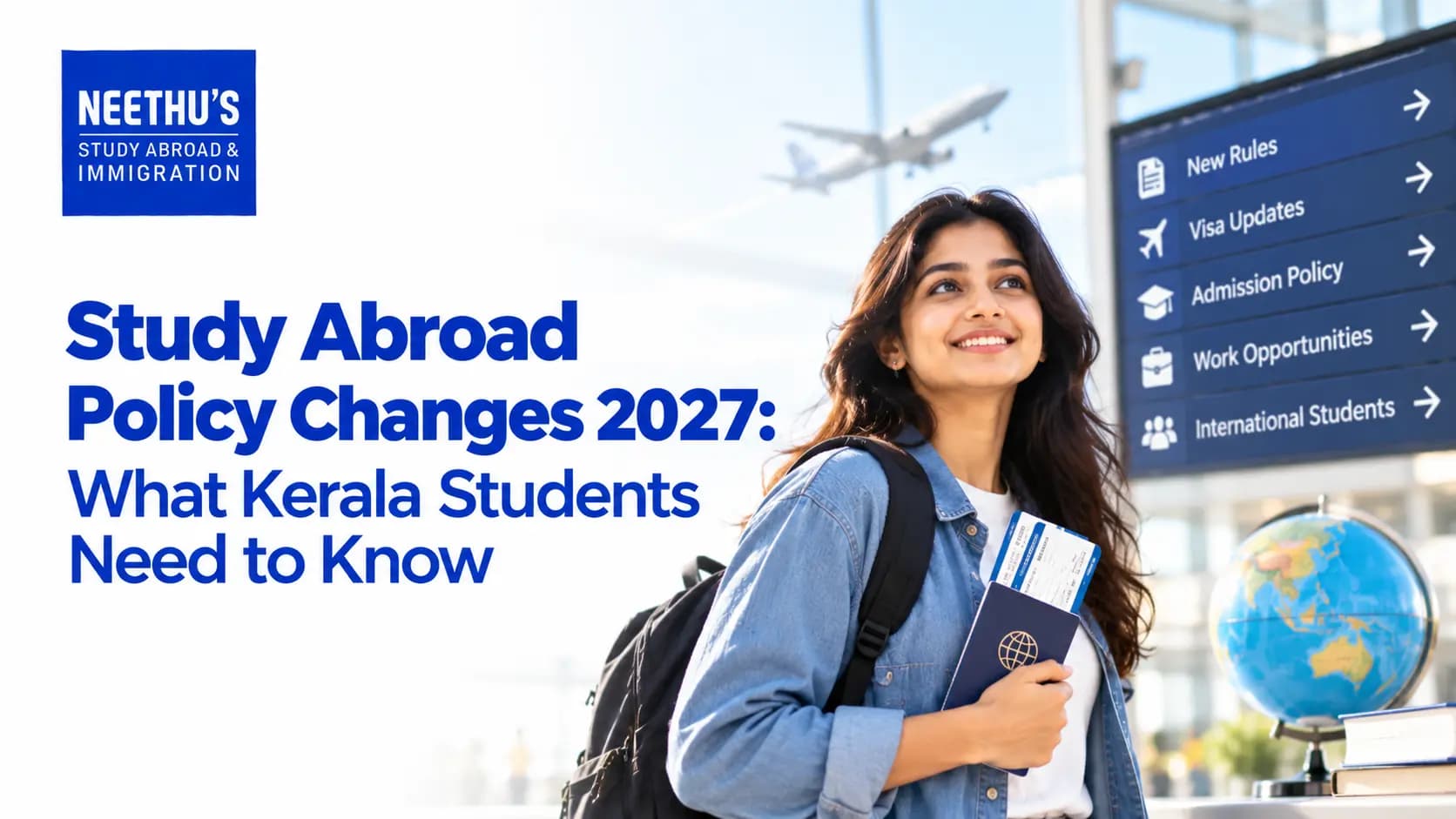
For students from Kerala planning to begin an international degree in 2027, choosing a country involves more than comparing universities and tuition fees. Immigration policies, financial requirements, work permissions, and post-study options can influence the overall value and practicality of an overseas education plan. As several countries continue to review their international student systems, applicants need to understand which changes are already confirmed and which requirements may be updated before they submit their applications.
The term study abroad policy changes 2027 covers different developments across individual destinations rather than one global set of rules. The UK, Canada, Australia, Germany, Ireland, New Zealand, the USA, France, Italy and Austria each have separate immigration systems.
For Kerala students, the safest approach is to check the rules applicable to their chosen country, course, and application date instead of relying on information from previous admission cycles.
Why International Students Need to Watch Policy Changes
Immigration policies can affect several stages of an overseas education journey. A government may change financial requirements, introduce new documentation procedures, regulate international student numbers or modify post-study work arrangements.
These changes do not necessarily mean that international students will face the same requirements everywhere. In some cases, a new rule may apply only to a particular visa category or nationality. In other cases, the change may affect students only when they apply for a post-study visa after graduation.
This distinction is important when planning for 2027. Students should identify the actual rule, its effective date and the group of applicants covered before changing their education plans.
UK: Graduate Visa Change Confirmed for 2027
The UK has one of the clearest confirmed changes for students who will complete their studies around the 2027 period.
Under current UK government guidance, eligible graduates applying for the Graduate visa on or before 31 December 2026 can receive two years of permission. For applications submitted on or after 1 January 2027, the standard Graduate visa period will be 18 months. Students who complete a PhD or another doctoral qualification continue to qualify for a three-year Graduate visa.
This change is important because the application date determines the duration. Students should therefore not assume that beginning a bachelor's or master's programme before 2027 automatically guarantees the earlier two-year period.
The Graduate visa is also not an indefinite immigration route. Eligible graduates may later consider another route, such as the Skilled Worker visa, if they satisfy its separate requirements.
Students should also continue checking UK Immigration Rules because additional amendments can be introduced independently of the Graduate visa change.
Canada: International Student Numbers Remain Closely Managed
Canada has introduced measures to manage temporary-resident numbers, including international students.
Under Canada's 2026–2028 Immigration Levels Plan, the government has set a notional target of 150,000 new international student arrivals for 2027. The figure forms part of the country's broader temporary-resident planning framework and should not be described as a simple guarantee that exactly 150,000 study permits will be issued.
Students applying to Canada should therefore pay attention to current study-permit requirements, institutional eligibility and any applicable application limits or exemptions.
Financial preparation is equally important. Applicants must demonstrate sufficient funds under the requirements applicable when they apply. Because financial thresholds can be revised, students should use the latest figures published by Immigration, Refugees and Citizenship Canada rather than relying on an older application or social media post.
Australia: Financial Capacity and Visa Conditions Matter
Australia continues to apply specific requirements to Student visa applicants. Depending on the application, students may need to provide evidence relating to financial capacity and English-language ability. The Australian government advises students to demonstrate that they have sufficient funds and states that they should not depend on employment to support themselves or their families while in Australia.
Students should also distinguish between the minimum amount required for visa purposes and the actual cost of living. Expenses can vary considerably between Australian cities, so a realistic budget should include accommodation, food, transportation, tuition and other expenses.
For a 2027 applicant, these current requirements are more useful than assuming that Australia will introduce one completely new student visa system in 2027.
Germany: Plan for Financial Requirements and Residence Procedures
Germany remains an attractive option for students seeking European education, particularly because many public universities have relatively low tuition costs compared with several other destinations. However, lower tuition does not mean that students can ignore immigration-related expenses.
Applicants from India generally need to meet the applicable student visa or residence requirements and demonstrate sufficient financial resources. Depending on the circumstances, this can involve a blocked account or another accepted form of financial proof.
Students should also consider that visa processing, university admission and residence registration are separate administrative stages. Requirements can vary according to the programme and individual circumstances.
For a 2027 intake, students should verify the required financial amount and documentation shortly before submitting the visa application rather than using figures from an older Germany study guide.
Ireland: Check Student Permission and Graduate Options
Ireland is another destination considered by Indian students, particularly for programmes in business, technology, healthcare and other professional areas.
Students should examine the conditions attached to their immigration permission, including study requirements and employment restrictions. Work permission is not simply an unrestricted right to take any job, and students must comply with the conditions attached to their immigration status.
Ireland also has post-study options for eligible graduates, but these depend on the qualification and applicable immigration rules. Students should therefore check the latest graduate permission requirements before selecting a programme primarily because of its potential post-study benefits.
New Zealand: Understand Visa Conditions Before Arrival
New Zealand's student visa system also requires applicants to satisfy requirements relating to their study plans, finances and other eligibility conditions.
Students should check whether their chosen course and institution meet the requirements for their intended visa. Work rights can depend on the visa conditions, so students should not assume that every international student receives identical employment permission.
For 2027 applicants, the key consideration is to verify the current financial requirements, course conditions and work rights close to the visa application date.
USA: F-1 Students Should Look Beyond Admission
The United States continues to use the F-1 student visa for many international academic programmes. Admission to a US institution is an important step, but students must also satisfy the applicable visa requirements.
Applicants should prepare for the visa interview process, understand the purpose of their programme and ensure that their documentation is consistent with their application.
Students interested in working after graduation should also understand the rules surrounding Optional Practical Training, commonly known as OPT. Eligibility and duration depend on the programme and applicable immigration rules. Therefore, students should not treat post-study employment as an automatic benefit of obtaining an F-1 visa.
France: Financial Requirements Have Recently Been Updated
France has also made a significant recent adjustment that could be relevant to students preparing for 2027.
Campus France India announced that from 1 August 2026, the minimum financial resources required for a French student visa increased to €877.50 per month, replacing the previous €615 threshold.
Students from India also fall under the "Études en France" procedure for relevant higher-education applications. Campus France lists India among the countries covered by this procedure.
A long-stay student visa can allow eligible international students to study in France, and the student VLS-TS permits employment up to 964 hours per year, equivalent to an average of 20 hours per week.
These requirements demonstrate why students should check both the university application procedure and visa rules when planning for a 2027 intake.
Italy: Check Current Visa and University Procedures
Italy continues to attract international students through its universities and comparatively varied tuition structures. Indian applicants should pay attention to university admission procedures, visa documentation and financial evidence.
The exact process can depend on the programme, institution and applicant's circumstances. Students should therefore verify the current procedure through the Italian authorities and the university before submitting documents.
Students should also avoid choosing Italy solely on the assumption that relatively affordable tuition automatically means a lower total cost. Accommodation, insurance, transportation and other living expenses need to be included in the budget.
Austria: Residence Requirements Need Attention
Austria is another European destination where students need to distinguish university admission from immigration permission.
Non-EU students generally need the appropriate residence permission for longer study periods. Financial resources, accommodation and other supporting documents can form part of the process.
Because requirements and financial thresholds can be updated, applicants planning for 2027 should confirm the latest information with the relevant Austrian authority before preparing their final application.
What Student Visa Rule Changes Mean for Kerala Students
The phrase student visa rule changes can sound like every country is introducing a completely new visa system. In reality, immigration updates can range from a revised financial threshold to a change in post-study permission.
Kerala students should therefore ask four basic questions whenever they see a visa update:
What exactly has changed?
Find the official announcement instead of relying only on a headline.
When does it take effect?
A policy may apply to applications submitted after a particular date rather than to everyone already studying.
Who does it affect?
Some measures are limited to specific nationalities, courses, institutions or visa categories.
Will it affect my plans?
A change in post-study work permission may not affect a student who intends to return to India after graduation, while a financial requirement may directly affect the application budget.
Study Abroad Updates for Indian Students to Follow
The most useful study abroad updates for Indian students are those that have a direct effect on admission, visa eligibility, finances and employment conditions.
Students should regularly check:
-
Current visa and residence requirements
-
Minimum financial evidence
-
University or institution eligibility
-
English-language requirements
-
Student work conditions
-
Post-study work routes
-
Application deadlines
-
Changes to international student intake policies
It is also important to check whether the information is current. A rule published in 2024 may no longer apply to someone submitting a visa application in 2027.
How to Prepare for a 2027 Study Abroad Application
Preparation should begin with academic planning rather than the visa form.
Students should first shortlist countries and courses that match their qualifications and career objectives. They can then compare universities, tuition fees, and expected living costs.
Language-test preparation should begin early where IELTS, PTE, TOEFL, or another recognised test is required. Academic certificates, passports and financial documents should also be organised well before the application deadline.
Once an offer is received, students should review the latest immigration requirements again. This second check is important because policies can change between the university application and visa submission.
Students should also maintain a financial buffer rather than planning their entire overseas budget around expected part-time income.
Do Not Rely on Old Information About New Visa Rules
Online searches for new visa rules 2027 can produce information from government websites, universities, news portals, consultants, and social media.
The problem is that these sources may discuss different stages of a policy. One article may describe a proposal, another may report an announcement, and a third may explain a rule that has already taken effect.
Students should therefore check the official immigration authority whenever a change could affect their application.
They should pay particular attention to the effective date, eligible applicants and transition arrangements. This is especially important for students who begin researching in 2026 but submit their visa application in 2027.
The Role of Professional Guidance
Students dealing with several destinations may find it difficult to keep track of university deadlines, financial documentation and immigration procedures at the same time. Professional education guidance can help applicants organise these stages and identify documents they may need.
Students looking for the Best study abroad consultants in kerala should nevertheless verify important immigration information through official government sources. A consultant can assist with an application, but the final visa requirements are determined by the relevant immigration authority.
Applicants should also ask questions about university selection, total costs, documentation and the basis for any claims about post-study opportunities before making a financial commitment.
Final Thoughts
The overseas education environment for 2027 is not governed by one universal set of immigration changes. Each destination is following its own policy direction, and students need to understand which requirements actually apply to their chosen course and application date.
The UK has already confirmed that the standard Graduate visa will reduce to 18 months for eligible applications made from 1 January 2027, while eligible doctoral graduates retain a three-year period. Canada has set a notional target of 150,000 new international student arrivals for 2027 as part of its temporary-resident planning framework. Australia continues to require eligible Student visa applicants to satisfy financial and English-language requirements, while France has already raised its minimum financial-resource requirement for student visa applicants from August 2026.
For students in Kerala, the most practical approach is to compare the complete picture: academic quality, tuition, living costs, visa requirements, permitted work and post-study options.
Rather than making decisions based on a single headline about immigration, applicants should review official information at each stage of the process. Checking the rules before choosing a course, again after receiving admission and once more before submitting the visa application can help students avoid relying on outdated information.
With careful research and realistic financial planning, students can approach their 2027 overseas education plans with a much clearer understanding of the requirements that may affect them.
Frequently Asked Questions
1. What are the major study abroad policy changes for 2027?
There is no single policy covering every study destination. Important developments vary by country. For example, the UK Graduate visa will generally be 18 months for eligible applications made from 1 January 2027, while Canada is continuing to manage international student numbers through its immigration planning framework.
2. Will student visa rules change in 2027?
Some changes have already been confirmed for 2027, while other immigration requirements may be revised before students submit their applications. Applicants should check the official immigration website of their chosen destination for the rules applicable at the time of application.
3. Which countries should Kerala students consider when planning for 2027?
Popular destinations include the UK, Canada, Australia, Germany, Ireland, New Zealand, the USA, France, Italy and Austria. The right choice depends on the student's course, budget, academic background, visa requirements and career plans.
4. What should Indian students check before applying for a 2027 intake?
Students should review university admission requirements, tuition fees, living expenses, financial evidence, language requirements, visa conditions, student work rights and post-study options. They should also verify whether their chosen programme remains eligible under the latest immigration rules.
5. What is changing about the UK Graduate visa in 2027?
For eligible applications made on or after 1 January 2027, the standard UK Graduate visa period will be 18 months. Eligible graduates with a PhD or another doctoral qualification will continue to receive a three-year Graduate visa.
6. How is Canada managing international students in 2027?
Canada's 2026–2028 Immigration Levels Plan includes a planning target of 150,000 new international student arrivals for 2027. Students should also check current study-permit requirements, applicable application limits and exemptions before applying.
7. Are financial requirements important for student visas?
Yes. Countries can require applicants to demonstrate sufficient funds for tuition, living expenses or other costs. Financial thresholds can change, so students should use the latest figures published by the relevant immigration authority rather than older information.
8. Can students work while studying abroad?
Work rights depend on the destination and the conditions attached to the student's visa or residence permission. Students should check the permitted hours and restrictions before accepting employment and should not rely entirely on part-time work to finance their education.
9. Where can students find reliable study abroad updates for Indian students?
Government immigration websites are the most reliable source for visa requirements. Students should also check their university's international student office and official education portals. Important requirements should be verified close to the date of visa submission.
10. Should Kerala students consult study abroad consultants for 2027 applications?
Professional guidance can help students compare courses, understand application procedures, and organise documentation. However, students should independently verify important immigration requirements through the relevant government authority because visa policies can change.

































































































































_03-12-2025_01-17-26%20PM.webp&w=3840&q=75)
_02-12-2025_03-07-49%20PM.webp&w=3840&q=75)

_27-11-2025_04-06-24%20PM.webp&w=3840&q=75)
_25-11-2025_04-38-18%20PM.webp&w=3840&q=75)
_24-11-2025_03-20-26%20PM.webp&w=3840&q=75)
_22-11-2025_12-44-47%20PM.webp&w=3840&q=75)
_21-11-2025_04-17-47%20PM.webp&w=3840&q=75)
_20-11-2025_03-55-26%20PM.webp&w=3840&q=75)
_18-11-2025_04-00-40%20PM.webp&w=3840&q=75)
_15-11-2025_10-48-43%20AM.webp&w=3840&q=75)
%20(1)_14-11-2025_03-52-25%20PM.webp&w=3840&q=75)
_13-11-2025_03-02-38%20PM.webp&w=3840&q=75)
_08-11-2025_04-15-36%20PM.webp&w=3840&q=75)
_05-11-2025_04-01-50%20PM.webp&w=3840&q=75)
_05-11-2025_03-46-26%20PM.webp&w=3840&q=75)
_03-11-2025_03-31-09%20PM.webp&w=3840&q=75)
_04-11-2025_.webp&w=3840&q=75)
_04-11-2025_.webp&w=3840&q=75)
_29-10-2025_04-52-52%20PM.webp&w=3840&q=75)
_28-10-2025_04-09-08%20PM.webp&w=3840&q=75)
_24-10-2025_05-10-31%20PM.webp&w=3840&q=75)
_24-10-2025_04-55-51%20PM.webp&w=3840&q=75)
_22-10-2025_04-40-20%20PM.webp&w=3840&q=75)
%20(1)_21-10-2025_03-05-46%20PM.webp&w=3840&q=75)
_21-10-2025_02-43-15%20PM.webp&w=3840&q=75)
_17-10-2025_05-08-52%20PM.webp&w=3840&q=75)
_17-10-2025_04-54-54%20PM.webp&w=3840&q=75)
_15-10-2025_03-46-47%20PM.webp&w=3840&q=75)
_14-10-2025_03-42-40%20PM.webp&w=3840&q=75)
_14-10-2025_03-29-48%20PM.webp&w=3840&q=75)
_13-10-2025_03-48-51%20PM.webp&w=3840&q=75)
_11-10-2025_04-28-42%20PM.webp&w=3840&q=75)
%20(1)_09-10-2025_04-12-08%20PM.webp&w=3840&q=75)

_07-10-2025_02-55-25%20PM.webp&w=3840&q=75)
_07-10-2025_02-39-51%20PM.webp&w=3840&q=75)
_06-10-2025_03-42-37%20PM.webp&w=3840&q=75)
_03-10-2025_04-42-59%20PM.webp&w=3840&q=75)
_01-10-2025_11-12-12%20AM.webp&w=3840&q=75)
%20(1)_29-09-2025_02-54-12%20PM.webp&w=3840&q=75)

_26-09-2025_12-14-18%20PM.webp&w=3840&q=75)
_24-09-2025_04-44-26%20PM.webp&w=3840&q=75)
_23-09-2025_04-14-36%20PM.webp&w=3840&q=75)
_22-09-2025_04-08-09%20PM.webp&w=3840&q=75)
_20-09-2025_03-26-03%20PM.webp&w=3840&q=75)
_17-09-2025_04-06-42%20PM.webp&w=3840&q=75)
_15-09-2025_04-43-43%20PM.webp&w=3840&q=75)
_13-09-2025_12-17-49%20PM.webp&w=3840&q=75)
_12-09-2025_04-31-36%20PM.webp&w=3840&q=75)
_12-09-2025_04-17-03%20PM.webp&w=3840&q=75)
_10-09-2025_03-59-59%20PM.webp&w=3840&q=75)
_09-09-2025_04-11-16%20PM.webp&w=3840&q=75)
_09-09-2025_03-53-52%20PM.webp&w=3840&q=75)





































_12-06-2025_03-40-35%20PM.webp&w=3840&q=75)