Preparing your study abroad journey…
Preparing your study abroad journey…
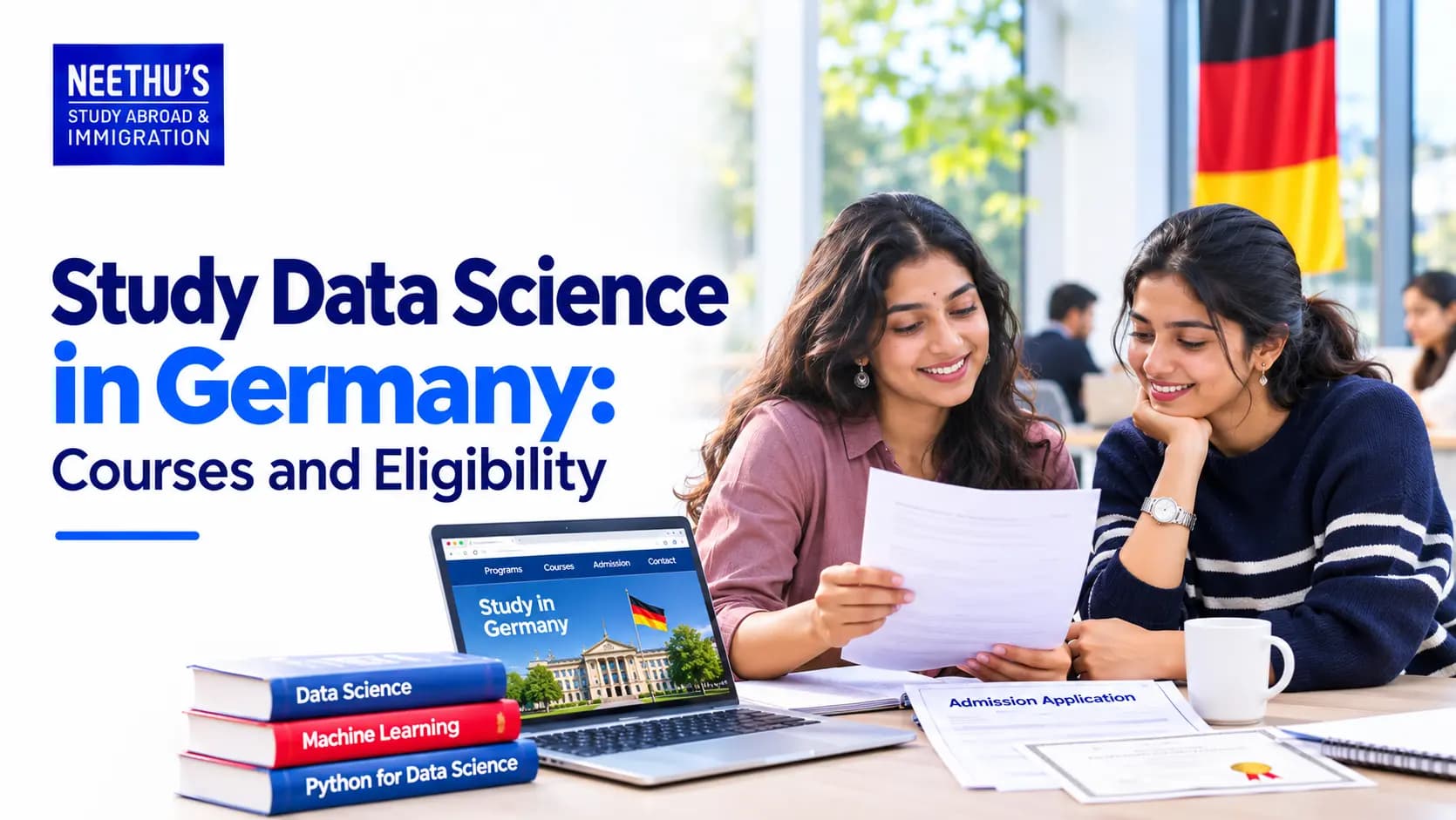
Data science is transforming the way businesses collect information, understand market trends, and make important decisions. From artificial intelligence and healthcare to banking and manufacturing, organisations increasingly depend on data-driven technologies to improve efficiency and develop innovative solutions. This growing demand has made data science an attractive career choice for students interested in technology, mathematics and analytical problem-solving.
Germany has become a popular destination for international students because of its strong academic institutions, research opportunities, and technology-driven industries. Its universities offer specialised programmes that combine theoretical learning with practical applications, helping students develop skills required in the modern digital economy.
For Indian graduates planning to build careers in analytics, machine learning or artificial intelligence, choosing to study in Germany can provide valuable international exposure and access to advanced academic facilities.
However, selecting a suitable university involves understanding course structures, admission requirements, tuition fees, and language qualifications. This article explores the available programmes, eligibility criteria, application procedure, and career opportunities for Indian students interested in pursuing data science in Germany.
Germany offers an academic environment that encourages research, innovation and practical learning. Its universities maintain connections with research centres and technology companies, allowing students to understand how theoretical concepts are applied in professional settings.
Here are some reasons to consider Germany for higher education in data science.
Research-oriented education: Students can explore advanced topics through research assignments, laboratory activities and practical projects.
Technology and innovation: Germany has established industries in automotive engineering, healthcare, manufacturing, and information technology that increasingly use data analytics.
English-taught programmes: Several universities offer master's degrees in data science and related disciplines in English.
Affordable public education options: Many public universities do not charge general tuition fees for consecutive master's programmes, although semester contributions and certain exceptions apply.
International learning environment: Students interact with classmates from different countries and gain exposure to different academic and professional perspectives.
Understanding the opportunities available through Germany education for Indian students can help applicants select programmes that match their academic backgrounds and future ambitions.
German universities offer different specialisations within data science. Students can choose programmes according to their interests, previous qualifications and career objectives.
This programme focuses on collecting, processing and analysing large datasets. Students develop knowledge of statistical methods, programming and predictive modelling.
Common subjects include:
Data mining and data management.
Statistical analysis.
Machine learning.
Data visualisation.
Database systems.
Big data technologies.
It is particularly suitable for graduates with backgrounds in computer science, mathematics, statistics or related disciplines.
This programme combines data analysis with intelligent computing technologies. Students learn how algorithms identify patterns, process information and support automated decision-making.
Major subjects may include deep learning, neural networks, natural language processing and intelligent systems.
Business analytics focuses on applying data-based methods to commercial and organisational challenges.
Students learn to analyse business performance, understand consumer behaviour, interpret market information and support strategic decisions.
This course may be suitable for graduates interested in combining business knowledge with analytical skills.
Applied data science programmes concentrate on practical applications and industry-related problem-solving.
Students may work with real datasets, complete research assignments and develop projects involving predictive analytics, data engineering and statistical programming.
Several German universities offer specialised programmes related to data science, machine learning and analytics.
Students can explore the following institutions:
|
University |
Relevant programme |
|
Freie Universität Berlin |
MSc Data Science |
|
University of Trier |
MSc Data Science |
|
University of Oldenburg |
MSc Data Science and Machine Learning |
|
University of Augsburg |
MSc Data Science |
|
TU Ilmenau |
MSc Data Science |
Each institution has its own admission criteria, academic requirements, and application deadlines.
For example, some universities require applicants to demonstrate sufficient academic credits in mathematics, statistics, computer science and programming. Students should carefully examine the curriculum and eligibility conditions before submitting applications.
It is also important to check the programme's accreditation, teaching language, research opportunities, and available specialisations.
Admission requirements differ between universities. However, most master's programmes expect applicants to have a relevant undergraduate qualification and a strong foundation in quantitative subjects.
Applicants generally need a recognised bachelor's degree in a related discipline, such as:
Computer Science.
Information Technology.
Data Science.
Mathematics.
Statistics.
Physics.
Engineering.
Business Informatics.
Some universities may accept graduates from other disciplines if they have completed sufficient coursework in mathematics, statistics and programming.
Universities may specify minimum percentage requirements or grade classifications for admission.
Since German institutions use their own grading system, Indian students should check how their bachelor's degree marks are evaluated.
Some programmes also consider the number of academic credits completed in relevant subjects.
Students applying for English-taught programmes may need to provide proof of language proficiency.
Commonly accepted examinations include:
IELTS Academic.
TOEFL iBT.
Cambridge English qualifications.
Other university-approved English tests.
The minimum required score depends on the selected institution. Certain universities may offer exemptions to applicants who have completed previous education in English, depending on their admission regulations.
Applicants choosing English-taught programmes may not need German proficiency for admission.
However, learning German can be beneficial when communicating with local communities, participating in internships, and exploring employment opportunities.
Students applying for German-taught programmes must satisfy the language requirements specified by the university.
Preparing the required documents in advance can make the application process more organised.
The commonly requested documents include:
Valid passport.
Bachelor's degree certificate.
Academic transcripts and mark sheets.
Updated CV or résumé.
Statement of purpose.
English language proficiency certificate, if required.
Letters of recommendation, where applicable.
Course descriptions or module details.
GRE scores, if requested.
APS certificate, where applicable.
Indian applicants should pay particular attention to the APS certificate requirements. Some German universities require this document to verify academic qualifications obtained in India.
Applicants should also check whether documents need certified translations, specific formats or additional authentication before submission.
The admission procedure involves several stages, from university selection to receiving an official offer.
Identify universities offering suitable data science programmes. Compare course content, academic requirements, language of instruction, and application deadlines.
Review the admission criteria carefully. Mathematics, statistics, and programming knowledge are particularly important for many data science programmes.
Check whether your undergraduate degree meets the university's subject-specific credit requirements.
Collect academic certificates, transcripts, passport details, language test results and other supporting documents.
Arrange APS certification if required by your selected university.
Depending on the institution, applications may be submitted through the university's online portal or Uni-Assist.
Uni-Assist evaluates international applications for participating German universities. Applicants should confirm the correct application method before submitting their documents.
Some universities may require interviews, aptitude assessments or additional academic evaluations.
Prepare to explain your educational background, interest in data science and future career objectives.
After reviewing the application, the university communicates its decision.
Successful applicants should carefully read the admission letter, confirm their place and complete any remaining enrolment requirements.
The total cost of studying in Germany depends on the university, city, accommodation and personal spending habits.
Many public universities offer consecutive master's programmes without general tuition fees. However, students generally need to pay semester contributions. Certain universities and federal states charge tuition fees for specific programmes or non-EU students.
An approximate monthly budget for international students is given below:
|
Expense |
Estimated monthly cost |
|
Accommodation |
€350–€650 |
|
Food and groceries |
€180–€250 |
|
Health insurance |
€120–€150 |
|
Transportation |
€30–€60 |
|
Personal expenses |
€100–€150 |
|
Study-related expenses |
€30–€60 |
These figures are indicative estimates rather than fixed costs. Actual expenses may be higher in major cities such as Munich, Frankfurt and Hamburg.
Students should also budget for initial expenses, including travel, accommodation deposits, visa charges and document processing.
Indian students accepted into recognised German universities generally need a national student visa to pursue full-time higher education.
The commonly required documents include:
Valid passport.
University admission letter.
Completed visa application.
Proof of sufficient financial resources.
Health insurance documentation.
Academic certificates and transcripts.
Language proficiency evidence, where applicable.
Additional documents requested by the German authorities.
For 2026, the standard blocked-account requirement is €11,904 for one year, equivalent to €992 per month. Students may also be able to demonstrate financial support through an eligible scholarship or declaration of commitment.
Applicants should verify the latest financial requirements, appointment procedures and documentation instructions before submitting their visa applications.
Germany offers career opportunities across several industries that depend on data analysis and digital technologies.
Graduates with relevant qualifications and practical experience can explore the following roles.
Data Scientist: Works with complex datasets to identify patterns, develop predictive models, and support business decisions.
Data Analyst: Examines information, prepares reports, and communicates findings that help organisations improve performance.
Machine Learning Engineer: Develops and maintains machine learning models used in automated applications.
Business Intelligence Analyst: Uses analytical tools and reporting systems to identify business trends and performance indicators.
Data Engineer: Designs and maintains systems for collecting, storing, and processing large amounts of information.
AI Specialist: Develops intelligent applications involving automation, natural language processing and predictive technologies.
Career opportunities depend on technical knowledge, practical experience, language proficiency, and employer requirements.
Graduates of German universities may also qualify for an 18-month residence permit to search for suitable employment after completing their studies, subject to the applicable immigration conditions.
Applying to a German university involves several administrative and academic requirements. Students unfamiliar with the process may benefit from professional guidance.
When researching the Best study abroad consultants in Kerala, consider agencies with experience in German university admissions and international student applications.
A reliable consultant may assist with:
University and course selection.
Academic eligibility assessment.
Application documentation.
Statement of purpose preparation.
APS certification guidance.
Student visa documentation.
Pre-departure assistance.
Students should independently verify university recognition, official tuition fees and admission conditions before making financial commitments. No consultant can guarantee admission or visa approval.
Germany provides attractive higher education opportunities for students interested in data science, artificial intelligence and advanced analytics. Its universities offer specialised programmes that combine mathematical foundations, programming knowledge and practical applications.
For Indian graduates, selecting the right data science course for indian students requires careful evaluation of academic eligibility, subject-specific credits, language requirements and career objectives.
Students planning to study in Germany should begin researching universities early, prepare their application documents carefully, and understand the financial and visa requirements before making a decision.
With the right academic preparation and a clear career direction, pursuing data science in Germany can be a valuable step towards building an international career in the technology sector.
1. Is Germany a good destination for Indian students to study data science?
Yes. Germany offers quality education, internationally recognised degrees, advanced research facilities, and opportunities to gain practical experience in data science and related fields.
2. What are the eligibility requirements for data science courses in Germany?
Most master's programmes require a relevant bachelor's degree in computer science, mathematics, statistics, engineering, or a related subject. Applicants may also need to meet specific academic and language requirements.
3. Can Indian students study data science in Germany without IELTS?
Some universities accept alternative proof of English proficiency, such as a Medium of Instruction certificate. However, acceptance policies vary by university and programme.
4. What subjects are covered in a data science course in Germany?
Common subjects include programming, statistics, machine learning, artificial intelligence, data mining, database management, big data analytics and data visualisation.
5. How long does it take to complete a data science degree in Germany?
A bachelor's degree generally takes three to three-and-a-half years, while most master's programmes take one-and-a-half to two years, depending on the university and course structure.
6. Are there English-taught data science programmes in Germany?
Yes. Several German universities offer data science programmes taught entirely in English, particularly at the master's level. Students should check the language requirements of each programme.
7. How much does it cost to study data science in Germany?
Costs depend on the university, location, and type of institution. Many public universities charge little or no tuition for eligible programmes, but semester contributions and living expenses still apply. Some states and universities charge tuition fees.
8. Can Indian students work while studying in Germany?
International students can work alongside their studies within the limits permitted by German student immigration regulations. Students should check the latest rules before accepting employment.
9. What career opportunities are available after studying data science in Germany?
Graduates can explore roles such as data scientist, data analyst, machine learning engineer, business intelligence analyst, data engineer, and AI specialist.
10. Can Indian students stay in Germany after completing a data science degree?
Yes. Eligible international graduates can apply for a residence permit to look for qualified employment after completing their studies. They must meet the applicable immigration requirements.