MBBS in Europe After NEET: Comparing Georgia, Bulgaria, Latvia and Moldova on Fees, Duration and NMC Approval
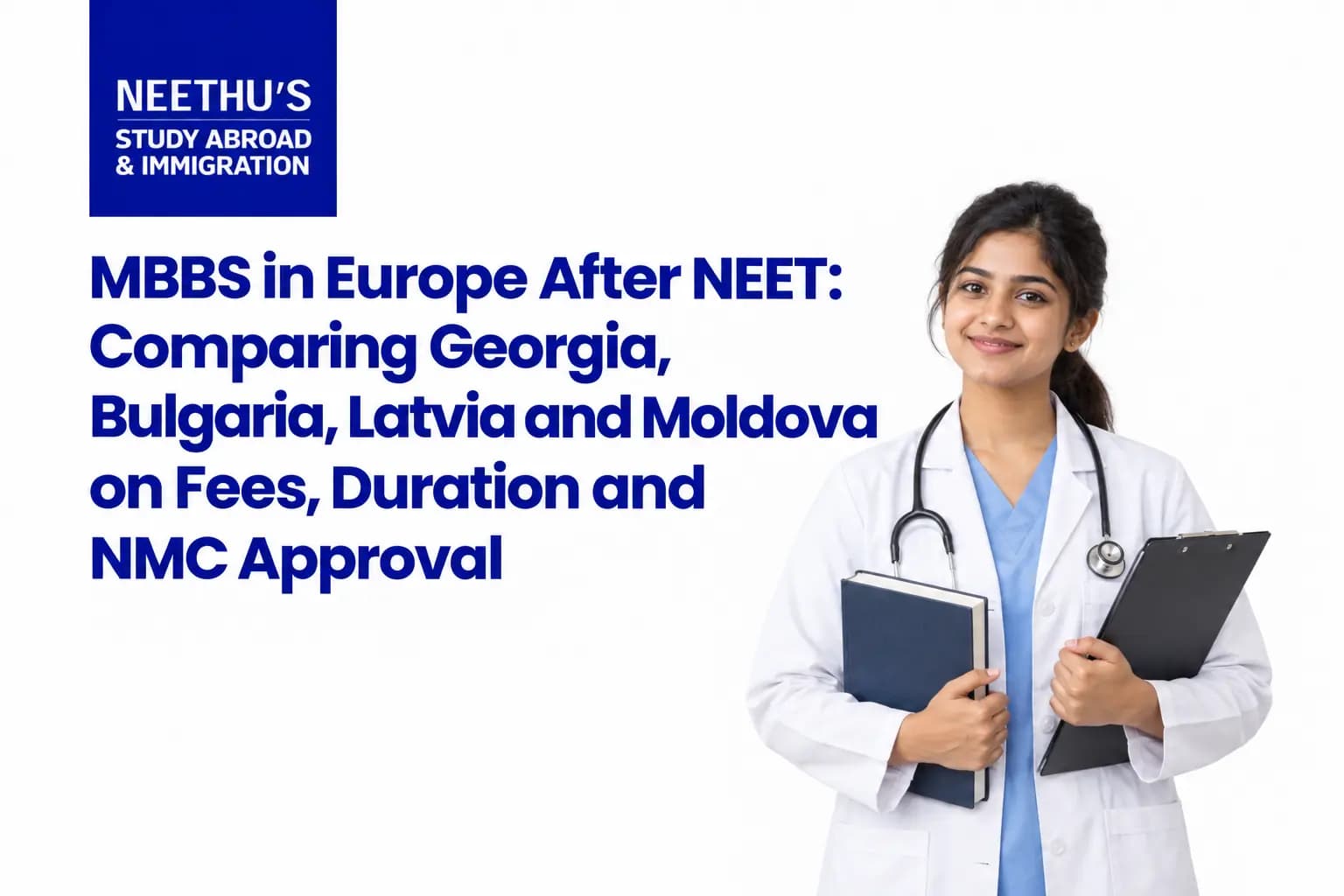
For Indian students who qualify NEET but are unable to secure a preferred medical seat in India, studying medicine abroad can be an alternative worth exploring. European destinations such as Georgia, Bulgaria, Latvia and Moldova attract international students with English-taught medical programmes, modern universities and different fee structures.
However, choosing an overseas medical college should not be based on tuition fees alone. Course duration, clinical training, recognition in the country of study, eligibility to practise in India and compliance with National Medical Commission (NMC) rules are equally important.
Students looking for guidance can consult the Best study abroad consultants in Kerala to compare universities, admission requirements, and documentation before making a decision.
Important: NMC does not simply “approve” an entire country for MBBS. Indian students must verify whether the specific foreign medical institution and programme meet the applicable NMC Foreign Medical Graduate Licentiate (FMGL) requirements. NMC itself advises students to confirm course content, duration, and internship details directly with the university.
Georgia: Affordable Fees and a Popular Choice for Indian Students
Georgia has become a familiar destination for Indian medical aspirants because several universities offer six-year Medical Doctor programmes in English.
For example, Caucasus University lists its English-medium Medical Doctor programme at US$6,000 per year, with 360 ECTS and a six-year duration. That works out to approximately US$36,000 for six years, or around ₹34 lakh, before considering changes in tuition, living costs, and exchange rates.
Tbilisi State Medical University lists its English-medium Medical Doctor programme at US$8,000 per year.
Georgia's national currency is the Georgian lari (GEL). At an illustrative rate of 1 GEL ≈ ₹36.28, students should still remember that universities may quote international tuition in US dollars rather than GEL.
The main advantage of Georgia is its relatively broad selection of English-medium medical programmes. But students should carefully examine clinical training, internship arrangements and the exact programme structure before admission.
Bulgaria: European Union Education With Higher Tuition
Bulgaria offers another option for students who want to study medicine within the European Union. English-medium Medicine programmes generally take six years.
Medical University–Varna, for example, lists Medicine in English as a six-year programme. Its 2026/27 tuition is €10,000 for first- and second-year students, while later-year fees are listed at €9,100 and €9,000 respectively.
Medical University–Sofia also lists English-medium Medicine at €9,950 per year for its foreign students.
Using €1 ≈ ₹109.75 as an illustrative exchange rate:
-
€9,950 ≈ ₹10.92 lakh per year
-
€10,000 ≈ ₹10.98 lakh per year
-
Six years at €10,000 annually would be approximately €60,000 or ₹65.85 lakh
Bulgaria now uses the euro as its national currency, following its adoption of the euro in 2026. Students should therefore check the university's latest fee schedule rather than relying on older information quoting Bulgarian lev.
Bulgaria can be attractive for students interested in an EU-based medical education, but tuition is generally higher than the more economical options available in Georgia and Moldova.
Latvia: Strong European Academic Environment
Latvia is another European destination offering six-year medical education in English.
Rīga Stradiņš University (RSU) offers a six-year, 360-ECTS Medical Doctor programme in English. The programme includes theoretical, preclinical, clinical and practical components, and the university states that its Medicine programme is locally accredited.
For the 2026/27 academic year, RSU lists tuition for Medicine at €13,500 per year.
That means the indicative tuition calculation is:
-
€13,500 per year ≈ ₹14.82 lakh
-
€81,000 over six years ≈ ₹88.90 lakh
These figures are tuition estimates only and do not include accommodation, food, insurance, travel or other student expenses.
Latvia uses the euro, making the fee structure relatively straightforward for students comparing it with other EU destinations. The major consideration is affordability. Compared with Georgia and Moldova, Latvia can require a substantially larger overall education budget.
Moldova: Lower Tuition With a Six-Year Medicine Programme
Moldova may appeal to students looking for a comparatively economical medical education. Nicolae Testemitanu State University of Medicine and Pharmacy offers a six-year integrated Medicine programme, with English among the available languages of instruction.
For international students in the 2026/27 academic year, the university lists Medicine at €6,000 per academic year.
Therefore:
-
€6,000 per year ≈ ₹6.59 lakh
-
€36,000 for six years ≈ ₹39.51 lakh
Moldova's national currency is the Moldovan leu (MDL). However, the university's international tuition is quoted in euros. For reference, an illustrative exchange rate is 1 MDL ≈ ₹5.51.
An important point is that the university states that students studying Medicine in English must also learn Romanian as part of the curriculum. This can be useful for communication during clinical training and interaction with patients.
Georgia vs Bulgaria vs Latvia vs Moldova: Fee Comparison
|
Country |
Typical course duration |
Example annual tuition |
Approx. INR per year |
Approx. tuition for full course* |
|
Georgia |
6 years |
US$6,000–8,000 |
₹5.67–7.56 lakh |
₹34–45.36 lakh |
|
Bulgaria |
6 years |
€9,950–10,000 |
₹10.92–10.98 lakh |
Around ₹65.85 lakh |
|
Latvia |
6 years |
€13,500 |
₹14.82 lakh |
Around ₹88.90 lakh |
|
Moldova |
6 years |
€6,000 |
₹6.59 lakh |
Around ₹39.51 lakh |
*Illustrative calculation assuming the quoted annual tuition remains unchanged throughout the programme. Actual fees may change by academic year, university and programme. INR conversions use approximate exchange rates and are not fixed currency rates.
What Does NMC Approval Actually Mean?
This is the most important part of the decision for an Indian student.
It is risky to select a university simply because an agent or website describes it as “NMC approved.” The NMC framework places specific conditions on foreign medical education.
According to NMC's FMGL-related guidance, students seeking registration in India need to meet requirements covering the duration of the medical course, medium of instruction, prescribed subjects, clinical training, internship and registration in the country where the qualification is awarded, along with the required screening/licensing examination or test.
NMC guidance specifies a foreign medical degree course of at least 54 months, followed by an internship of at least 12 months in the same foreign medical institution under the applicable FMGL framework. The foreign medical degree must also be taught in English and include the required subjects and clinical training.
Indian citizens and OCI students intending to study medicine abroad also need to qualify NEET as applicable under NMC rules.
Therefore, before paying a university deposit, students should obtain written confirmation about:
-
Total course duration
-
Medium of instruction
-
Clinical training
-
Internship duration and location
-
Whether the internship satisfies applicable NMC conditions
-
Registration/licensing eligibility in the country of study
-
Current university accreditation
-
Eligibility for the required Indian licensing examination
Which Country Is Best for Indian Students?
There is no single answer for every student.
Georgia may suit students looking for a relatively affordable English-medium programme and a wide choice of universities.
Bulgaria can be considered by students who prefer an EU-based medical education and can manage comparatively higher tuition.
Latvia offers an established European academic environment, but its tuition can be significantly higher.
Moldova may be attractive for students prioritising lower tuition while still looking for a six-year English-medium Medicine programme.
The right choice should ultimately depend on the specific university, not just the country.
How Neethus Study Abroad Can Help
Choosing an overseas medical college involves more than completing an application form. Students need to compare universities, understand fee structures, check admission requirements and examine whether the selected programme aligns with the regulations applicable to Indian medical graduates.
Neethus study abroad can help students and parents organise these comparisons before making a final decision. A useful counselling process should include university selection, document preparation, admission guidance, visa support and an explanation of the requirements students will face after graduation.
Students can also speak with Neethus Academy to understand the difference between university recognition, accreditation and eligibility for returning to India as a foreign medical graduate.
Final Thoughts
MBBS in Europe after NEET can provide an alternative route for students who want to pursue medicine outside India. Georgia, Bulgaria, Latvia and Moldova all have six-year medical programmes, but their tuition costs and academic environments differ considerably.
Based on the examples above, Georgia and Moldova can be more budget-conscious choices, while Bulgaria and Latvia require a larger financial commitment. However, cost should never be the only deciding factor.
The most important step is to verify the exact university and programme against the latest NMC requirements before admission. Regulations can change, and compliance should be checked for the specific academic year in which you plan to enrol.
For Indian students, the safest approach is to compare fees + duration + clinical exposure + university accreditation + NMC eligibility together rather than relying on a simple “NMC approved” label.
FAQ
1. Can Indian students study MBBS in Europe after qualifying NEET?
Yes. Indian students who meet the applicable NEET and foreign medical education requirements can apply to eligible medical universities in countries such as Georgia, Bulgaria, Latvia, and Moldova.
2. Which European country is the cheapest for MBBS among Georgia, Bulgaria, Latvia and Moldova?
The answer depends on the university and year of admission. Based on the fee examples discussed in this guide, Georgia and Moldova can offer comparatively lower tuition than Bulgaria and Latvia. Students should also consider living expenses and other costs.
3. What is the duration of MBBS in Georgia, Bulgaria, Latvia and Moldova?
The medical programmes discussed in these four countries generally have a six-year duration, including the relevant clinical and practical components. Students should verify the exact programme structure of their chosen university before admission.
4. Is MBBS from Georgia recognised by the NMC?
Indian students should not rely on a general claim that a country or university is simply “NMC approved.” They should verify that the specific medical programme and university meet the NMC's applicable Foreign Medical Graduate Licentiate requirements before enrolling.
5. Do I need NEET to study MBBS abroad?
Indian citizens and OCI students seeking to study medicine abroad are required to meet the applicable NEET qualification requirements. NEET qualification is an important eligibility condition for Indian students planning to pursue a foreign medical degree.
6. What should students check before choosing an MBBS university abroad?
Students should verify the university's accreditation, course duration, medium of instruction, clinical training, internship arrangements, eligibility for registration in the study country and compliance with the latest NMC requirements.
7. Which currency is used for MBBS fees in these countries?
Georgia uses the Georgian lari (GEL), although some universities quote international tuition in US dollars. Bulgaria and Latvia use the euro (EUR), while Moldova uses the Moldovan leu (MDL), with some universities quoting international fees in euros. INR conversions depend on the prevailing exchange rate.
8. Is studying MBBS abroad better than studying medicine in India?
It depends on the student's circumstances, academic goals, budget, and eligibility. Studying abroad can provide another route into medical education, but students must carefully evaluate university recognition, clinical training, total costs and the requirements for practising medicine in India.
9. Can I practise medicine in India after completing MBBS in Europe?
Foreign medical graduates must satisfy the NMC's applicable requirements and complete the required licensing or screening process before obtaining registration to practise in India. Students should check the rules applicable when they begin their course rather than relying on outdated information.
10. How can the Best study abroad consultants in Kerala help with MBBS abroad?
The Best study abroad consultants in Kerala can assist students with comparing universities, understanding admission requirements, preparing documents and navigating the application and visa process. Students should independently verify the latest NMC requirements for their chosen university before paying fees or accepting admission.










































































































































_03-12-2025_01-17-26%20PM.webp&w=3840&q=75)
_02-12-2025_03-07-49%20PM.webp&w=3840&q=75)

_27-11-2025_04-06-24%20PM.webp&w=3840&q=75)
_25-11-2025_04-38-18%20PM.webp&w=3840&q=75)
_24-11-2025_03-20-26%20PM.webp&w=3840&q=75)
_22-11-2025_12-44-47%20PM.webp&w=3840&q=75)
_21-11-2025_04-17-47%20PM.webp&w=3840&q=75)
_20-11-2025_03-55-26%20PM.webp&w=3840&q=75)
_18-11-2025_04-00-40%20PM.webp&w=3840&q=75)
_15-11-2025_10-48-43%20AM.webp&w=3840&q=75)
%20(1)_14-11-2025_03-52-25%20PM.webp&w=3840&q=75)
_13-11-2025_03-02-38%20PM.webp&w=3840&q=75)
_08-11-2025_04-15-36%20PM.webp&w=3840&q=75)
_05-11-2025_04-01-50%20PM.webp&w=3840&q=75)
_05-11-2025_03-46-26%20PM.webp&w=3840&q=75)
_03-11-2025_03-31-09%20PM.webp&w=3840&q=75)
_04-11-2025_.webp&w=3840&q=75)
_04-11-2025_.webp&w=3840&q=75)
_29-10-2025_04-52-52%20PM.webp&w=3840&q=75)
_28-10-2025_04-09-08%20PM.webp&w=3840&q=75)
_24-10-2025_05-10-31%20PM.webp&w=3840&q=75)
_24-10-2025_04-55-51%20PM.webp&w=3840&q=75)
_22-10-2025_04-40-20%20PM.webp&w=3840&q=75)
%20(1)_21-10-2025_03-05-46%20PM.webp&w=3840&q=75)
_21-10-2025_02-43-15%20PM.webp&w=3840&q=75)
_17-10-2025_05-08-52%20PM.webp&w=3840&q=75)
_17-10-2025_04-54-54%20PM.webp&w=3840&q=75)
_15-10-2025_03-46-47%20PM.webp&w=3840&q=75)
_14-10-2025_03-42-40%20PM.webp&w=3840&q=75)
_14-10-2025_03-29-48%20PM.webp&w=3840&q=75)
_13-10-2025_03-48-51%20PM.webp&w=3840&q=75)
_11-10-2025_04-28-42%20PM.webp&w=3840&q=75)
%20(1)_09-10-2025_04-12-08%20PM.webp&w=3840&q=75)
_07-10-2025_02-55-25%20PM.webp&w=3840&q=75)
_07-10-2025_02-39-51%20PM.webp&w=3840&q=75)
_06-10-2025_03-42-37%20PM.webp&w=3840&q=75)
_03-10-2025_04-42-59%20PM.webp&w=3840&q=75)
_01-10-2025_11-12-12%20AM.webp&w=3840&q=75)
%20(1)_29-09-2025_02-54-12%20PM.webp&w=3840&q=75)
_26-09-2025_12-14-18%20PM.webp&w=3840&q=75)
_24-09-2025_04-44-26%20PM.webp&w=3840&q=75)
_23-09-2025_04-14-36%20PM.webp&w=3840&q=75)
_22-09-2025_04-08-09%20PM.webp&w=3840&q=75)
_20-09-2025_03-26-03%20PM.webp&w=3840&q=75)
_17-09-2025_04-06-42%20PM.webp&w=3840&q=75)
_15-09-2025_04-43-43%20PM.webp&w=3840&q=75)
_13-09-2025_12-17-49%20PM.webp&w=3840&q=75)
_12-09-2025_04-31-36%20PM.webp&w=3840&q=75)
_12-09-2025_04-17-03%20PM.webp&w=3840&q=75)
_10-09-2025_03-59-59%20PM.webp&w=3840&q=75)
_09-09-2025_04-11-16%20PM.webp&w=3840&q=75)
_09-09-2025_03-53-52%20PM.webp&w=3840&q=75)












































_12-06-2025_03-40-35%20PM.webp&w=3840&q=75)