Cost of Studying in Latvia for Indian Students: Tuition, Living Expenses and Total Budget for the 2027 Intake
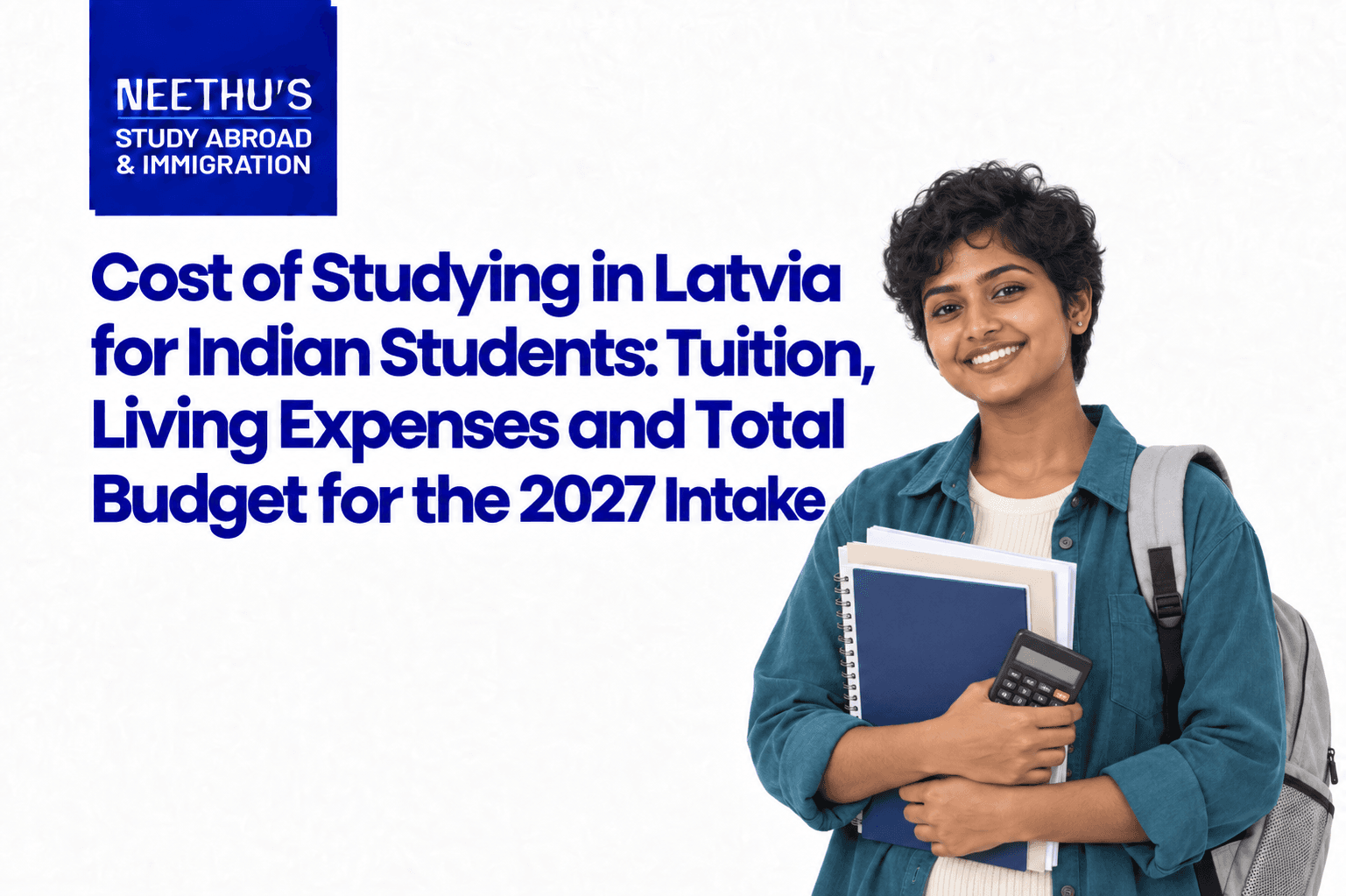
Latvia is attracting growing interest from international students who want to earn a European qualification without choosing some of the more expensive destinations in Western Europe. Universities in the country offer programmes across business, engineering, information technology, healthcare and other fields, with a number of courses available in English.
For Indian students considering the 2027 intake, understanding the financial side of studying abroad is just as important as choosing a university. Tuition fees form only one part of the expense. Accommodation, food, transport, insurance, travel, application charges and immigration-related costs can all affect the total amount a student needs.
The cost of studying in Latvia varies according to the programme, institution, city and personal lifestyle. Having a realistic budget before applying can help students and their families make better financial decisions.
Tuition Fees in Latvia
Tuition fees in Latvia are not fixed across all universities or programmes. The amount depends mainly on the institution and subject chosen.
According to the official Study in Latvia portal, some bachelor's programmes cost less than €1,600 per year, while Dentistry can cost up to €15,000 annually. Executive MBA programmes can be considerably more expensive, with fees reaching up to €25,600.
Some indicative annual tuition ranges include:
|
Study area |
Approximate annual fee |
Approximate INR |
|
Computer Science |
€1,800–€3,800 |
₹1.99–₹4.19 lakh |
|
Engineering |
€2,700–€3,500 |
₹2.98–₹3.86 lakh |
|
Business and Management |
€2,000–€6,000 |
₹2.21–₹6.62 lakh |
|
Medicine and healthcare |
€8,000–€15,000 |
₹8.83–₹16.55 lakh |
|
Dentistry |
Up to €15,000 |
Up to ₹16.55 lakh |
|
Executive MBA |
Up to €25,600 |
Up to ₹28.25 lakh |
These figures are only useful for initial planning. Actual tuition can differ between universities and individual courses, so applicants should confirm the current fee directly with their chosen institution.
Monthly Living Expenses
After tuition, everyday living costs are likely to be the largest part of a student's budget.
The official Study in Latvia portal estimates that international students should expect average living expenses of approximately €450–€700 per month. Using an indicative exchange rate of approximately €1 = ₹110.36, this works out to around:
-
€450 ≈ ₹49,700 per month
-
€700 ≈ ₹77,300 per month
For an entire year, the estimated living budget would therefore be:
-
€5,400 per year ≈ ₹5.96 lakh
-
€8,400 per year ≈ ₹9.27 lakh
Actual spending can be lower or higher depending on accommodation, food choices, location and personal habits.
Accommodation Expenses
Housing is an important consideration when preparing a study budget.
Students can usually choose between university accommodation, student residences, shared flats and private apartments. According to Study in Latvia, dormitories and student hostels can cost around €70–€120 per month. Renting a room in a shared apartment can cost approximately €100–€200, while a private apartment may cost around €250–€350 per month.
At the indicative exchange rate, these amounts are approximately:
-
Dormitory: ₹7,700–₹13,200 per month
-
Shared accommodation: ₹11,000–₹22,100 per month
-
Private apartment: ₹27,600–₹38,600 per month
Students focused on keeping costs low may find university accommodation or shared housing more economical than renting an entire apartment.
Food and Grocery Costs
Food expenses depend greatly on individual habits. Cooking at home and purchasing groceries can help students maintain a predictable monthly budget. Eating out regularly will increase expenses.
The official Study in Latvia portal indicates that a meal at a city-centre restaurant can cost approximately €5–€9, while daily specials in pubs and cafés may be around €3–€5.
Students can reduce food expenses by planning weekly meals, buying groceries in larger quantities where practical and limiting frequent restaurant visits. A monthly budget should also allow for toiletries, household items, clothing, and occasional entertainment.
Transportation Expenses
Transportation is another cost that students should include in their budget. Public transport is available in Latvian cities, and students can receive discounts. Study in Latvia lists student monthly transport tickets at approximately €5–€15, while a one-way ticket is around €2.
That student monthly ticket range is roughly ₹550–₹1,655 at the indicative exchange rate. Living close to campus can further reduce commuting costs. Students should compare rent against transportation expenses when selecting accommodation.
Application and Initial Expenses
The financial planning process should begin before travelling to Latvia. Students may have to pay an application fee depending on their university. Study in Latvia states that application fees are generally around €150–€200, although the amount varies and some higher education institutions do not charge one. This is approximately ₹16,500–₹22,100.
Other initial expenses may include:
-
Passport-related expenses
-
Academic document processing
-
English-language examination fees, if applicable
-
Health insurance
-
Visa or residence-permit expenses
-
Flight tickets
-
Initial accommodation costs
-
Study materials
-
Personal and emergency expenses
These costs vary between students, so it is sensible to keep additional funds available rather than budgeting only for tuition and monthly living costs.
Financial Requirements for Indian Students
Students should understand the Latvia student visa requirements for indians before finalising their financial plan.
Students coming to Latvia for higher education need to meet the relevant immigration and residence requirements. Depending on the application and circumstances, they may need to provide evidence showing that they have sufficient funds for their stay.
Latvia's Office of Citizenship and Migration Affairs currently lists €780 per month as the necessary subsistence amount for many residence-permit situations from 1 April 2026. This figure is an immigration-related minimum and should not automatically be interpreted as the student's complete monthly cost of living.
The official Study in Latvia portal estimates average student living expenses at €450–€700 per month, which is a separate estimate based on typical living costs.
Since immigration rules and financial thresholds can change, applicants should verify the latest requirements with the relevant Latvian authorities before submitting their application.
What Could a First Year in Latvia Cost?
There is no single answer because tuition varies significantly by subject. Consider a student enrolled in a programme costing €3,000 per year. If the student spends €450–€700 per month on living costs, the annual living budget would be €5,400–€8,400.
Adding tuition produces an estimated total of €8,400–€11,400 per year. This is approximately ₹9.27–₹12.57 lakh at the exchange rate used for this article. For a programme costing €10,000 in tuition, the same living-cost range would result in:€15,400–€18,400 per year or approximately ₹16.99–₹20.30 lakh.
These calculations do not include every possible expense, such as flights, insurance, visa or residence-permit charges, and unexpected costs.
Example Annual Budget
The following example provides a general idea of how a student might structure a first-year budget:
|
Expense |
Approximate EUR |
Approximate INR |
|
Tuition for a lower-cost programme |
€2,000–€4,000 |
₹2.21–₹4.41 lakh |
|
Living and accommodation |
€5,400–€8,400 |
₹5.96–₹9.27 lakh |
|
Application fee |
€150–€200 |
₹16,500–₹22,100 |
|
Travel, insurance and other costs |
Varies |
Varies |
|
Estimated basic first-year budget |
€7,550–€12,600+ |
₹8.33–₹13.90 lakh+ |
This should be viewed as a planning example rather than a guaranteed cost. A student's actual expenditure will depend on the university, course, accommodation, and lifestyle.
Ways to Manage Expenses
Students can take several practical steps to keep their costs under control. Choosing shared accommodation instead of a private apartment can reduce housing expenses. Cooking at home, using student transport discounts and comparing accommodation options can also help.
Scholarships may provide additional support. Latvia has a state scholarship programme for eligible international students, although the official information makes clear that scholarship funding may not cover all expenses associated with studying and living in Latvia. Students should therefore calculate their own finances even if they are applying for a scholarship.
Is Latvia Affordable for Indian Students?
For students comparing European destinations, Latvia can offer a relatively moderate cost structure. Some programmes have tuition fees that are lower than those found in several other European study destinations, while the official estimate for average living expenses is €450–€700 per month.
However, affordability depends strongly on the chosen course. A student studying a lower-cost programme will have a very different financial requirement from someone pursuing Dentistry or an Executive MBA. Instead of considering tuition alone, students should calculate the total cost of education and living for the complete duration of the programme.
Planning Your Budget for the 2027 Intake
Anyone planning to study in Latvia in 2027 should begin financial planning early. Start by checking the current tuition fee of your chosen programme. Next, estimate accommodation, food, and transport expenses. Add health insurance, travel, application charges, and immigration-related costs to create a complete budget. It is also wise to maintain an emergency reserve. Currency fluctuations can affect Indian students because expenses are paid in euros while family budgets are often planned in rupees.
For the calculations in this article, an indicative rate of €1 = ₹110.36 has been used. The actual INR equivalent may change by the time students pay their tuition, accommodation, or other expenses.
Final Thoughts
The cost of studying in Latvia for indian students depends on several factors, including the university, subject, accommodation, and lifestyle. While some programmes have relatively modest tuition fees, specialised courses can cost considerably more. Living expenses are estimated at around €450–€700 per month, although individual spending patterns can produce different results.
For the 2027 intake, students should prepare a complete financial plan instead of focusing only on tuition. Accommodation, food, transportation, insurance, travel, and immigration-related expenses can all contribute to the overall cost.
Students who want to study in Latvia should also remember that published costs are estimates rather than fixed guarantees. Tuition fees, accommodation charges, exchange rates, scholarship availability and immigration requirements may change before the 2027 intake.
Support from experienced study abroad consultants in Kerala can help students understand university choices and application procedures, but applicants should independently confirm current fees, scholarship conditions and immigration requirements through official sources.
A well-prepared budget can make the transition to studying abroad easier and reduce the risk of unexpected financial pressure.
Important: Tuition fees, living costs, exchange rates, scholarship conditions, and immigration requirements may change for the 2027 intake. Students should check the latest information on their chosen university's official website and the relevant Latvian government authorities before applying or making financial commitments. INR conversions in this article are approximate and should be treated as indicative only.
FAQs
1. Is Latvia affordable for Indian students?
Latvia can be a relatively affordable European study destination, although the overall cost depends on the university, programme, accommodation and lifestyle. Students should calculate tuition and living expenses together when planning their budget.
2. How much does it cost to study in Latvia for Indian students?
Tuition fees vary significantly by programme. Some bachelor's programmes cost less than €1,600 per year, while specialised programmes such as Dentistry and Executive MBA courses can be considerably more expensive.
3. What are the average living expenses for students in Latvia?
The official Study in Latvia portal estimates average living expenses at approximately €450–€700 per month, which is roughly ₹49,700–₹77,300 based on an indicative exchange rate of €1 = ₹110.36.
4. How much does accommodation cost in Latvia?
Student dormitories can cost around €70–€120 per month, shared accommodation around €100–€200, and a private apartment approximately €250–€350 per month. Actual prices depend on location and property.
5. What is the currency used in Latvia?
Latvia uses the euro (€) as its official currency. Indian students should monitor exchange rates because the equivalent cost in Indian rupees can change over time.
6. Do Indian students need to show proof of funds to study in Latvia?
Indian students may need to provide evidence of sufficient financial resources as part of the relevant immigration or residence-permit process. The exact financial requirement depends on the applicable rules and should be checked with the Latvian authorities before applying.
7. Can students reduce their living expenses in Latvia?
Yes. Choosing university accommodation or shared housing, cooking at home, using student transport discounts, and managing discretionary spending can help students keep their monthly expenses under control.
8. Are scholarships available for international students in Latvia?
Yes. Latvia has scholarship opportunities for eligible international students. However, the amount and conditions vary, and some scholarships may not cover all tuition and living expenses.
9. How much should an Indian student budget for the first year in Latvia?
The amount depends on the course. For a programme costing around €3,000 in annual tuition, combined tuition and estimated living costs could be approximately €8,400–€11,400 per year, excluding certain additional expenses such as travel, insurance and immigration-related charges.
10. Can the cost of studying in Latvia change by 2027?
Yes. Tuition fees, accommodation costs, exchange rates, scholarship conditions and immigration requirements can change. Students planning for the 2027 intake should confirm the latest information directly with their chosen university and Latvian government authorities before making financial decisions.




























































































































































_03-12-2025_01-17-26%20PM.webp&w=3840&q=75)
_02-12-2025_03-07-49%20PM.webp&w=3840&q=75)

_27-11-2025_04-06-24%20PM.webp&w=3840&q=75)
_25-11-2025_04-38-18%20PM.webp&w=3840&q=75)
_24-11-2025_03-20-26%20PM.webp&w=3840&q=75)
_22-11-2025_12-44-47%20PM.webp&w=3840&q=75)
_21-11-2025_04-17-47%20PM.webp&w=3840&q=75)
_20-11-2025_03-55-26%20PM.webp&w=3840&q=75)
_18-11-2025_04-00-40%20PM.webp&w=3840&q=75)
_15-11-2025_10-48-43%20AM.webp&w=3840&q=75)
%20(1)_14-11-2025_03-52-25%20PM.webp&w=3840&q=75)
_13-11-2025_03-02-38%20PM.webp&w=3840&q=75)
_08-11-2025_04-15-36%20PM.webp&w=3840&q=75)
_05-11-2025_04-01-50%20PM.webp&w=3840&q=75)
_05-11-2025_03-46-26%20PM.webp&w=3840&q=75)
_03-11-2025_03-31-09%20PM.webp&w=3840&q=75)
_04-11-2025_.webp&w=3840&q=75)
_04-11-2025_.webp&w=3840&q=75)
_29-10-2025_04-52-52%20PM.webp&w=3840&q=75)
_28-10-2025_04-09-08%20PM.webp&w=3840&q=75)
_24-10-2025_05-10-31%20PM.webp&w=3840&q=75)
_24-10-2025_04-55-51%20PM.webp&w=3840&q=75)
_22-10-2025_04-40-20%20PM.webp&w=3840&q=75)
%20(1)_21-10-2025_03-05-46%20PM.webp&w=3840&q=75)
_21-10-2025_02-43-15%20PM.webp&w=3840&q=75)
_17-10-2025_05-08-52%20PM.webp&w=3840&q=75)
_17-10-2025_04-54-54%20PM.webp&w=3840&q=75)
_15-10-2025_03-46-47%20PM.webp&w=3840&q=75)
_14-10-2025_03-42-40%20PM.webp&w=3840&q=75)
_14-10-2025_03-29-48%20PM.webp&w=3840&q=75)
_13-10-2025_03-48-51%20PM.webp&w=3840&q=75)
_11-10-2025_04-28-42%20PM.webp&w=3840&q=75)
%20(1)_09-10-2025_04-12-08%20PM.webp&w=3840&q=75)
_07-10-2025_02-55-25%20PM.webp&w=3840&q=75)
_07-10-2025_02-39-51%20PM.webp&w=3840&q=75)
_06-10-2025_03-42-37%20PM.webp&w=3840&q=75)
_03-10-2025_04-42-59%20PM.webp&w=3840&q=75)
_01-10-2025_11-12-12%20AM.webp&w=3840&q=75)
%20(1)_29-09-2025_02-54-12%20PM.webp&w=3840&q=75)

_26-09-2025_12-14-18%20PM.webp&w=3840&q=75)
_24-09-2025_04-44-26%20PM.webp&w=3840&q=75)
_23-09-2025_04-14-36%20PM.webp&w=3840&q=75)
_22-09-2025_04-08-09%20PM.webp&w=3840&q=75)
_20-09-2025_03-26-03%20PM.webp&w=3840&q=75)
_17-09-2025_04-06-42%20PM.webp&w=3840&q=75)
_15-09-2025_04-43-43%20PM.webp&w=3840&q=75)
_13-09-2025_12-17-49%20PM.webp&w=3840&q=75)
_12-09-2025_04-31-36%20PM.webp&w=3840&q=75)
_12-09-2025_04-17-03%20PM.webp&w=3840&q=75)
_10-09-2025_03-59-59%20PM.webp&w=3840&q=75)
_09-09-2025_04-11-16%20PM.webp&w=3840&q=75)
_09-09-2025_03-53-52%20PM.webp&w=3840&q=75)
















































_12-06-2025_03-40-35%20PM.webp&w=3840&q=75)