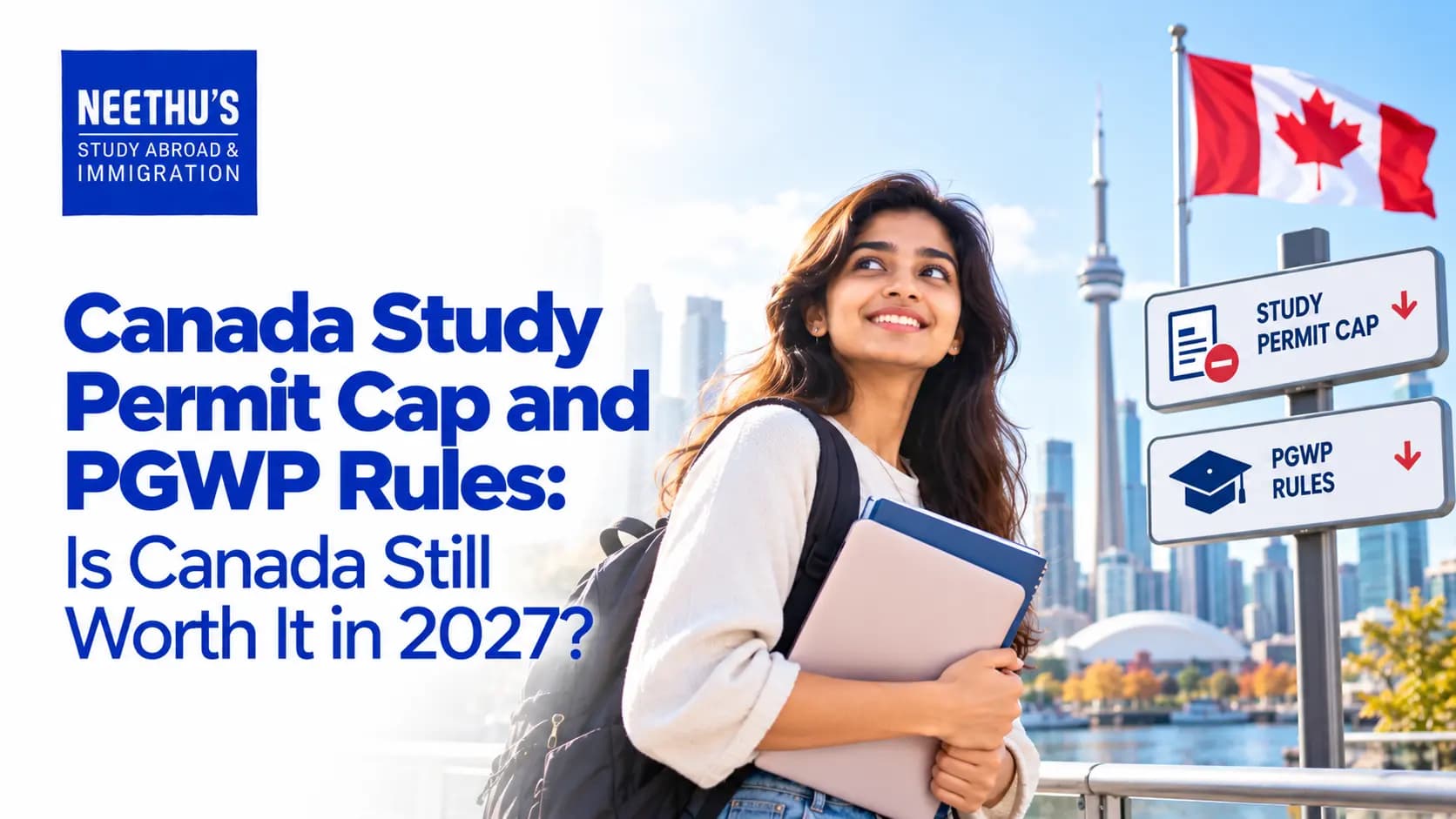
Canada Study Permit Cap and PGWP Rules: Is Canada Still Worth It in 2027?
Canada remains one of the most popular choices for Indian students seeking an international education. Canadian institutions offer a wide range of undergraduate, postgraduate, and specialised programs, while the country's multicultural environment can make the transition easier for international students. However, Canada has tightened regulations around international education.
Students preparing for a 2027 intake need to look beyond university admission. Changes to study permit planning, financial requirements, and post-graduation work eligibility can influence the value of a particular course. Understanding these rules before paying a tuition deposit can help students avoid choosing a program that does not match their long-term plans.
The Canada study permit cap is therefore an important subject for prospective applicants. At the same time, recent PGWP eligibility changes mean that students need to examine their chosen program carefully instead of assuming that completing any Canadian course will automatically lead to a Post-Graduation Work Permit.
Why Canada's International Student System Is Changing
Canada has been taking measures to manage the number of temporary residents in the country. International students form an important part of this population, and the federal government has introduced controls affecting the number of new study permit applications and approvals.
The changes are designed to bring international student numbers into a more controlled framework while addressing pressures associated with housing, public services and temporary migration.
Canada's 2026–2028 Immigration Levels Plan includes a planning target of approximately 150,000 new international student arrivals for 2027. This figure should not be interpreted as a simple nationwide visa quota where exactly that number of students will receive permits. The actual process involves different applicant categories, provincial and territorial arrangements, and exemptions.
This distinction is particularly important because students often come across simplified information online describing the system as a single "Canada visa cap."
What the Canada Study Permit Cap 2027 Could Mean for Applicants
The Canada study permit cap forms part of Canada's broader approach to managing international student admissions.
Depending on the applicant and program, a student may need a Provincial Attestation Letter (PAL) or Territorial Attestation Letter (TAL) when applying for a study permit. There are exemptions under the current system, including certain students entering master's or doctoral programs at eligible public institutions.
Therefore, students should determine whether an attestation document is required before submitting an application.
The situation also means that selecting an institution requires more research than simply comparing tuition fees. Students should verify that their chosen school is a Designated Learning Institution and examine the eligibility of their specific program for post-study work opportunities.
Since immigration policies can be revised, students applying for the 2027 intake should check the applicable requirements when preparing their actual application.
PGWP Rules Have Become More Program-Specific
The Post-Graduation Work Permit has traditionally been an important consideration for international students choosing Canada. An eligible graduate may receive a work permit after completing qualifying studies, allowing them to gain professional experience in Canada.
However, the rules are no longer as straightforward as they were for many previous applicants.
The recent PGWP eligibility change introduced additional requirements relating to language proficiency and, for certain non-degree programs, the field of study.
Graduates of bachelor's, master's and doctoral programs generally need to demonstrate language proficiency equivalent to Canadian Language Benchmark 7 in English or the applicable French-language standard. Graduates of other university or college programs generally have different language thresholds.
For certain non-degree programs, eligibility is also connected to specific fields of study. These fields are linked to areas where Canada has identified labour-market needs, and the list can change.
This makes the course-selection stage extremely important. Students should not assume that a program is PGWP-eligible simply because it is offered by a Canadian college or university.
Check the Exact Program Before Paying Your Deposit
A common mistake among international applicants is to check only whether the institution is recognised.
Institution-level eligibility is important, but students should also investigate their particular program.
Before making a payment, prospective students should check:
-
Whether the institution is a designated learning institution
-
Whether the specific program is eligible for a PGWP
-
Whether the program duration satisfies the applicable requirement
-
Whether a field-of-study condition applies
-
What language requirement will apply after graduation
-
Whether the program has any special delivery arrangement affecting eligibility
Students should also be careful when considering private-college programs delivered through partnerships or curriculum-licensing arrangements. Some such programs do not qualify for a PGWP under current rules.
A course should therefore be evaluated according to official immigration information rather than solely on an education agent's description.
Understanding the Canada Financial Proof Requirement
Money is another major part of the Canadian study permit process.
Applicants have to demonstrate that they can financially support themselves during their studies. This generally includes money for tuition, living expenses, and transportation. The applicant is expected to show that sufficient funds are available without depending on future employment in Canada to meet the basic cost of studying and living.
The Canada financial proof requirement is not limited to showing a particular balance in a bank account. Immigration authorities can consider the overall financial circumstances and supporting documentation provided by the applicant.
For study permit applications submitted from September 1, 2026, the published minimum living-expense amount for one applicant outside Quebec is CAD 23,448, excluding tuition and transportation. The amount is subject to annual updates, so students applying in 2027 should confirm the current figure directly with the Canadian government before submitting their application.
Financial evidence can include education loans, scholarships, bank funds, guaranteed investment certificates, and other accepted sources. Applicants should be able to explain where the money came from and demonstrate that it is genuinely available for their education and living expenses.
Why Financial Planning Should Start Early
Waiting until the visa application stage to organise finances can create unnecessary complications.
Students and their families should calculate the complete cost of the proposed education. This can include tuition, accommodation, food, transportation, health insurance, books, flights and other personal expenses.
Loan approval letters and bank documentation should also be organised carefully. If substantial funds have recently been deposited into an account, applicants should be prepared to provide appropriate evidence explaining the source.
Good financial preparation is particularly important when students are applying under a system where immigration authorities are paying closer attention to temporary-resident numbers.
Does Canada Still Make Sense for International Students?
The changing rules do not mean that every student should automatically reject Canada as a destination. They do mean that applicants need to evaluate their choices more carefully.
For some students, a Canadian degree may fit well with their academic and professional goals. Others may discover that a different destination or program better matches their budget, qualifications or career plans.
The most important factor is not simply whether Canada offers a post-study work opportunity. Students should consider the entire educational journey.
This includes the cost of the course, the reputation and suitability of the institution, employment opportunities related to the student's field, PGWP eligibility, and possible future immigration pathways.
A PGWP Is Not the Same as Permanent Residence
Students should also understand the difference between a post-graduation work permit and permanent immigration.
An eligible graduate may qualify for a PGWP, but receiving one does not automatically provide permanent residence. A graduate who later wants to apply for permanent residence must satisfy the requirements of the immigration program available to them at that time.
Those requirements can depend on factors such as occupation, work experience, language ability, province, and other eligibility conditions.
Consequently, students should avoid choosing a course based on claims that it guarantees permanent residence.
What Indian Students Should Do Before Applying
Students planning to study in Canada in 2027 can take several practical steps before submitting an application.
First, identify programs that match previous education and career objectives. A course should make academic sense rather than being selected only because it appears to have favourable immigration prospects.
Next, verify the institution's current DLI status and investigate whether the exact program is eligible for a PGWP.
Students should then determine whether they need a PAL or TAL and check whether they qualify for an exemption.
Financial preparation should happen alongside the admission process. Calculate the first-year cost and identify how tuition and living expenses will be funded.
Finally, check the latest information on the official Canadian immigration website before submitting the study permit application. Requirements can change between different admission cycles.
How to Approach Studying in Canada in 2027
Anyone planning to study in Canada should now approach the process as a combination of education planning and immigration compliance.
Instead of asking only, "Which college has the cheapest course?", students should ask several questions:
Does this program suit my previous qualification?
Is the institution eligible under Canada's international student system?
Does the exact program qualify for a PGWP?
Will I meet the required language conditions?
What funds will I need to demonstrate?
Do I require a provincial or territorial attestation?
What are my realistic career options after graduation?
Answering these questions before applying can help students make a more informed decision.
Getting Professional Guidance
Canadian education and immigration requirements can be difficult to interpret because different rules may apply to different programs and applicant categories.
Students looking for the Best study abroad consultants in kerala should therefore focus on consultants who provide transparent information about institutions, fees, eligibility, and immigration requirements.
A good counselling process should explain both the advantages and limitations of a proposed course. Students should also independently verify important immigration information through official Canadian government sources.
Be particularly cautious of anyone promising a guaranteed study permit, guaranteed employment, or guaranteed permanent residence. Immigration decisions remain with the relevant Canadian authorities.
Final Thoughts
Canada's international student system has become more structured, and applicants planning for 2027 need to prepare accordingly. The Canada study permit cap 2027 is only one part of the picture. Students also need to understand PGWP eligibility changes, financial documentation, and the requirements associated with their particular program.
The Canada financial proof requirement should be planned well before the visa application, while students interested in post-study work should verify their program's current PGWP status rather than relying on general information about studying in Canada.
For anyone planning to study in Canada, the best approach is to compare the complete academic, financial, and post-study picture before making a commitment. Policies may continue to evolve before the 2027 intake, so applicants should always confirm the latest rules at the time of application.
Frequently Asked Questions
1. What is the Canada study permit cap 2027?
The Canada study permit cap 2027 is part of Canada's broader system for managing the number of new international students entering the country. The government has established planning targets for international student arrivals, while actual study permit requirements can vary by applicant category, province, institution, and program.
2. Will the study permit cap prevent Indian students from studying in Canada?
No. The cap does not mean that Indian students are automatically prevented from applying. However, applicants may need to meet additional requirements, such as obtaining a Provincial or Territorial Attestation Letter where applicable. Students should check the rules that apply to their particular program and institution.
3. What are the major PGWP eligibility changes?
Recent PGWP eligibility changes include additional language requirements and, for certain non-degree programs, field-of-study conditions. Students should also confirm that their institution and specific program are eligible for a Post-Graduation Work Permit before enrolling.
4. Does every Canadian college program qualify for a PGWP?
No. Completing a program at a Canadian college does not automatically guarantee PGWP eligibility. The institution must meet the applicable requirements, and the specific program must also qualify under the rules in effect when the student applies.
5. What is the Canada financial proof requirement for international students?
The Canada financial proof requirement requires applicants to demonstrate that they have sufficient funds to cover tuition, living expenses, and transportation without relying on future employment in Canada. The required living-expense amount is updated periodically, so applicants should check the latest official figure before applying.
6. Can students work while studying in Canada?
Eligible international students may be permitted to work while studying, subject to the conditions attached to their study permit and the rules applicable at that time. Students should not depend on part-time employment as their primary source of funds for tuition and living expenses.
7. Is a PGWP guaranteed after completing a Canadian course?
No. A Canadian qualification does not by itself guarantee a Post-Graduation Work Permit. Students must satisfy the eligibility requirements that apply when they submit their PGWP application, including requirements relating to the program, institution, language proficiency, and other conditions.
8. Does getting a PGWP automatically lead to permanent residence?
No. A PGWP is a temporary work permit. Graduates who later want to apply for permanent residence must qualify under an available immigration pathway and meet its requirements. Eligibility can depend on factors such as work experience, language proficiency, occupation, and other criteria.
9. What should Indian students check before choosing a Canadian course for 2027?
Students should verify the institution's DLI status, the exact program's PGWP eligibility, tuition and living costs, applicable language requirements, PAL/TAL requirements, and the financial documents needed for the study permit. They should also consider whether the course fits their previous education and career plans.
10. Should students consult study abroad consultants before applying to Canada?
Professional guidance can help students understand admission, documentation, and changing immigration requirements. Students considering the Best study abroad consultants in Kerala should still verify important information through official Canadian government sources and avoid consultants who promise guaranteed visas, jobs or permanent residence.




































































































































_03-12-2025_01-17-26%20PM.webp&w=3840&q=75)
_02-12-2025_03-07-49%20PM.webp&w=3840&q=75)

_27-11-2025_04-06-24%20PM.webp&w=3840&q=75)
_25-11-2025_04-38-18%20PM.webp&w=3840&q=75)
_24-11-2025_03-20-26%20PM.webp&w=3840&q=75)
_22-11-2025_12-44-47%20PM.webp&w=3840&q=75)
_21-11-2025_04-17-47%20PM.webp&w=3840&q=75)
_20-11-2025_03-55-26%20PM.webp&w=3840&q=75)
_18-11-2025_04-00-40%20PM.webp&w=3840&q=75)
_15-11-2025_10-48-43%20AM.webp&w=3840&q=75)
%20(1)_14-11-2025_03-52-25%20PM.webp&w=3840&q=75)
_13-11-2025_03-02-38%20PM.webp&w=3840&q=75)
_08-11-2025_04-15-36%20PM.webp&w=3840&q=75)
_05-11-2025_04-01-50%20PM.webp&w=3840&q=75)
_05-11-2025_03-46-26%20PM.webp&w=3840&q=75)
_03-11-2025_03-31-09%20PM.webp&w=3840&q=75)
_04-11-2025_.webp&w=3840&q=75)
_04-11-2025_.webp&w=3840&q=75)
_29-10-2025_04-52-52%20PM.webp&w=3840&q=75)
_28-10-2025_04-09-08%20PM.webp&w=3840&q=75)
_24-10-2025_05-10-31%20PM.webp&w=3840&q=75)
_24-10-2025_04-55-51%20PM.webp&w=3840&q=75)
_22-10-2025_04-40-20%20PM.webp&w=3840&q=75)
%20(1)_21-10-2025_03-05-46%20PM.webp&w=3840&q=75)
_21-10-2025_02-43-15%20PM.webp&w=3840&q=75)
_17-10-2025_05-08-52%20PM.webp&w=3840&q=75)
_17-10-2025_04-54-54%20PM.webp&w=3840&q=75)
_15-10-2025_03-46-47%20PM.webp&w=3840&q=75)
_14-10-2025_03-42-40%20PM.webp&w=3840&q=75)
_14-10-2025_03-29-48%20PM.webp&w=3840&q=75)
_13-10-2025_03-48-51%20PM.webp&w=3840&q=75)
_11-10-2025_04-28-42%20PM.webp&w=3840&q=75)
%20(1)_09-10-2025_04-12-08%20PM.webp&w=3840&q=75)
_07-10-2025_02-55-25%20PM.webp&w=3840&q=75)
_07-10-2025_02-39-51%20PM.webp&w=3840&q=75)
_06-10-2025_03-42-37%20PM.webp&w=3840&q=75)
_03-10-2025_04-42-59%20PM.webp&w=3840&q=75)
_01-10-2025_11-12-12%20AM.webp&w=3840&q=75)
%20(1)_29-09-2025_02-54-12%20PM.webp&w=3840&q=75)

_26-09-2025_12-14-18%20PM.webp&w=3840&q=75)
_24-09-2025_04-44-26%20PM.webp&w=3840&q=75)
_23-09-2025_04-14-36%20PM.webp&w=3840&q=75)
_22-09-2025_04-08-09%20PM.webp&w=3840&q=75)
_20-09-2025_03-26-03%20PM.webp&w=3840&q=75)
_17-09-2025_04-06-42%20PM.webp&w=3840&q=75)
_15-09-2025_04-43-43%20PM.webp&w=3840&q=75)
_13-09-2025_12-17-49%20PM.webp&w=3840&q=75)
_12-09-2025_04-31-36%20PM.webp&w=3840&q=75)
_12-09-2025_04-17-03%20PM.webp&w=3840&q=75)
_10-09-2025_03-59-59%20PM.webp&w=3840&q=75)
_09-09-2025_04-11-16%20PM.webp&w=3840&q=75)
_09-09-2025_03-53-52%20PM.webp&w=3840&q=75)









































_12-06-2025_03-40-35%20PM.webp&w=3840&q=75)