IELTS vs PTE in 2027: Which Is Better for Indian Students Studying Abroad?
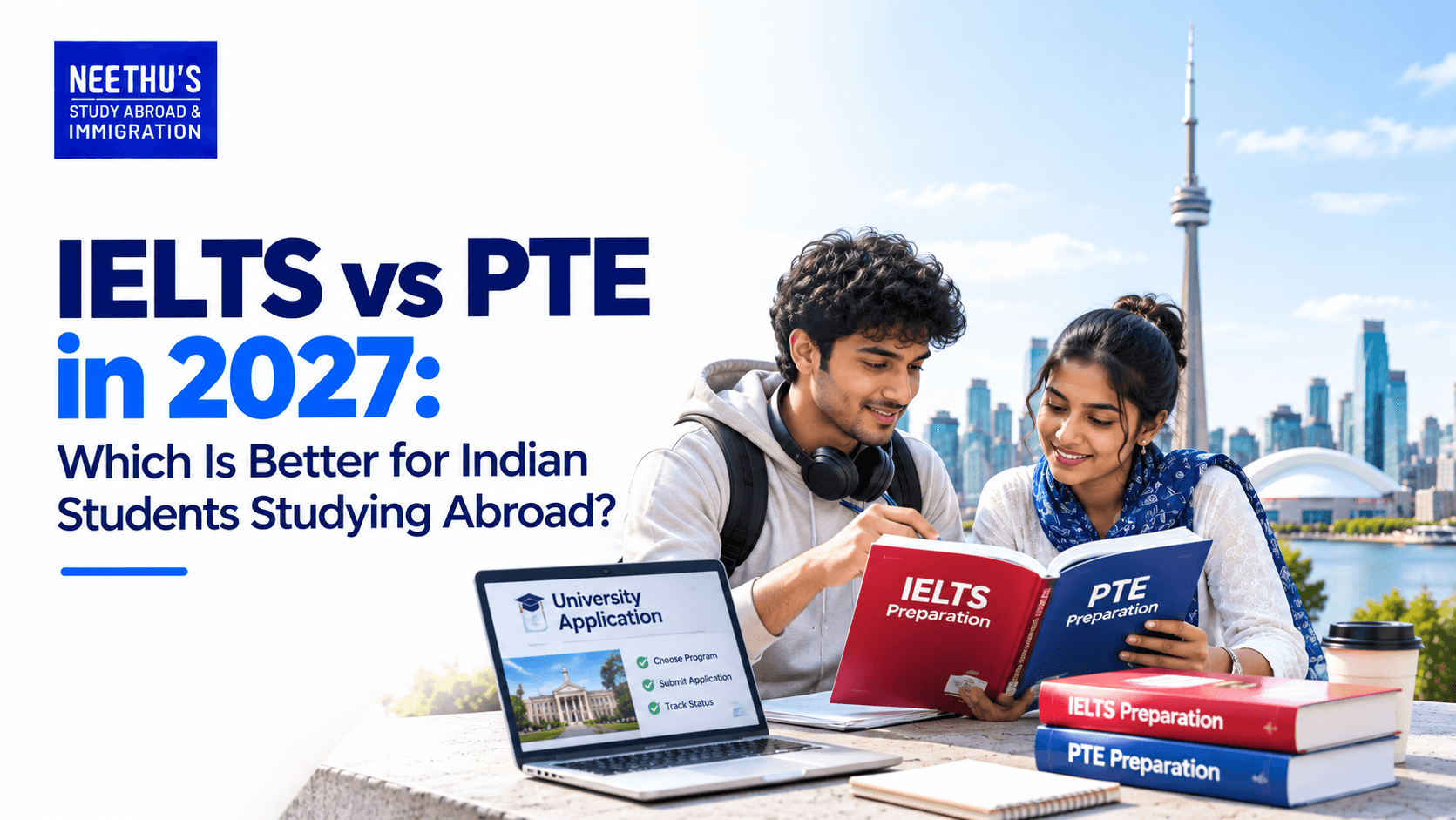
Choosing the right English language proficiency test is an important step for Indian students planning to pursue higher education overseas. Most international universities require applicants to demonstrate their ability to understand lectures, communicate effectively, participate in discussions, and complete academic assignments in English. IELTS and PTE are two widely recognised examinations that students can consider when preparing for international admissions.
Although both tests assess English language skills, they differ in their examination format, scoring methods, test delivery, and result processing. Some students prefer IELTS because of its familiar speaking interview format, while others choose PTE because it is computer-based and uses automated scoring for several sections.
With international admission requirements and immigration policies continuing to evolve, students planning to study abroad in 2027 should understand how these examinations work before booking a test.
This guide compares IELTS and PTE, explains their differences, and helps Indian students decide which examination may be more suitable for their academic plans.
1. What Is IELTS?
The International English Language Testing System (IELTS) is an English proficiency examination designed to assess the language abilities of people who want to study, work, or migrate to English-speaking destinations.
IELTS is jointly owned by the British Council, IDP IELTS, and Cambridge University Press and Assessment.
Students applying to international universities generally take IELTS Academic, which evaluates their ability to use English in an academic environment.
The examination includes four sections:
-
Listening: Assesses the ability to understand conversations, discussions, and spoken information.
-
Reading: Tests comprehension of academic texts, ideas, and supporting details.
-
Writing: Evaluates the ability to organise information, explain arguments, and communicate ideas in written English.
-
Speaking: Measures spoken communication through a face-to-face or video-call interview with an examiner, depending on the test arrangement.
IELTS uses a band score ranging from 0 to 9. Each section receives an individual score, and the overall band score represents the candidate's combined performance.
Many universities request an overall score between 6.0 and 7.0, although requirements vary depending on the programme and institution.
2. What Is PTE Academic?
Pearson Test of English (PTE) Academic is a computer-based English proficiency examination developed by Pearson. It is designed for students applying to universities and other institutions that accept this qualification.
Unlike IELTS, PTE Academic uses computer-based tasks and automated scoring for several assessment components.
The examination evaluates four language skills:
-
Speaking: Tests pronunciation, fluency, and the ability to communicate spoken information.
-
Writing: Assesses grammar, vocabulary, spelling, and written communication.
-
Reading: Measures understanding of written passages and the ability to interpret information.
-
Listening: Evaluates the ability to understand spoken English and identify relevant details.
PTE Academic uses a scoring scale from 10 to 90. Candidates receive an overall score and individual skill scores.
The computer-based format may appeal to students who are comfortable speaking into a microphone and completing different question types on a screen.
3. IELTS vs PTE: Major Differences
Although both examinations assess English proficiency, their formats and scoring systems are different.
|
Comparison |
IELTS Academic |
PTE Academic |
|
Test format |
Computer or paper-based, depending on availability |
Computer-based |
|
Speaking assessment |
Interview with an examiner |
Speaking into a microphone |
|
Scoring system |
Band scores from 0–9 |
Score scale from 10–90 |
|
Test duration |
Approximately 2 hours 45 minutes |
Approximately 2 hours |
|
Listening |
Audio-based questions |
Audio-based questions |
|
Reading |
Academic reading passages |
Computer-based reading tasks |
|
Writing |
Essays and report-based tasks |
Integrated and independent writing tasks |
|
Results |
Delivery time depends on test format and location |
Typically available within 2 days, though delays can occur |
Students should check the official examination websites for current test formats, availability, fees, and result timelines before registering.
4. Which Test Is Easier for Indian Students?
There is no universally easier examination. The difficulty depends on a student's English proficiency, familiarity with computers, speaking confidence, and ability to manage different question formats.
IELTS may be suitable for students who:
-
Prefer communicating directly with an examiner.
-
Are comfortable writing essays and structured responses.
-
Can understand different English accents.
-
Prefer a familiar interview-style speaking assessment.
PTE may be suitable for students who:
-
Are comfortable using computers.
-
Prefer completing the entire examination digitally.
-
Can speak clearly into a microphone.
-
Are familiar with integrated question types.
-
Prefer a computer-based assessment environment.
Students should take practice examinations for both tests before deciding. Their performance in mock tests can provide a better indication of which format matches their strengths.
5. Which Test Is Better for Studying in Different Countries?
University acceptance is one of the most important factors when selecting an English proficiency test. IELTS and PTE are accepted by many international institutions, but acceptance is not universal.
United Kingdom
UK universities accept IELTS and PTE Academic for many academic programmes. However, individual institutions establish their own minimum scores.
Students applying for specific immigration routes should also check whether their examination meets the relevant UK Home Office requirements. Not every university-accepted English test is automatically suitable for every visa purpose.
Canada
Canadian universities and colleges accept IELTS and, where specified, PTE Academic for various academic programmes.
Students should distinguish between university admission requirements and immigration language requirements. The tests accepted for one purpose may not necessarily satisfy another.
Australia
Both IELTS and PTE Academic are accepted by many Australian educational institutions.
However, professional registration programmes and specific visa categories may have separate English language standards. Students planning to study nursing, medicine, or other regulated courses should check the relevant professional authority's requirements.
Ireland
Irish universities accept recognised English proficiency tests, including IELTS and PTE Academic at many institutions.
Minimum scores depend on the selected programme. Healthcare and other professional courses may have additional language requirements.
Germany and Other European Countries
English-taught programmes at European universities may accept IELTS or PTE Academic, depending on institutional policy.
Students should verify the accepted tests directly with their chosen university. Some programmes may also require German, French, or another local language.
6. IELTS for Studying Abroad: Important Things to Know
For students considering IELTS for studying abroad, the Academic version is generally the relevant examination for university admissions.
Its speaking section is conducted through an interaction with an examiner, which allows candidates to demonstrate their ability to communicate naturally.
IELTS can be a suitable option for students who prefer explaining ideas verbally rather than speaking to a computer.
Another advantage is its wide recognition among educational institutions and immigration authorities. However, acceptance should always be checked for the exact university, programme, and visa category.
Before registering, students should review the university's required overall band score and minimum scores for each individual section.
7. PTE for International Students: Advantages and Limitations
PTE for International students can be a useful option for applicants who prefer a fully computer-based examination.
Its digital format allows candidates to complete speaking, writing, reading, and listening tasks in an integrated testing environment.
Some potential advantages include:
-
Computer-based examination throughout.
-
Automated scoring for several tasks.
-
Typically quick result availability.
-
Flexible question formats.
-
Convenient digital score reporting.
However, PTE also requires preparation. Candidates must understand its different question types, manage their time effectively, and practise speaking clearly into a microphone.
Students should not assume that choosing a computer-based examination automatically guarantees a higher score.
8. IELTS and PTE Exam Fees in 2027
Examination fees can influence the decision, particularly for students preparing for multiple university applications.
The cost of IELTS and PTE varies depending on the country, test location, examination type, and booking date.
Students in India should check the official IELTS and Pearson websites for the latest 2027 registration charges.
Apart from the examination fee, applicants should consider additional expenses such as:
-
Preparation materials.
-
Coaching classes, if required.
-
Mock examinations.
-
Additional test attempts.
-
Travel expenses to the examination centre.
It is better to prepare thoroughly before booking a test rather than spending money on repeated attempts.
9. How to Choose Between IELTS and PTE in 2027
The right examination depends on your destination, academic requirements, and personal strengths.
Consider these factors before making a decision:
Check university acceptance: Confirm whether your preferred universities accept IELTS, PTE, or both.
Understand the required scores: Compare the minimum overall and individual section scores.
Evaluate your strengths: Identify whether you perform better in face-to-face speaking or computer-based tasks.
Take mock tests: Attempt practice examinations to understand the format and assess your performance.
Consider application deadlines: Select an examination date that allows sufficient time for results and possible retakes.
Check visa requirements: Review the official immigration rules separately from university admission requirements.
Students seeking guidance from the Best study abroad consultants in kerala should choose professionals who understand university-specific English language requirements and current visa regulations. They can help applicants identify suitable tests based on their chosen destination and programme.
10. Common Mistakes Students Should Avoid
Many applicants focus only on achieving an overall score and overlook other important admission conditions.
Avoid these common mistakes:
-
Booking an examination without checking university acceptance.
-
Ignoring individual section score requirements.
-
Preparing only through memorised answers.
-
Not attempting full-length mock tests.
-
Confusing academic test requirements with immigration requirements.
-
Booking the examination too close to the university deadline.
-
Assuming that IELTS or PTE is easier for everyone.
-
Failing to check score validity and submission deadlines.
A well-planned preparation strategy can help students avoid unnecessary delays and additional examination expenses.
Conclusion
IELTS and PTE Academic are both valuable English proficiency examinations for Indian students planning to pursue higher education overseas in 2027. While IELTS offers an examiner-led speaking assessment and a familiar band-scoring system, PTE provides a fully computer-based testing experience with a different scoring approach.
Neither examination is automatically better for every student. The right choice depends on university acceptance, destination-specific requirements, individual language skills, and personal comfort with the test format.
Before registering, compare the requirements of your shortlisted institutions, take practice tests, and prepare according to your weaker language areas. Making an informed decision can help you meet admission requirements and move forward with your international education plans.
FAQs
1. Which is better for Indian students in 2027, IELTS or PTE?
Both are accepted by many international universities. The better option depends on the destination, university requirements, and the student's comfort with each examination format.
2. Is PTE easier than IELTS?
Not necessarily. PTE may suit students who prefer computer-based assessments, while IELTS may be more comfortable for those who prefer speaking with an examiner.
3. Do UK universities accept PTE Academic in 2027?
Many UK universities accept PTE Academic, but acceptance and minimum scores depend on the institution and programme. Visa-related requirements should be checked separately.
4. Can I use IELTS Academic for studying abroad?
Yes. IELTS Academic is widely accepted for undergraduate and postgraduate university admissions. Individual institutions specify their required scores.
5. What is the validity of IELTS and PTE scores?
Both are generally considered valid for two years, although individual universities and authorities may have their own policies.
6. Which examination gives faster results, IELTS or PTE?
PTE Academic results are typically available within two days. IELTS result timelines depend on the test format and location.
7. Can I take PTE or IELTS more than once?
Yes. Candidates can retake either examination if they want to improve their scores, subject to the respective test provider's booking rules.
8. What IELTS score is required to study abroad?
Many universities require an overall band score between 6.0 and 7.0, but competitive programmes and professional courses may require higher scores.
9. Is PTE accepted in Australia and Canada?
Yes. Many universities in both countries accept PTE Academic, but applicants should verify the requirements of their specific institution and visa category.
10. Should I join coaching classes for IELTS or PTE?
Coaching is optional. Students with good English skills may prepare independently using official practice materials, while others may benefit from structured training and mock examinations.