Canada Study Visa Rejection in 2026: Top Reasons Indian Students Get Refused and How to Avoid Them
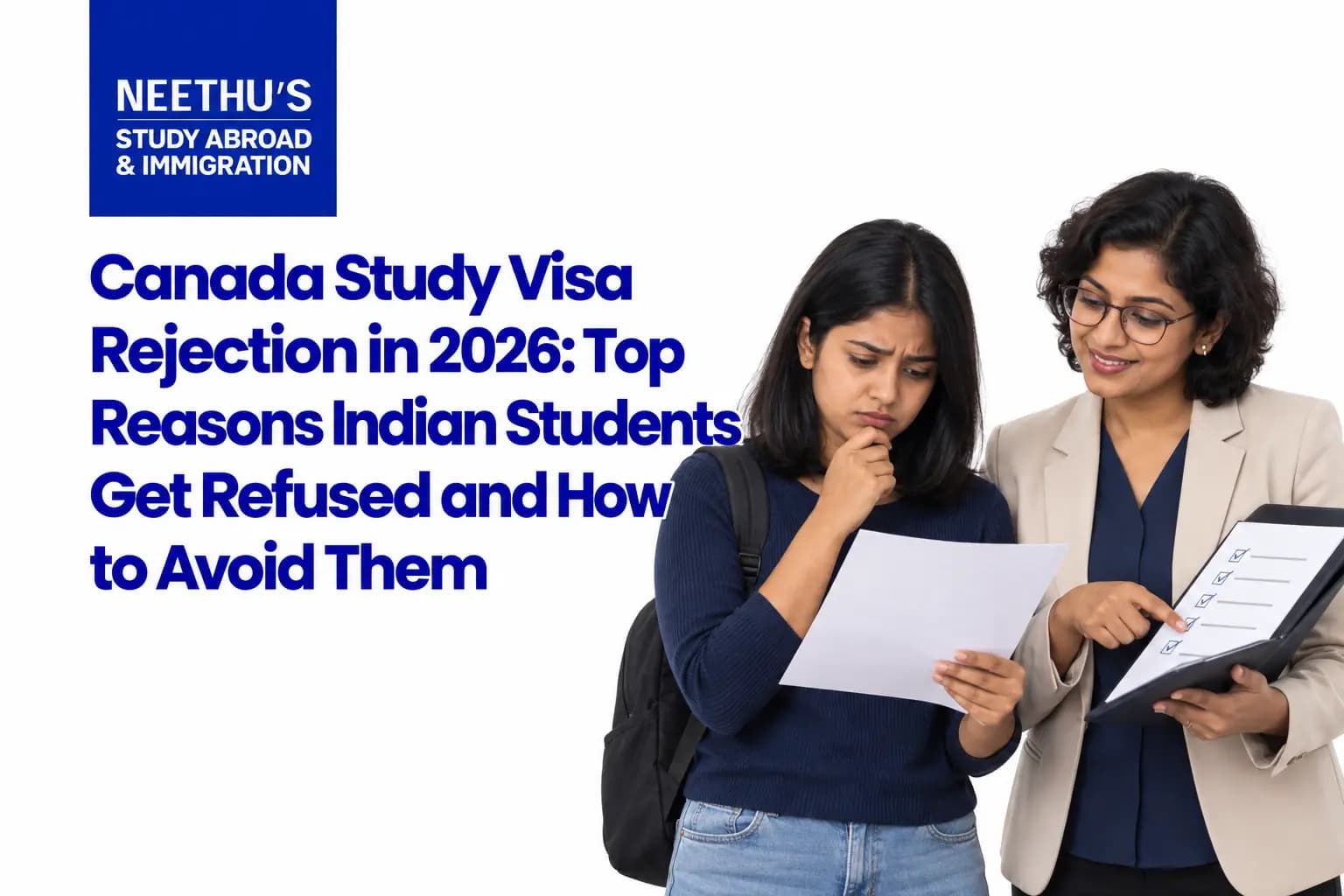
Canada continues to attract international students because of its universities, colleges, career-focused programmes, and multicultural environment. For Indian students, studying in Canada can offer valuable academic and professional opportunities. However, obtaining a Canadian study permit requires careful preparation, especially as immigration policies and application requirements continue to evolve.
A refusal does not necessarily mean that a student is academically unsuitable. An application may be refused when an immigration officer is not satisfied with the applicant's study plans, financial situation, temporary resident intentions or supporting documents. Understanding the Canada visa rejection reasons commonly encountered by applicants can help students identify weaknesses before submitting their applications.
The Canada student visa rejection reasons 2026 applicants should be aware of include an unclear study plan, insufficient financial evidence, questionable programme selection, inconsistent documentation, unexplained academic gaps and concerns about genuine study intentions. By preparing each part of the application carefully, students can reduce avoidable mistakes.Canada study visa rejection
What Has Changed for Canada Study Permits in 2026?
Canada's international student system has undergone significant changes since 2024. The government introduced a cap on study permit applications and strengthened requirements around financial capacity and documentation.
For eligible applicants, a Provincial Attestation Letter (PAL) or Territorial Attestation Letter (TAL) may be required, although exemptions exist for certain categories. Some students may also need specific documentation depending on their programme and institution.
Another important consideration is the financial requirement. Students must demonstrate that they can support themselves in Canada without relying on unauthorised work or uncertain sources of income.
Because immigration rules can change, applicants should always check the latest requirements on the official Government of Canada website before submitting an application.
1. Weak or Unclear Study Plan
One of the most important parts of a study permit application is demonstrating why the chosen programme makes sense for the applicant.
An application can become questionable if the selected course appears unrelated to previous education or work experience and the applicant does not provide a convincing explanation.
For example, a student with a business background applying for an unrelated technical programme should clearly explain why the new field is relevant to their career plans.
Your study plan should answer straightforward questions:
-
Why did you choose this programme?
-
Why is this programme appropriate for your background?
-
Why did you choose Canada?
-
Why did you select this particular institution?
-
How will the programme help your future career?
-
What are your plans after completing your studies?
Avoid copying generic statements from the internet. Your explanation should reflect your actual academic and professional goals.
2. Insufficient Proof of Funds
Financial concerns are another major issue in study permit applications.
Students must demonstrate that they have enough money to cover tuition, living expenses, transportation and other relevant costs. The source of the funds also matters.
Simply showing a large balance in a bank account shortly before applying may not be persuasive if there is no clear explanation of where the money came from.
Applicants should maintain proper financial records and be prepared to explain significant deposits or transfers.
Depending on the circumstances, supporting documents may include:
-
Bank statements
-
Education loan documents
-
Scholarship letters
-
Fixed-deposit records
-
Proof of income
-
Tax documents
-
Sponsor's financial records
-
Evidence explaining the source of funds
The objective is not simply to show money but to demonstrate that the funds are genuine, accessible and sufficient for the proposed period of study.
3. Concerns About Genuine Study Intent
Immigration officers need to be satisfied that the primary purpose of the application is genuinely to study.
This does not mean that students cannot have long-term career ambitions in Canada. However, the application should clearly establish the educational purpose of the proposed programme.
If the application focuses heavily on employment opportunities, permanent settlement or earning money in Canada while providing little explanation of the academic purpose, it may create concerns.
A strong application connects the programme with the student's previous education, professional experience and realistic career objectives.
4. Choosing a Programme That Does Not Make Sense
Programme selection can have a significant influence on how an application is viewed.
Students sometimes choose courses based mainly on tuition fees, availability or perceived immigration advantages. This can create questions when the programme does not fit their academic history.
A better approach is to research the curriculum carefully.
Look at the subjects covered, duration, career relevance and entry requirements. Then explain why the programme is a logical next step.
For applicants seeking a Canada student visa for Indian students, demonstrating academic progression can be particularly important when moving from one qualification to another.
5. Poor Academic Background or Unexplained Gaps
Academic performance is not the only factor considered in a study permit application, but unexplained inconsistencies can weaken an application.
If there is a long gap between studies, explain what happened during that period.
Perhaps you were working, preparing for competitive examinations, completing professional training or dealing with another legitimate circumstance. Provide supporting evidence wherever possible.
Similarly, if your recent academic performance differs significantly from your earlier results, explain the circumstances rather than leaving the officer to make assumptions.
6. Incomplete or Inconsistent Documentation
Even a strong student can face problems if the documents submitted with the application contain contradictions.
Check that details such as your name, dates, educational history, employment information and financial information are consistent throughout the application.
Common problems can include:
-
Missing documents
-
Incorrect dates
-
Unexplained financial transactions
-
Contradictory information
-
Poor-quality scans
-
Incomplete forms
-
Unclear translations
-
Unsupported claims
Before submission, create a document checklist and review every item carefully.
7. Weak Financial History
Having sufficient funds today is not necessarily enough.
An officer may also look at the financial history presented in the application. A sudden transfer of a substantial amount without evidence explaining its source can raise questions.
If parents are sponsoring the education, their income and financial capacity should reasonably support the amount being provided.
For education loans, include the relevant sanction or approval documents and clearly explain how the loan will contribute to tuition and living costs.
Transparency is preferable to trying to make the financial situation appear stronger than it actually is.
8. Problems With English or French Language Evidence
Depending on the institution and programme, students may need to provide proof of language proficiency.
An applicant should meet the language requirements specified by the educational institution. If a test score is part of the admission documentation, ensure that the information submitted to immigration authorities is accurate and consistent with the admission record.
A language score alone does not guarantee study permit approval, but discrepancies or questionable documentation can create additional concerns.
9. Failure to Demonstrate Ties and Temporary Intent
A study permit is temporary status. Applicants therefore need to demonstrate that they understand the conditions attached to their stay and have credible plans consistent with their circumstances.
This does not mean that every student must prove they will never return to Canada or pursue another legal immigration option in the future. Rather, the application should address the temporary nature of the study permit and provide a credible explanation of the student's circumstances and plans.
Family connections, career opportunities, professional commitments and other relevant circumstances may help establish the broader context.
10. Relying on Generic SOPs or Unverified Advice
A Statement of Purpose should tell your story—not somebody else's.
Using a template filled with impressive but vague sentences can make an application less convincing. Statements such as “Canada has world-class education” are not enough by themselves.
Instead, explain specific reasons for your programme and institution.
For example, discuss particular subjects in the curriculum, how they relate to your previous education and what skills you expect to develop.
Likewise, be cautious about advice promising guaranteed visa approval or claiming that a particular college or course automatically leads to immigration benefits.
No legitimate consultant can guarantee a study permit decision.
How to Avoid Canada Study Visa Rejection
The best way to reduce the risk of refusal is to prepare the application as one consistent story.
Start with your academic history. Identify the programme you genuinely want to study and explain why it represents a sensible progression.
Next, prepare your finances. Make sure the source of funds is documented and that your financial evidence supports the costs involved.
Then review your supporting documents for consistency.
Finally, read your application from an immigration officer's perspective. Does it clearly explain why you are studying this programme, why Canada is appropriate for your educational goals and how you will finance the experience?
If any major question remains unanswered, address it before submitting the application.
What to Do If Your Canada Study Visa Is Refused
Receiving a refusal can be disappointing, but it does not necessarily mean that you can never apply again.
First, carefully review the refusal information provided by Canadian immigration authorities. Identify the concerns that may have contributed to the decision.
Do not simply submit the same application again with minor changes.
If the previous application had weak financial evidence, improve the financial documentation. If the study plan was unclear, develop a more specific explanation. If there were inconsistencies, correct them and provide appropriate supporting evidence.
Depending on the circumstances, professional immigration advice may also be worthwhile, particularly if the refusal reasons are unclear or the case involves complicated documentation.
Key Checklist Before Applying in 2026
Before submitting your study permit application, check the following:
Academic fit: Is your programme a logical progression from your previous education or career?
Financial capacity: Can you clearly demonstrate sufficient funds and explain their source?
Study plan: Does your explanation provide specific and believable reasons for your programme and institution?
Documentation: Are all forms and supporting documents complete and consistent?
Language: Do you meet the institution's language requirements?
Temporary status: Have you addressed your circumstances and plans in relation to the temporary nature of your study permit?
Current rules: Have you checked the latest requirements directly through official Canadian immigration sources?
Final Thoughts
The Canada student visa rejection reasons 2026 applicants encounter are not limited to one particular mistake. Refusals can result from concerns about finances, study plans, programme selection, documentation, academic progression or the overall credibility of an application.
For Indian students, the safest approach is to build an application around genuine educational goals rather than trying to fit into a perceived visa formula.
A strong application should tell a consistent story: your previous education, your chosen programme, your reason for studying in Canada, your financial preparation and your future plans should all make sense together.
Rules and document requirements can change, so always verify the latest information through Canada's official immigration channels before applying. Careful preparation cannot guarantee approval, but it can help you avoid preventable errors and present your circumstances clearly.
Frequently Asked Questions
1. What are the most common Canada student visa rejection reasons in 2026?
Common reasons include insufficient financial evidence, an unclear study plan, weak academic progression, inconsistent documents, concerns about study intentions and failure to satisfy visa requirements.
2. Why is a Canada study visa rejected even after receiving an admission letter?
An admission letter confirms acceptance by an educational institution, but it does not guarantee study permit approval. Immigration officers separately assess finances, study plans, documentation and eligibility.
3. How can Indian students avoid Canada student visa rejection?
Students should provide genuine and consistent information, demonstrate sufficient funds, choose a programme that matches their background and clearly explain their academic and career objectives.
4. How much money should I show for a Canada study permit?
Applicants must demonstrate sufficient funds for tuition, living expenses and transportation. The required living-expense amount can change, so applicants should check the latest figures on the official Canadian immigration website.
5. Can a weak Statement of Purpose lead to visa refusal?
Yes. An unclear or generic study plan may make it difficult for an officer to understand why the applicant selected the programme, institution and destination.
6. Does a study gap affect a Canada study permit application?
A study gap does not automatically result in refusal. However, applicants should provide a credible explanation of what they did during the gap and include supporting evidence where appropriate.
7. Can I reapply after my Canada study permit is refused?
Yes, you can generally submit another application. Before reapplying, carefully review the refusal reasons and address the concerns rather than simply submitting the same application again.
8. Does choosing a private college increase the risk of Canada visa refusal?
The type of institution alone does not determine the outcome. Applicants should select a legitimate institution and programme that fits their academic background and explain their choice clearly.
9. Is IELTS score important for getting a Canada study permit?
Language proficiency can be relevant to admission and the overall application, but an IELTS score by itself does not guarantee study permit approval. The complete application is assessed.
10. Where can I check the latest Canada student visa requirements for 2026?
Applicants should use the official Government of Canada immigration website for the latest study permit requirements, financial rules, document requirements and application updates.


































































































































































































_03-12-2025_01-17-26%20PM.webp&w=3840&q=75)
_02-12-2025_03-07-49%20PM.webp&w=3840&q=75)

_27-11-2025_04-06-24%20PM.webp&w=3840&q=75)
_25-11-2025_04-38-18%20PM.webp&w=3840&q=75)
_24-11-2025_03-20-26%20PM.webp&w=3840&q=75)
_22-11-2025_12-44-47%20PM.webp&w=3840&q=75)
_21-11-2025_04-17-47%20PM.webp&w=3840&q=75)
_20-11-2025_03-55-26%20PM.webp&w=3840&q=75)
_18-11-2025_04-00-40%20PM.webp&w=3840&q=75)
_15-11-2025_10-48-43%20AM.webp&w=3840&q=75)
%20(1)_14-11-2025_03-52-25%20PM.webp&w=3840&q=75)
_13-11-2025_03-02-38%20PM.webp&w=3840&q=75)
_08-11-2025_04-15-36%20PM.webp&w=3840&q=75)
_05-11-2025_04-01-50%20PM.webp&w=3840&q=75)
_05-11-2025_03-46-26%20PM.webp&w=3840&q=75)
_03-11-2025_03-31-09%20PM.webp&w=3840&q=75)
_04-11-2025_.webp&w=3840&q=75)
_04-11-2025_.webp&w=3840&q=75)
_29-10-2025_04-52-52%20PM.webp&w=3840&q=75)
_28-10-2025_04-09-08%20PM.webp&w=3840&q=75)
_24-10-2025_05-10-31%20PM.webp&w=3840&q=75)
_24-10-2025_04-55-51%20PM.webp&w=3840&q=75)
_22-10-2025_04-40-20%20PM.webp&w=3840&q=75)
%20(1)_21-10-2025_03-05-46%20PM.webp&w=3840&q=75)
_21-10-2025_02-43-15%20PM.webp&w=3840&q=75)
_17-10-2025_05-08-52%20PM.webp&w=3840&q=75)
_17-10-2025_04-54-54%20PM.webp&w=3840&q=75)
_15-10-2025_03-46-47%20PM.webp&w=3840&q=75)
_14-10-2025_03-42-40%20PM.webp&w=3840&q=75)
_14-10-2025_03-29-48%20PM.webp&w=3840&q=75)
_13-10-2025_03-48-51%20PM.webp&w=3840&q=75)
_11-10-2025_04-28-42%20PM.webp&w=3840&q=75)
%20(1)_09-10-2025_04-12-08%20PM.webp&w=3840&q=75)

_07-10-2025_02-55-25%20PM.webp&w=3840&q=75)
_07-10-2025_02-39-51%20PM.webp&w=3840&q=75)
_06-10-2025_03-42-37%20PM.webp&w=3840&q=75)
_03-10-2025_04-42-59%20PM.webp&w=3840&q=75)
_01-10-2025_11-12-12%20AM.webp&w=3840&q=75)
%20(1)_29-09-2025_02-54-12%20PM.webp&w=3840&q=75)

_26-09-2025_12-14-18%20PM.webp&w=3840&q=75)
_24-09-2025_04-44-26%20PM.webp&w=3840&q=75)
_23-09-2025_04-14-36%20PM.webp&w=3840&q=75)
_22-09-2025_04-08-09%20PM.webp&w=3840&q=75)
_20-09-2025_03-26-03%20PM.webp&w=3840&q=75)
_17-09-2025_04-06-42%20PM.webp&w=3840&q=75)
_15-09-2025_04-43-43%20PM.webp&w=3840&q=75)
_13-09-2025_12-17-49%20PM.webp&w=3840&q=75)
_12-09-2025_04-31-36%20PM.webp&w=3840&q=75)
_12-09-2025_04-17-03%20PM.webp&w=3840&q=75)
_10-09-2025_03-59-59%20PM.webp&w=3840&q=75)
_09-09-2025_04-11-16%20PM.webp&w=3840&q=75)
_09-09-2025_03-53-52%20PM.webp&w=3840&q=75)




















































_12-06-2025_03-40-35%20PM.webp&w=3840&q=75)