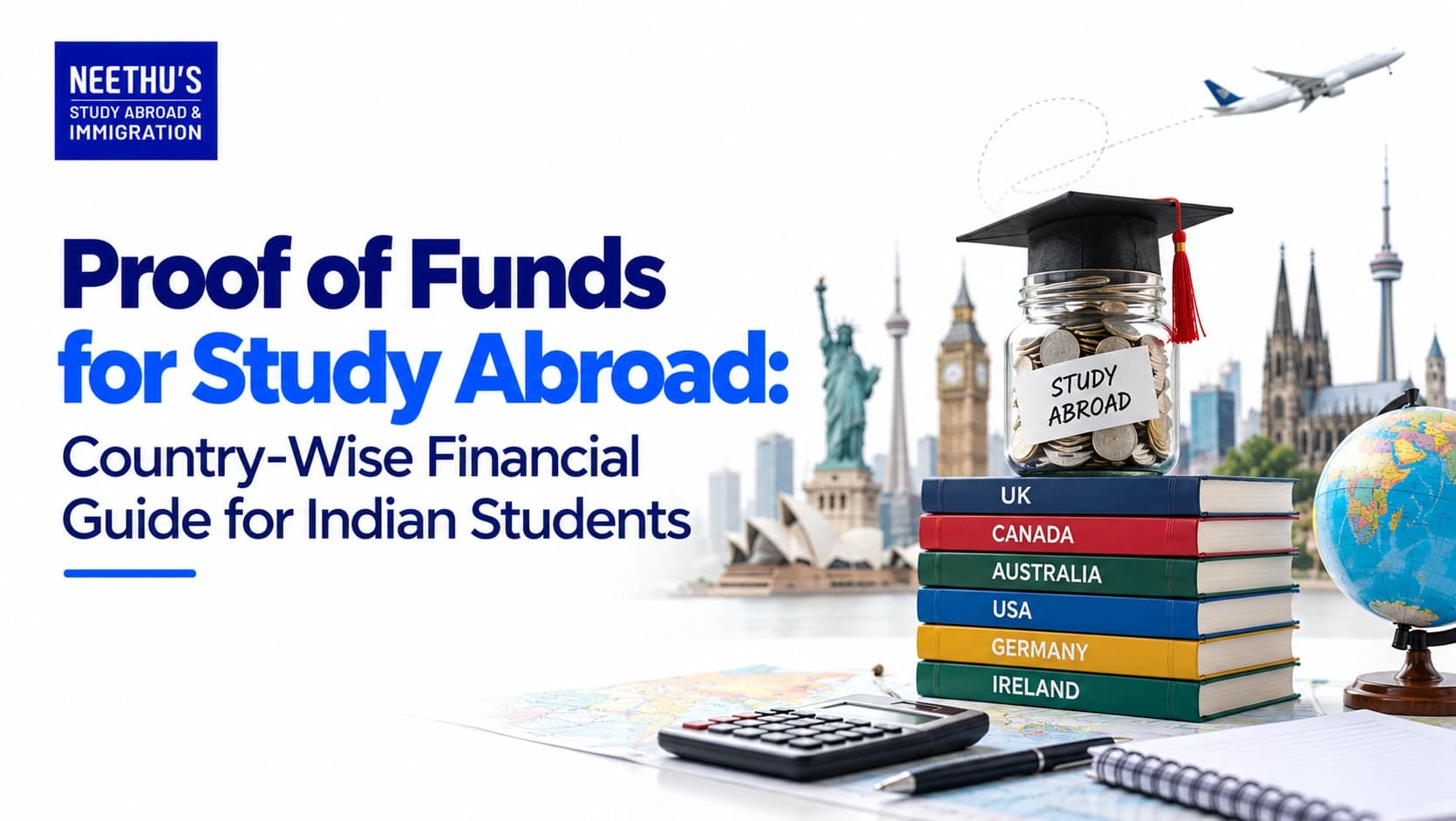
Proof of Funds for Study Abroad: Country-Wise Financial Guide for Indian Students
Studying in another country requires careful planning, including choosing the right programme, finding suitable accommodation and estimating everyday expenses. Besides meeting university admission requirements, students must also prepare financial documents for their visa applications. Many countries ask applicants to prove that they have sufficient funds to pay their tuition fees and manage their living costs throughout their studies.
The proof of funds for study abroad requirements are different in each destination. The amount students need to demonstrate may depend on tuition fees, living expenses, the length of the programme and whether family members will accompany them. Bank statements, education loans, scholarship awards and financial sponsorship documents are among the forms of evidence that may be accepted.
Indian students can avoid unnecessary financial pressure by understanding these requirements before applying. This guide explores six popular study destinations, explains the types of documents students may need and offers practical suggestions for organising their finances.
Understanding Proof of Funds
Proof of funds is financial evidence used to demonstrate that a student has access to money for education and living expenses. Immigration authorities may examine this information when deciding whether an applicant can meet the financial conditions of a student visa.
The evidence required depends on the country and the applicant's circumstances. It may include savings, eligible education loans, scholarship funding, sponsorship from an accepted source or money deposited in a designated blocked account.
Students should understand that a visa's minimum financial requirement is not necessarily the full amount needed for a comfortable student life. Rent, food, insurance, transport, study materials and unexpected expenses can increase the overall budget. It is therefore sensible to calculate the total cost of the programme rather than planning around the minimum figure alone.
Country-Wise Financial Requirements for International Students
1. United Kingdom
The UK requires most Student visa applicants to demonstrate that they can pay their outstanding course fees and cover their living expenses. The amount required for living costs depends on whether the student will be studying in London or elsewhere in the country.
The published requirement is approximately £1,529 per month in London and £1,171 per month outside London, for a maximum of nine months. This works out to approximately £13,761 and £10,539, respectively, for the living-cost component. Outstanding course fees must be considered separately.
Applicants generally need to show that the required money has been held for at least 28 consecutive days, with the end of that period falling within 31 days of the visa application. Eligible student loans and official financial sponsorship may also be accepted under the applicable rules.
These figures reflect the published requirements at the time of writing. Students should check the latest UK government guidance before applying, as financial thresholds and exemptions can change.
2. Canada
Students applying for a Canadian study permit must show that they can finance their education, living expenses and travel. They should demonstrate that their financial plan does not depend entirely on finding employment after arrival.
For applications submitted on or after 1 September 2026, a single applicant studying outside Quebec generally needs approximately CAD 23,448 for one year's living expenses, excluding tuition fees and transportation. The amount increases when eligible family members accompany the student. Quebec follows separate financial requirements.
Depending on the applicant's circumstances, supporting documents may include personal bank statements, education loan records, tuition payment receipts, eligible investment certificates, scholarship letters or sponsor documentation. Students enrolling in longer programmes should also explain how they intend to pay for subsequent years.
The living-cost figure is not the complete cost of studying in Canada. Applicants should check the latest Immigration, Refugees and Citizenship Canada guidance and calculate their tuition and travel expenses separately.
3. Australia
Australia assesses whether international students have sufficient financial resources to support their intended stay. Depending on the application, the financial assessment may cover living expenses, course fees, travel and the costs of eligible accompanying family members.
The published annual living-cost amount for a single student is approximately AUD 29,710, with tuition and travel costs considered separately. Additional financial amounts may apply to a spouse or dependent children.
Students may be able to provide evidence through eligible bank deposits, recognised education loans, scholarships or other accepted financial arrangements. In certain circumstances, evidence of eligible parental or partner income may also be used.
In addition to meeting the visa requirements, students should plan for rent, food, transport, Overseas Student Health Cover and personal spending. Actual expenses can vary substantially between Australian cities and accommodation types.
Before submitting their visa application, students should visit the Australian Department of Home Affairs website to check the latest financial requirements and verify which supporting documents apply to their situation.
4. United States
The financial preparation required for studying in the United States depends on the university, programme and location. F-1 student visa applicants must demonstrate that they can pay the costs associated with their education and living arrangements.
As a broad planning estimate, annual tuition and living expenses may total around US20,000toUS70,000 or more. This is not a government-set visa minimum. Some colleges and programmes cost less, while certain universities, professional courses and locations can be significantly more expensive.
Universities usually provide a cost-of-attendance estimate that includes relevant expenses such as tuition, accommodation, meals, insurance and books. This estimate helps students understand the financial resources needed for the programme and supports the institution's Form I-20 process.
Evidence may include personal or family bank statements, eligible education loans, scholarship awards and sponsorship documents. Students should follow their university's instructions carefully and ensure that their financial evidence reflects the actual cost of the chosen programme.
5. Germany
Germany offers international students several possible ways to demonstrate that they can cover their living expenses. A blocked account is a commonly used option, although a qualifying scholarship or another accepted form of financial support may be suitable in certain circumstances.
For relevant study visa applications in 2026, the commonly published blocked-account amount is approximately €11,904 for one year, equivalent to €992 per month. Applicants should confirm the applicable amount and accepted alternatives with the German mission responsible for their application.
Students must also consider their wider budget. Monthly spending may include rent, groceries, health insurance, public transport, study materials and other personal expenses. Costs differ between cities, and accommodation can be a major part of the budget.
Before opening a blocked account, students should verify the latest requirements with the German Federal Foreign Office or their responsible German mission. They should also check whether their individual circumstances permit another form of financial evidence.
6. Ireland
International students planning to study in Ireland must demonstrate that they have sufficient resources to support themselves throughout their stay.
For visa-required students attending academic courses lasting more than eight months, the published financial guidance requires access to at least €10,000 for one academic year, in addition to the applicable course fees. For courses lasting eight months or less, the requirement is generally calculated at approximately €833 per month, subject to the relevant limit.
Students planning longer courses should also provide information about how they will fund subsequent academic years. Depending on their circumstances, they may use bank statements, scholarship confirmations, eligible sponsorship records or other accepted evidence.
The minimum financial requirement should not be treated as a guarantee that the amount will cover every living expense. Accommodation costs, location, insurance, transport and personal spending can affect the total budget. Applicants should consult Ireland's official immigration guidance to confirm the latest requirements before applying.
Financial Documents Students Should Prepare
The exact documentation depends on the destination country, but students may need to organise the following records:
-
Bank statements: Statements covering the period specified by the relevant immigration authority.
-
Education loan evidence: Loan sanction letters and additional documentation required under the applicable rules.
-
Scholarship confirmation: An official letter stating the funding amount, duration and expenses covered.
-
Sponsor documentation: Financial records, proof of income and evidence of the relationship with the student, where applicable.
-
Fixed deposit records: Documents for deposits accepted by the relevant immigration authority.
-
Tuition payment receipts: Evidence of payments already made to the university.
-
Source-of-funds records: Documents explaining large deposits or other transactions if the authorities request clarification.
Students should make sure that all documents are genuine and consistent. Temporary arrangements designed only to inflate a bank balance, altered statements or misleading sponsorship information can put a visa application at risk.
Financial Planning Errors to Avoid
One of the most common errors is using outdated figures when calculating the required funds. Immigration rules can change, so students should verify the current requirements instead of relying solely on older articles or advice from social media.
Another problem is treating the minimum visa amount as the complete study budget. Even if a student meets the financial threshold, they may need additional money for accommodation deposits, travel, insurance and unexpected expenses.
Applicants should also check whether their intended source of funding is accepted. Not every type of bank account, loan or sponsorship arrangement meets every country's rules. Students who depend on family support should prepare the necessary sponsor records early.
Starting financial preparations well before the application deadline gives students time to arrange loans, collect statements and resolve inconsistencies in their documents.
How Indian Students Can Prepare for the Process
A practical starting point is to prepare a full budget for the chosen course and destination. Include tuition fees, accommodation, food, transportation, insurance, visa-related costs and an emergency reserve. Then compare this estimate with the official financial evidence requirements.
Students who need education loans should contact lenders early and understand the documentation and approval timelines. Those relying on family funding should gather the relevant financial and relationship records before the visa application stage.
For study abroad for Indian students, financial planning should start while comparing universities, not after receiving an admission offer. Students can also seek assistance from the Best study abroad consultants in kerala to understand application timelines, organise documents and learn about destination-specific procedures. However, the latest instructions from the relevant immigration authority should always be used to confirm visa requirements.
Conclusion
Preparing finances is an important part of the journey towards international education. The United Kingdom, Canada, Australia, the United States, Germany and Ireland have different approaches to assessing a student's financial capacity, and the documents accepted in one country may not be sufficient in another.
Understanding the approximate expenses early allows students to plan their savings, explore eligible loans and arrange financial sponsorship where permitted. It is equally important to distinguish between a visa's minimum financial threshold and the total amount needed to manage student life.
By preparing the proof of funds for study abroad documents in advance, keeping financial records transparent and checking current official requirements, Indian students can approach the application process with better preparation and a clearer understanding of their financial responsibilities.
FAQs
1. What is proof of funds for study abroad?
Proof of funds is a set of financial documents that demonstrates a student's ability to pay tuition fees, accommodation, living expenses and other costs while studying in another country.
2. Why do countries require financial proof for student visas?
Many countries require financial evidence to ensure that international students can support themselves during their studies without facing financial difficulties.
3. Which documents can be used as proof of funds?
Commonly accepted documents include bank statements, education loan sanction letters, scholarship letters, fixed deposit certificates and financial sponsorship documents. Requirements vary by country and visa category.
4. How much money should Indian students show for studying abroad?
The required amount depends on the destination country, tuition fees, course duration and living expenses. Students should check the latest official immigration guidelines before preparing their financial documents.
5. Can parents sponsor a student's education abroad?
Yes, many countries allow parents or other eligible sponsors to fund a student's education. Applicants may need to provide proof of the sponsor's income, bank balance, relationship to the student and willingness to cover expenses.
6. Is an education loan accepted as proof of funds?
An approved education loan may be accepted in several countries. However, the loan must meet the destination country's requirements, and students may need to provide an official sanction letter or other supporting documents.
7. How many months of bank statements are required for a student visa?
The required period differs by country. Some immigration authorities specify a particular number of months of bank statements or require funds to remain in the account for a minimum period. Always follow the current official guidelines.
8. Can students use fixed deposits to demonstrate financial capacity?
Fixed deposits may be accepted in certain countries, provided they meet the relevant rules for accessibility, ownership and documentation. Students should confirm whether their chosen visa category accepts them.
9. What happens if a student cannot provide sufficient financial proof?
If the submitted documents do not meet the visa requirements, the application may be delayed or refused. Students should review the financial criteria carefully and submit genuine, complete and verifiable documents.
10. Can study abroad consultants help with financial documentation?
Yes, experienced consultants can help students understand country-specific financial requirements, organise supporting documents and prepare for the visa process. Students should independently verify the latest rules through official government websites before applying.