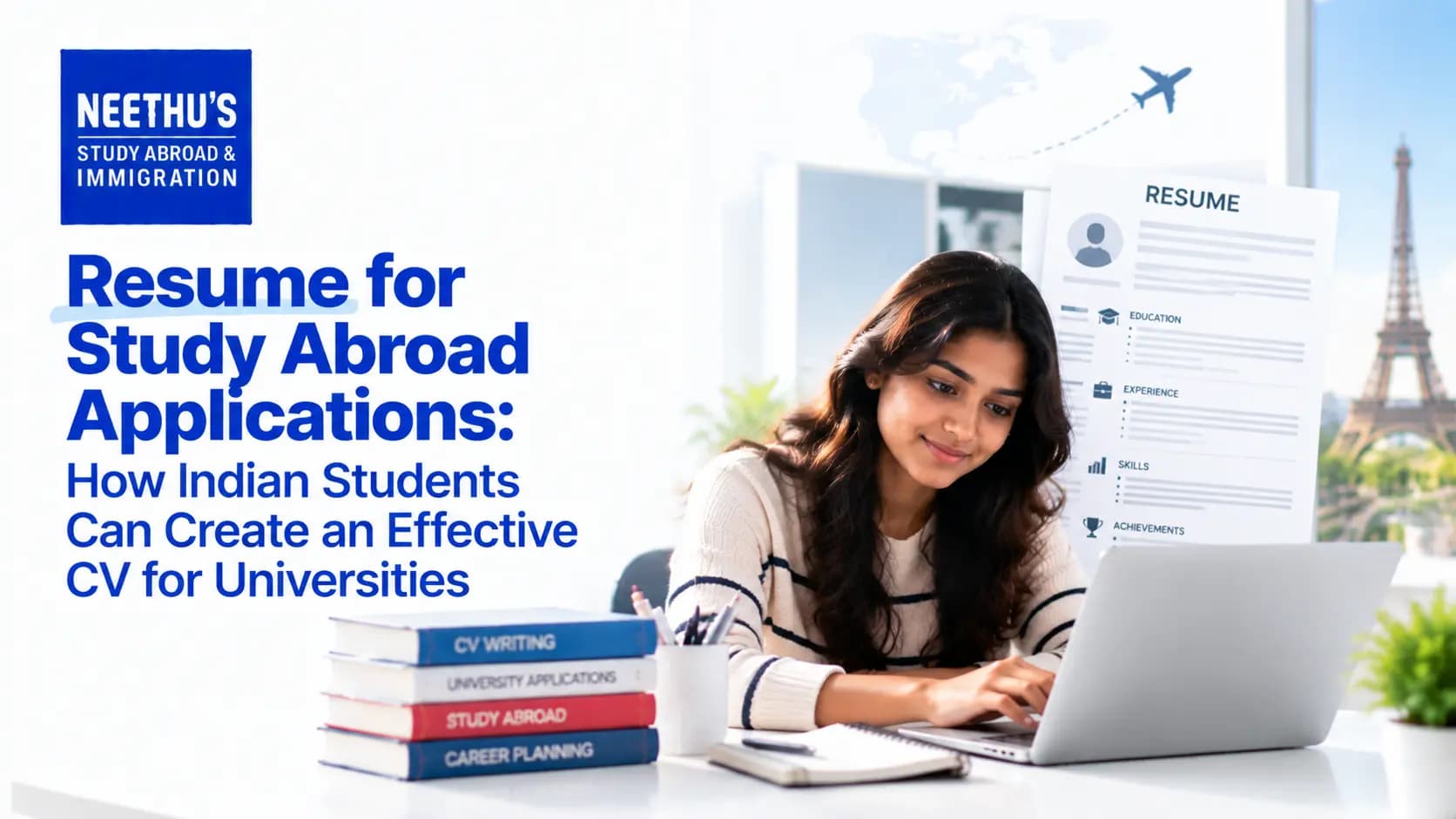
Resume for Study Abroad Applications: How Indian Students Can Create an Effective CV for Universities
Applying to a university overseas involves more than submitting academic transcripts and language test scores. Your application needs to present a clear picture of your education, skills, experience, achievements, and academic interests. One of the most important documents that brings these details together is your resume or CV.
For Indian students, preparing a university-focused resume can be different from creating a resume for a regular job application. Overseas universities are often interested in understanding an applicant's academic journey, projects, research exposure, extracurricular involvement, internships, leadership experience, and career goals.
A well-structured resume for study abroad application should therefore focus on relevant achievements rather than simply listing everything the student has done. The objective is to give the admissions team a concise overview of the applicant's background and demonstrate why their profile matches the chosen program.
Why Is a Resume Important for Study Abroad Applications?
Universities may receive applications from students with diverse academic and professional backgrounds. A resume allows admissions officers to quickly understand an applicant's qualifications beyond examination marks.
Depending on the program, a CV can highlight:
-
Academic achievements
-
Internships
-
Research experience
-
Academic projects
-
Professional experience
-
Technical skills
-
Certifications
-
Leadership roles
-
Volunteer activities
-
Extracurricular achievements
-
Publications and conferences
-
Relevant awards
A good resume does not need to contain every activity from school or college. Instead, it should prioritize experiences that demonstrate preparation for the intended course.
For example, an applicant applying for a master's degree in data science could highlight programming projects, data analysis experience, internships, relevant certifications, and research work rather than unrelated activities.
Resume vs CV: What Should Indian Students Submit?
The terms resume and CV are often used interchangeably, but their meaning can vary depending on the country and institution.
A resume is generally concise and focuses on the most relevant academic, professional, and extracurricular experiences. A CV can be more detailed and may include research publications, conferences, teaching experience, presentations, and other academic achievements.
Before preparing the document, students should check the university's application instructions. If the institution specifically requests a CV, follow that format. If it asks for a resume, avoid submitting an unnecessarily long academic document.
How to Structure a Study Abroad Resume
A clear structure makes it easier for an admissions officer to locate important information. A typical university application resume can contain the following sections.
Contact Information
Start with your name and professional contact details. Include:
-
Full name
-
Phone number
-
Professional email address
-
City and country
-
LinkedIn profile, if relevant
-
Portfolio or GitHub link, when applicable
Avoid unnecessary personal information such as marital status, religion, passport number, or family details unless the university specifically requests them.
Professional or Academic Summary
A short summary can introduce your academic background, area of interest, and relevant experience. Keep it focused on the program you are applying for.
For example, an engineering student applying for a master's program could briefly mention their degree, technical interests, project experience, and motivation for pursuing advanced study.
The summary should not be a collection of vague statements such as "hardworking and enthusiastic student." Specific information is more useful.
Education
For students applying directly after graduation, education is usually one of the most important sections.
Mention:
-
Degree name
-
University or college
-
Location
-
Graduation year
-
Relevant specialization
-
Academic achievements, where appropriate
You can also include relevant coursework if it demonstrates preparation for the intended program.
There is no need to list every subject studied during school unless the university specifically asks for that information.
How to Highlight Academic Projects
Academic projects can be particularly valuable for students with limited professional experience. Rather than simply mentioning the project title, explain what you worked on and what you contributed.
For example:
Student Performance Prediction System
Developed a machine-learning model to analyze academic data and predict student performance. Worked on data preprocessing, model development, testing, and interpretation of results.
This approach provides more information than simply writing "Completed a machine-learning project."
Whenever possible, mention technologies, methodologies, outcomes, or measurable results.
Internships and Work Experience
Students with internships or professional experience should describe responsibilities that are relevant to their intended course.
Each entry can include:
-
Organization name
-
Position
-
Duration
-
Major responsibilities
-
Key achievements
-
Relevant tools or technologies
Use action-oriented language. Words such as "developed," "analyzed," "designed," "managed," "implemented," "researched," and "coordinated" can make descriptions more precise.
However, do not exaggerate responsibilities or claim achievements that cannot be supported.
Skills Section
The skills section should be tailored to the selected program.
For example, a computer science applicant might include:
-
Python
-
Java
-
SQL
-
Machine learning
-
Data structures
-
Git
-
Cloud platforms
A business student might highlight:
-
Financial analysis
-
Market research
-
Excel
-
Business analytics
-
Project management
Avoid filling the section with basic skills that are not relevant to the program. The goal is to demonstrate useful abilities rather than create a long list of keywords.
Certifications and Achievements
Professional certifications can strengthen a resume when they are relevant to the chosen program.
Include the certification name, issuing organization, and completion year where appropriate.
Students can also mention:
-
Scholarships
-
Academic awards
-
Competitions
-
Research achievements
-
Conference participation
-
Publications
-
Relevant online courses
Prioritize meaningful achievements instead of adding every certificate earned online.
Extracurricular Activities and Leadership
Universities may also consider activities outside academics, particularly when they demonstrate leadership, initiative, teamwork, or community involvement.
Examples include:
-
Student clubs
-
Sports
-
Cultural organizations
-
Volunteering
-
Event coordination
-
Student leadership
-
Community projects
Describe your role rather than simply listing the organization. For example, "Coordinated a student technology workshop attended by 100 participants" provides more useful information than "Member of technology club."
How to Write Resume for Overseas Education
Students often ask How to write resume for overseas education when they have little professional experience. The answer is to focus on transferable evidence rather than trying to make the document look artificially experienced.
Fresh graduates can emphasize academic projects, internships, laboratory work, research assignments, certifications, competitions, volunteering, and leadership activities.
Students with professional experience should give more attention to career achievements and responsibilities that relate to their intended program.
The resume should also be customized according to the course. A generic resume sent to every university may not effectively communicate why your background is relevant to each program.
Formatting Tips for Indian Students
A professional appearance matters. Use a simple layout with consistent headings, readable fonts, and sufficient spacing.
Keep formatting consistent for:
-
Dates
-
Job titles
-
University names
-
Section headings
-
Bullet points
Unless a university specifies otherwise, avoid excessive colors, decorative graphics, photographs, logos, and complicated designs.
A clean document makes the information easier to read and gives the admissions team more time to focus on your qualifications.
Common Resume Mistakes to Avoid
Students can unintentionally weaken their applications through small errors. Common mistakes include:
Making the Resume Too Long
A long resume does not necessarily demonstrate a stronger profile. Remove information that is unrelated to the intended course.
Including False Information
Never exaggerate grades, job responsibilities, project outcomes, or certifications. Universities may verify application information.
Using Grammatical Errors
Spelling and grammar mistakes can affect the professional presentation of your application. Proofread the document carefully before submitting it.
Using One Resume for Every Program
Different programs may value different experiences. Adjust the emphasis according to the course and university.
Adding Unnecessary Personal Details
Information such as age, marital status, religion, or family details is generally unnecessary unless specifically requested.
Final Checklist Before Submission
Before uploading your resume for study abroad application, review the document carefully.
Check whether:
-
Your contact details are accurate.
-
Education information matches your official documents.
-
Dates are consistent throughout the application.
-
Relevant projects are clearly explained.
-
Skills match the intended program.
-
Achievements are supported by genuine evidence.
-
Grammar and spelling have been checked.
-
Formatting is consistent.
-
The file meets the university's requirements.
-
The final document has an appropriate filename.
Students can also ask professors, mentors, or experienced application professionals to review the document for clarity.
If you are working with study abroad consultants in kerala, they may provide guidance on university documentation and application preparation. However, students should ensure that all information in the final resume accurately reflects their own academic and professional background.
How to Make Your Resume More Effective
The strongest university resumes are focused rather than overloaded. Every section should contribute something useful to the application.
Start by identifying the requirements of your target program. Then select academic projects, internships, skills, research work, and achievements that demonstrate your preparation for that field.
When considering How to write resume for overseas education, remember that admissions teams are not simply looking for a list of qualifications. They want to understand the applicant's academic journey and determine whether their background aligns with the program.
Use specific examples wherever possible. Instead of saying "excellent communication skills," mention a presentation, conference, project, or leadership activity that demonstrates communication ability.
Similarly, instead of saying "experienced in programming," identify the languages, projects, applications, or systems you have actually worked with.
Conclusion
Creating an effective university resume requires more than transferring information from an existing job CV. Indian students should approach the document as an academic application tool that presents their education, experiences, achievements, and interests in a clear and relevant manner.
A well-organized resume for study abroad application should be concise, accurate, customized, and easy to read. Focus on evidence rather than generic descriptions, highlight experiences connected to your intended program, and carefully follow the university's formatting instructions.
With thoughtful preparation and careful proofreading, your resume can provide admissions teams with a clear understanding of your background and help complete a strong study abroad application.
FAQs
1. What should an Indian student include in a study abroad resume?
A study abroad resume should generally include contact details, education, academic or professional experience, projects, relevant skills, certifications, achievements, research experience, and extracurricular activities. The exact sections depend on the university and program.
2. How long should a resume for studying abroad be?
For most university applications, a concise one- to two-page resume is sufficient. Students with extensive research, professional experience, or publications may need a longer CV if the university specifically requests one.
3. Should freshers include internships and academic projects in their resume?
Yes. Internships, academic projects, research assignments, workshops, and relevant coursework can be valuable for students who have limited professional experience.
4. Should I include my 10th and 12th standard details in a study abroad resume?
It depends on your academic background and the university's requirements. For postgraduate applications, your undergraduate degree and relevant higher education are generally more important. School qualifications can usually be omitted unless specifically requested.
5. Should I add a photo to my study abroad resume?
Generally, avoid adding a photograph unless the university or application guidelines specifically request one. A clean, professional resume without unnecessary personal information is usually preferable.
6. What skills should I include in my overseas university resume?
Include skills that are relevant to your intended program, such as programming languages, research methods, analytical tools, laboratory techniques, software, languages, or project-management skills. Avoid listing skills you cannot demonstrate through your experience.
7. Can I use the same resume for every university application?
You can use the same basic resume structure, but it is better to customize the content for each program. Give greater emphasis to projects, skills, research, and experiences that relate to the specific course.
8. Should I include extracurricular activities in my study abroad CV?
Yes, if they demonstrate useful qualities such as leadership, teamwork, initiative, communication, or community involvement. Focus on meaningful activities rather than listing every club or event you have participated in.
9. What are common mistakes in a study abroad resume?
Common mistakes include excessive length, grammatical errors, inconsistent dates, irrelevant information, unsupported claims, poor formatting, unnecessary personal details, and using the same generic content for unrelated programs.
10. How can I make my resume stronger for an overseas university application?
Focus on relevant achievements and provide specific details about your projects, internships, research, skills, and responsibilities. Keep the formatting simple, verify all information against your official documents, proofread carefully, and follow the university's specific resume or CV requirements.






















































































_03-12-2025_01-17-26%20PM.webp&w=3840&q=75)
_02-12-2025_03-07-49%20PM.webp&w=3840&q=75)

_27-11-2025_04-06-24%20PM.webp&w=3840&q=75)
_25-11-2025_04-38-18%20PM.webp&w=3840&q=75)
_24-11-2025_03-20-26%20PM.webp&w=3840&q=75)
_22-11-2025_12-44-47%20PM.webp&w=3840&q=75)
_21-11-2025_04-17-47%20PM.webp&w=3840&q=75)
_20-11-2025_03-55-26%20PM.webp&w=3840&q=75)
_18-11-2025_04-00-40%20PM.webp&w=3840&q=75)
_15-11-2025_10-48-43%20AM.webp&w=3840&q=75)
%20(1)_14-11-2025_03-52-25%20PM.webp&w=3840&q=75)
_13-11-2025_03-02-38%20PM.webp&w=3840&q=75)
_08-11-2025_04-15-36%20PM.webp&w=3840&q=75)
_05-11-2025_04-01-50%20PM.webp&w=3840&q=75)
_05-11-2025_03-46-26%20PM.webp&w=3840&q=75)
_03-11-2025_03-31-09%20PM.webp&w=3840&q=75)
_04-11-2025_.webp&w=3840&q=75)
_04-11-2025_.webp&w=3840&q=75)
_28-10-2025_04-09-08%20PM.webp&w=3840&q=75)
_24-10-2025_05-10-31%20PM.webp&w=3840&q=75)
_24-10-2025_04-55-51%20PM.webp&w=3840&q=75)
_22-10-2025_04-40-20%20PM.webp&w=3840&q=75)
%20(1)_21-10-2025_03-05-46%20PM.webp&w=3840&q=75)
_21-10-2025_02-43-15%20PM.webp&w=3840&q=75)
_17-10-2025_05-08-52%20PM.webp&w=3840&q=75)
_17-10-2025_04-54-54%20PM.webp&w=3840&q=75)
_15-10-2025_03-46-47%20PM.webp&w=3840&q=75)
_14-10-2025_03-42-40%20PM.webp&w=3840&q=75)
_14-10-2025_03-29-48%20PM.webp&w=3840&q=75)
_13-10-2025_03-48-51%20PM.webp&w=3840&q=75)
_11-10-2025_04-28-42%20PM.webp&w=3840&q=75)
%20(1)_09-10-2025_04-12-08%20PM.webp&w=3840&q=75)

_07-10-2025_02-55-25%20PM.webp&w=3840&q=75)
_07-10-2025_02-39-51%20PM.webp&w=3840&q=75)
_06-10-2025_03-42-37%20PM.webp&w=3840&q=75)
_03-10-2025_04-42-59%20PM.webp&w=3840&q=75)
_01-10-2025_11-12-12%20AM.webp&w=3840&q=75)
%20(1)_29-09-2025_02-54-12%20PM.webp&w=3840&q=75)
_26-09-2025_12-14-18%20PM.webp&w=3840&q=75)
_24-09-2025_04-44-26%20PM.webp&w=3840&q=75)
_23-09-2025_04-14-36%20PM.webp&w=3840&q=75)
_22-09-2025_04-08-09%20PM.webp&w=3840&q=75)
_20-09-2025_03-26-03%20PM.webp&w=3840&q=75)
_17-09-2025_04-06-42%20PM.webp&w=3840&q=75)
_15-09-2025_04-43-43%20PM.webp&w=3840&q=75)
_13-09-2025_12-17-49%20PM.webp&w=3840&q=75)
_12-09-2025_04-31-36%20PM.webp&w=3840&q=75)
_12-09-2025_04-17-03%20PM.webp&w=3840&q=75)
_10-09-2025_03-59-59%20PM.webp&w=3840&q=75)
_09-09-2025_04-11-16%20PM.webp&w=3840&q=75)
_09-09-2025_03-53-52%20PM.webp&w=3840&q=75)




























_12-06-2025_03-40-35%20PM.webp&w=3840&q=75)