
Preparing your study abroad journey…
Preparing your study abroad journey…
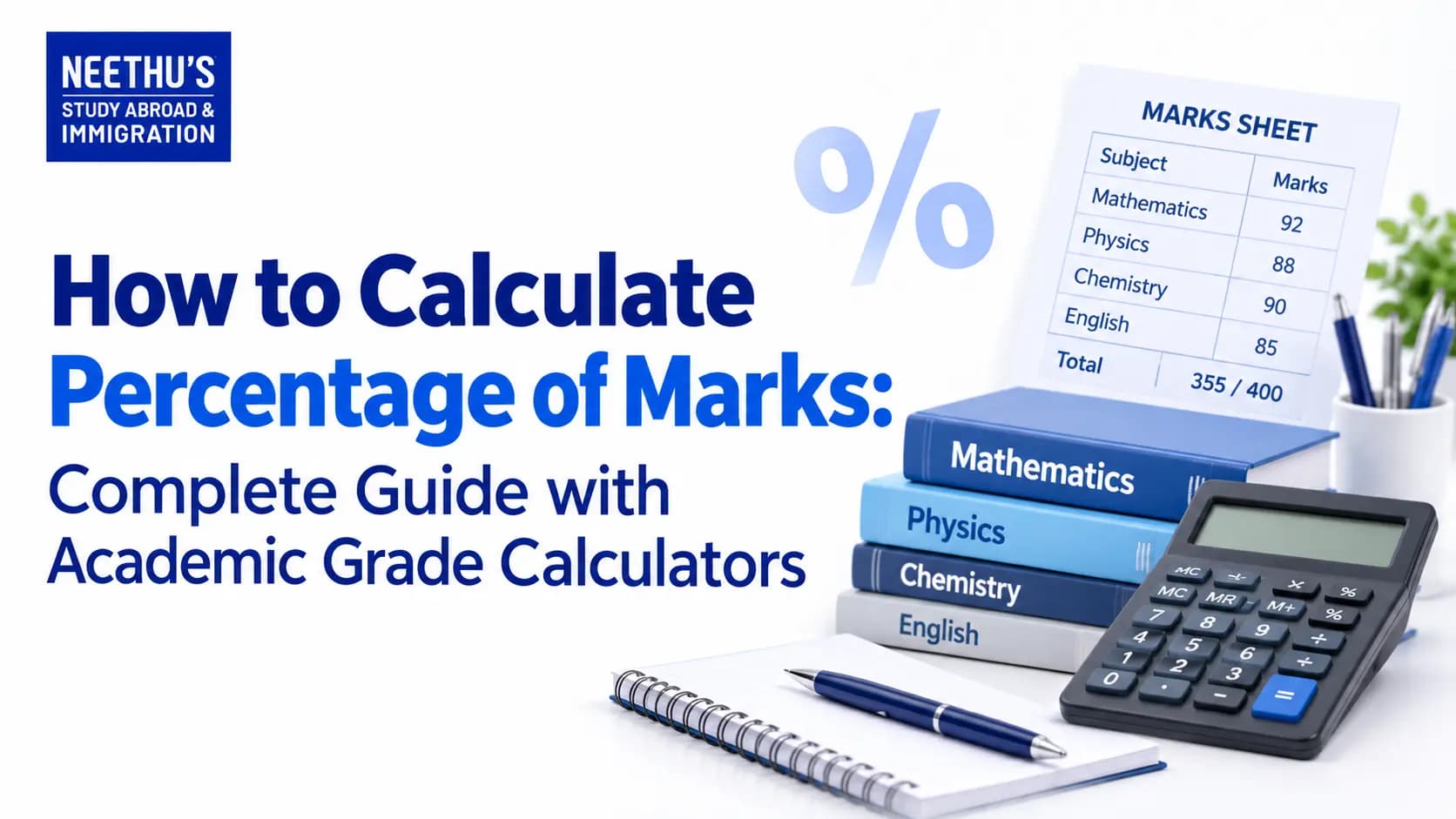
Calculating academic percentages is an important part of understanding examination performance. Whether students are checking their school results, applying for university admission or preparing documents for overseas education, knowing how to calculate marks accurately can make a significant difference. Academic institutions use different grading systems, including percentages, Grade Point Average (GPA), Cumulative Grade Point Average (CGPA) and Semester Grade Point Average (SGPA).
Students often find it confusing to convert one grading system into another, particularly when applying to universities in different countries. Understanding these calculations can help students compare academic performance and prepare their applications more effectively.
Learning How to Calculate Percentage of Marks is straightforward once you understand the basic formula. In addition to percentage calculations, several online tools can help students convert marks into grades, calculate cumulative scores and understand international academic requirements. This guide explains these calculations and introduces useful academic calculators.
A percentage represents a student's performance in relation to the total marks available. It expresses the obtained marks as a value out of 100.
The basic formula is:
Percentage = (Marks Obtained ÷ Total Maximum Marks) × 100
For example, suppose a student scores 425 marks out of 500.
Percentage = (425 ÷ 500) × 100
Percentage = 85%
Therefore, the student's overall percentage is 85%.
Students can use the same formula regardless of the examination or subject. The important requirement is to know the total maximum marks.
For example:
Marks obtained: 720
Maximum marks: 900
Percentage = (720 ÷ 900) × 100
Final percentage = 80%
This method is useful for calculating school examination results, university assessments and entrance examination scores.
The easiest method is to divide the marks obtained by the maximum marks and multiply the result by 100.
Students can also use an online percentage calculator to avoid manual calculation errors. They simply need to enter their obtained marks and total marks to receive the result instantly.
Understanding this calculation is useful when completing university applications, scholarship forms and academic documentation.
A Percentage to Marks Calculator helps students determine the actual marks corresponding to a particular percentage.
The formula is:
Marks Obtained = (Percentage × Total Marks) ÷ 100
For example, if a student wants to calculate 75% of an examination carrying 800 marks:
Marks = (75 × 800) ÷ 100
Result = 600 marks
This calculator is useful when students know their percentage but need to identify the equivalent marks for admission applications or academic comparisons.
CGPA and GPA are grading systems used by educational institutions to evaluate academic performance. CGPA generally represents performance across multiple semesters, while GPA may refer to an individual semester or an overall grade-point average, depending on the institution.
A CGPA to GPA Calculator helps students understand the relationship between these grading systems.
However, there is no single conversion formula applicable to every university. Some institutions use a 4.0 scale, while others follow 5.0, 7.0, 10.0 or different grading systems.
Students should use the conversion method specified by their university or receiving institution.
A GPA Calculator helps students calculate their Grade Point Average using individual course grades and credit hours.
The commonly used weighted GPA formula is:
GPA = Total of (Grade Points × Credit Hours) ÷ Total Credit Hours
For example:
|
Subject |
Grade Points |
Credits |
|
Mathematics |
4.0 |
3 |
|
English |
3.5 |
2 |
|
Science |
3.0 |
3 |
Total weighted points = 12 + 7 + 9 = 28
Total credits = 8
GPA = 28 ÷ 8 = 3.50
This calculation helps students understand their academic performance while considering the credit value of each subject.
SGPA stands for Semester Grade Point Average, whereas CGPA represents the cumulative academic performance across multiple semesters.
An SGPA to CGPA Calculator helps students determine their overall grade-point average after completing several semesters.
When all semesters carry equal credits, a simple average may be appropriate:
CGPA = Sum of Semester GPAs ÷ Number of Semesters
For example, consider the following scores:
Semester 1: 7.5
Semester 2: 8.0
Semester 3: 8.2
Semester 4: 7.8
CGPA = (7.5 + 8.0 + 8.2 + 7.8) ÷ 4
CGPA = 7.875
If semester credit totals differ, the cumulative GPA should be calculated using credit-weighted values instead.
A Cumulative GPA Calculator measures a student's overall academic performance across completed courses or semesters.
Unlike a calculator that considers only one semester, this tool includes previous academic results and their corresponding credit hours.
The formula is:
Cumulative GPA = Total Earned Grade Points ÷ Total Attempted Credit Hours
For example, if a student earns 120 grade points across 35 credit hours:
Cumulative GPA = 120 ÷ 35
Result = 3.43
This calculator is particularly useful for students applying for postgraduate programmes, scholarships and international university admissions.
A CGPA to Percentage Calculator converts cumulative grade points into an equivalent percentage.
However, conversion methods differ between universities and education boards. Some institutions provide an official multiplication factor, while others use a prescribed conversion formula.
For example, if a university specifies the formula:
Percentage = CGPA × 9.5
A student with a CGPA of 8.0 would receive:
8.0 × 9.5 = 76%
Students should always check their university's official conversion guidelines rather than assuming that the same formula applies everywhere.
An SGPA to Percentage Calculator converts semester grade points into an equivalent percentage.
The calculation depends on the grading regulations followed by the educational institution.
For example, if the university uses the conversion formula:
Percentage = (SGPA − 0.5) × 10
For an SGPA of 8.0:
Percentage = (8.0 − 0.5) × 10
Result = 75%
This is only an illustrative formula. Students must use the conversion method officially prescribed by their university.
The World Education Services (WES) GPA Calculator helps students understand how their academic grades may be represented on a different grading scale.
WES evaluates international educational credentials for purposes such as university admission and professional recognition. Its credential evaluation process considers factors such as the country of education, institution, qualification and academic records.
Students should understand that converting a percentage directly into a US GPA using a simple formula may not produce an official WES result.
For an accurate evaluation, applicants should follow the current WES requirements and submit the requested academic documents. The final assessment depends on the credential evaluation methodology used by WES.
A CGPA to Marks Calculator helps students estimate the equivalent marks associated with their cumulative grade points.
The conversion depends on the institution's prescribed formula.
For example, if a university specifies that percentage equals CGPA multiplied by 10, a student with a CGPA of 8.2 would have an equivalent percentage of 82%.
If the maximum marks are 1,000:
Equivalent marks = (82 ÷ 100) × 1,000
Result = 820 marks
This calculation should be treated as an estimate unless the university officially recognises the conversion formula.
A Percentage to GPA Calculator helps students understand how their percentage-based academic results may translate into a GPA scale.
Many international universities use a 4.0 grading system, but their conversion policies differ.
For instance, one institution may consider 85% equivalent to an A grade, while another may use a different percentage range.
Students applying abroad should check the receiving university's grading requirements instead of relying on a universal percentage-to-GPA formula.
The IELTS to CLB Calculator helps candidates compare their IELTS scores with the Canadian Language Benchmarks (CLB).
CLB is a Canadian standard used to describe English-language proficiency for immigration and other purposes.
The conversion considers individual IELTS scores in:
Listening
Reading
Writing
Speaking
For example, IELTS General Training scores of Listening 8.0, Reading 7.0, Writing 7.0 and Speaking 7.0 correspond to CLB 9 in all four abilities.
Candidates should remember that CLB conversion requirements can vary depending on the immigration programme. They must use the correct IELTS test type and refer to the official Canadian immigration conversion table.
Understanding academic calculations is essential for students evaluating their examination results and preparing for higher education. From basic percentage calculations to GPA, CGPA and international grading conversions, each system provides a different way of representing academic performance.
Learning How to Calculate Percentage of Marks can help students interpret their results, while specialised calculators make it easier to understand different grading systems. However, conversion formulas should always be checked against the rules of the relevant university or evaluating organisation.
Students planning to study overseas should also pay attention to international admission requirements and language proficiency standards. Guidance from the Best study abroad consultants in kerala can help applicants understand academic documentation, university eligibility and other important stages of the study abroad process.
1. How do I calculate the percentage of marks?
Divide the marks obtained by the total maximum marks and multiply the result by 100. For example, 450 out of 500 equals 90%.
2. How can I calculate percentage from marks obtained?
Use the formula: (Marks Obtained ÷ Total Marks) × 100. Enter the two values into a percentage calculator to get the result.
3. What is the easiest way to calculate percentage?
The easiest method is to divide your obtained marks by the maximum marks and multiply by 100.
4. How do I convert percentage into marks?
Multiply the percentage by the total maximum marks and divide by 100.
5. What is the difference between GPA and CGPA?
GPA generally represents academic performance over a semester or defined period, while CGPA represents cumulative performance across multiple semesters or courses.
6. How can I convert CGPA into a percentage?
Multiply the CGPA by the conversion factor prescribed by your university. The formula varies between institutions.
7. How is SGPA converted into CGPA?
When all semesters have equal credits, calculate the average of the semester GPAs. If credits differ, use a credit-weighted calculation.
8. What is a WES GPA Calculator?
It is a tool intended to help students understand GPA conversions for international credential evaluation. Official WES assessments follow their own evaluation procedures.
9. Can percentage be converted directly into a 4.0 GPA?
There is no universal conversion formula. The result depends on the grading policy of the university or credential evaluation organisation.
10. What is the purpose of an IELTS to CLB Calculator?
It helps candidates compare their IELTS General Training scores with Canadian Language Benchmark levels for English proficiency and relevant immigration requirements.