Preparing your study abroad journey…
Preparing your study abroad journey…
The International English Language Testing System (IELTS) is one of the most widely accepted English proficiency tests for people planning to study, work, or settle in another country. Universities, employers and immigration authorities use IELTS results to assess whether applicants can communicate effectively in English. However, the score needed is not the same for every purpose. A university may ask for a particular overall band, while a professional registration body or visa authority may require minimum scores in each individual section.
Understanding the IELTS score requirements before booking the test can help you prepare with a clear target. Whether you are applying to a university, exploring overseas employment or considering IELTS for immigration, your destination, course, occupation and visa category all influence the score you need. This guide explains how IELTS works and what applicants should consider when choosing a target score for education, employment and immigration.
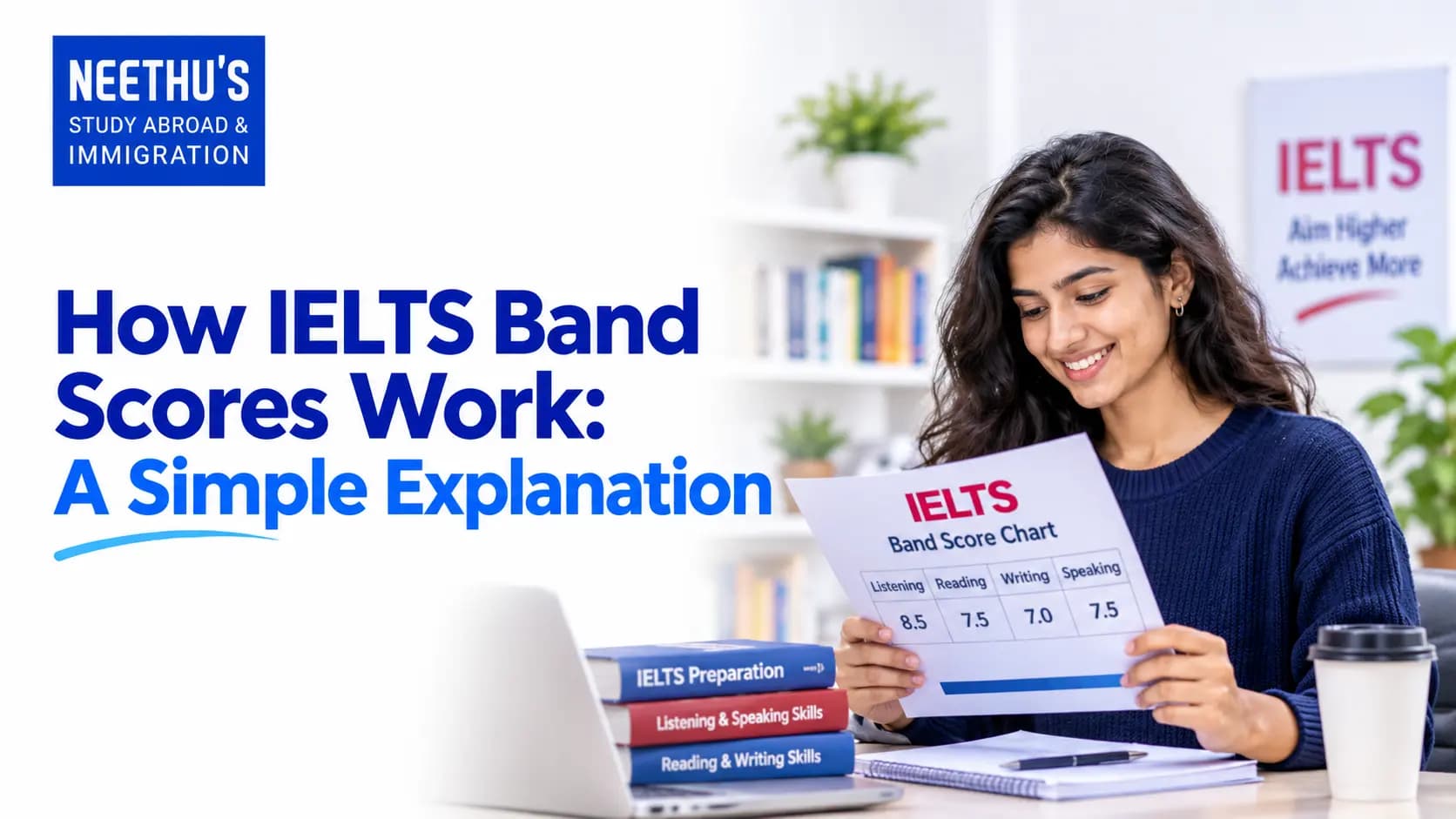
IELTS assesses four language skills: Listening, Reading, Writing and Speaking. Each section receives a band score from 0 to 9, with 9 representing an expert level of English proficiency. Your overall band score is calculated from the average of the four section scores and rounded to the nearest half or whole band.
For example, if your section scores are 7.0, 6.5, 6.0 and 7.5, your average is 6.75, which is rounded to an overall band score of 7.0.
Here is a general explanation of the band levels:
|
Band score |
English proficiency |
|
9 |
Expert user |
|
8 |
Very good user |
|
7 |
Good user |
|
6 |
Competent user |
|
5 |
Modest user |
|
4 |
Limited user |
|
3 or below |
Extremely limited to non-user |
An important point is that an acceptable overall score does not always mean you have met the requirement. Some institutions and authorities specify a minimum score for every section. For instance, an applicant might need an overall 6.5 with no individual section below 6.0.
Universities use English proficiency scores to determine whether international students can understand lectures, participate in discussions, complete assignments and communicate academically. The required band score depends on the country, institution, course level and subject.
For IELTS for study abroad, students should check the entry criteria of their chosen university rather than rely on a general country-level score. A university may accept an overall 6.0 for one undergraduate programme but ask for 7.0 or higher for a postgraduate course.
Many UK universities commonly ask international undergraduate and postgraduate applicants for an overall IELTS score between 6.0 and 7.0. Some programmes may also require a minimum score in each section.
Courses involving extensive communication, academic writing or professional practice may have higher English language requirements. Applicants should check the university's course page and any additional requirements for their programme.
Canadian universities and colleges often require an overall score around 6.0 to 6.5 for many undergraduate programmes. Postgraduate courses may ask for 6.5 or 7.0, depending on the institution and subject.
Professional programmes, including nursing and other healthcare-related courses, may have separate language requirements. Students should also distinguish between university admission criteria and the language conditions attached to immigration applications.
Australian universities commonly set IELTS requirements between 6.0 and 7.0 for different academic programmes. Certain courses, particularly those connected with healthcare, education and professional registration, may require higher scores or minimum section bands.
Students applying to Australian institutions should confirm whether the university accepts IELTS Academic and whether any additional English language conditions apply.
IELTS is accepted by many universities in the United States, although requirements vary considerably. Some institutions accept an overall score of approximately 6.0, while competitive universities and specialised programmes may ask for 7.0 or above.
Applicants should check whether the university accepts IELTS Academic and whether the selected department has additional requirements.
English communication is important in international workplaces, particularly in healthcare, education, customer service and professional environments. Employers may request an IELTS result to assess an applicant's ability to communicate with colleagues, clients and customers.
However, there is no single IELTS score that applies to every job or country. Some employers do not require IELTS at all, while regulated professions may have strict language standards set by professional authorities.
For example, nurses and other healthcare professionals may need to demonstrate English proficiency before they can register or practise in countries such as the UK, Australia or New Zealand. These requirements can differ from the scores required for a general work visa.
A candidate applying for an office-based role may be assessed through an interview or another language test instead of IELTS. Therefore, applicants should confirm whether the employer, licensing authority, or visa route specifically accepts IELTS and which test format is required.
Healthcare workers often face higher language expectations because their jobs involve communicating with patients, explaining treatment and understanding clinical instructions. Nurses, doctors and other regulated professionals may need to meet separate Listening, Reading, Writing and Speaking requirements.
Some registration bodies accept IELTS Academic, while others may provide specific rules about test dates, combined test sittings or minimum component scores. Candidates should review the latest guidance from the relevant professional regulator before scheduling an exam.
Many countries use English language tests as part of their immigration systems. The required score depends on the visa category, the applicant's circumstances, and the immigration authority's approved testing rules.
IELTS for immigration should not be treated as a single universal requirement. A score that is sufficient for a student visa may not be enough for skilled migration, permanent residency or professional registration.
The UK uses English language requirements across several visa routes. The required level depends on the type of application and the rules applicable to that route. Applicants may need to take an approved Secure English Language Test (SELT), and not every IELTS test is suitable for every immigration purpose.
Before booking, check whether the visa category requires IELTS for UKVI or another approved test. Also confirm the required English level and whether the test must be taken at an approved location.
Canada uses approved language tests for several immigration programmes, including economic immigration pathways. IELTS General Training is commonly used for immigration applications, but the required score is assessed through the Canadian Language Benchmark (CLB) system.
The score needed depends on the programme and the applicant's profile. For example, the language criteria for a Federal Skilled Worker application may differ from those for other pathways. Applicants should check the official immigration requirements and convert their IELTS results to the relevant CLB level.
Australia's skilled migration and other visa pathways may require applicants to demonstrate English proficiency. The required level can depend on the visa subclass, occupation and points claimed.
IELTS scores are generally assessed across all four skills. Applicants should confirm the accepted test format, minimum scores and current rules for their intended visa category before applying.
New Zealand has English language requirements for certain residence and work-related pathways. The required evidence may depend on the applicant's role, visa category and whether family members are included in the application.
Applicants should consult the official immigration guidance to confirm whether IELTS is accepted and what minimum score applies to their circumstances.
IELTS offers different test formats for different purposes. Choosing the correct one is essential because universities, employers and immigration authorities may not accept every version.
IELTS Academic is generally intended for students applying to higher education institutions and professionals seeking registration in certain fields. It assesses whether candidates have the English skills needed for academic study or professional environments.
IELTS General Training is commonly used for migration applications and some employment-related purposes. Its Reading and Writing sections focus more on everyday, workplace and social contexts.
IELTS for UKVI is a version of the test used for certain UK visa applications. Whether you need IELTS Academic, General Training or an approved UKVI test depends on the institution or immigration route. Always verify the exact test before registering.
Setting a target score should be one of the first steps in your preparation. Instead of aiming for a general band such as 7.0, identify the actual requirement of your chosen university, employer or visa category.
Start by checking the official website of the institution or authority. Note both the overall score and the minimum band required in each section. If you are applying to several universities, compare their requirements and prepare for the highest score among your preferred options.
You should also consider your current English proficiency. Taking a practice test can help identify whether you need more work on Listening, Reading, Writing or Speaking. A candidate who performs well in Listening but struggles with Writing may need a different preparation strategy from someone who finds all four sections equally challenging.
Allow sufficient time for preparation, practice under timed conditions and review your performance regularly. If your first result does not meet the required score, check whether you can retake the full test or use an accepted one-skill retake option. Acceptance depends on the organisation or authority receiving your results.
Many applicants make avoidable mistakes when planning their IELTS examination. One common error is focusing only on the overall band score without checking individual section requirements. Another is booking IELTS Academic when the intended immigration route requires General Training or a specific approved test.
Applicants should also avoid relying on outdated information from blogs, social media posts or unofficial score charts. Entry and immigration rules can change, so the latest official guidance should always take priority.
Students planning applications to multiple countries should compare requirements separately. A score accepted by one university or immigration programme may not meet the criteria of another. Keeping a record of test dates and result validity is equally important, as organisations may impose their own rules about how recent the result must be.
Preparing for IELTS is only one part of an international education application. Students also need to shortlist universities, understand admission criteria, prepare documents, and meet application deadlines. Professional guidance can help applicants organise these steps and avoid confusion when comparing different destinations.
Students looking for the Best study abroad consultants in Kerala should consider whether the consultancy provides clear information about university-specific English requirements, application procedures, and available test preparation support. Applicants should still verify IELTS requirements directly with the university or relevant authority before making decisions.
The IELTS score you need depends on what you plan to do overseas. University admission, professional employment and immigration applications can all have different English language criteria. Even within the same country, requirements may vary according to the institution, course, occupation or visa category.
Before booking your test, confirm the correct IELTS format, overall band score and minimum section scores. Use official sources to check current requirements and prepare according to your target. A clear understanding of the criteria can help you plan your IELTS preparation more effectively and move towards your international study, career or migration goals.
Note: The score ranges above are general examples, not guaranteed entry or visa thresholds. Requirements can change, so applicants should verify the latest criteria with their chosen university, employer, professional regulator, or immigration authority before booking IELTS.
1. What is a good IELTS score for studying abroad?
An overall band score of 6.5 is commonly accepted by many universities, but some institutions and courses require 7.0 or higher. Always check the university's specific admission criteria.
2. Is IELTS 6.0 enough to study abroad?
Yes, some universities accept an overall IELTS score of 6.0, particularly for certain undergraduate programmes. However, individual section requirements may also apply.
3. Which IELTS test is required for studying abroad?
IELTS Academic is generally used for university admissions and higher education applications. Students should confirm that their chosen institution accepts this test.
4. What IELTS score is required for immigration?
The required score depends on the destination country and visa category. Immigration authorities may also specify minimum scores for Listening, Reading, Writing and Speaking.
5. Is IELTS Academic or General Training better for immigration?
IELTS General Training is commonly used for several migration pathways. However, some visa routes require a specific approved test, so applicants should check the relevant immigration rules.
6. Can I apply for a work visa with IELTS 6.5?
An IELTS score of 6.5 may meet the English language requirement for certain work-related pathways, but it is not sufficient for every country or occupation. Professional registration requirements may also differ.
7. Do all four IELTS sections need the same band score?
No. Some universities and immigration authorities require only a minimum overall score, while others set separate minimum scores for each section.
8. How long is an IELTS test result valid?
IELTS results are generally recommended as valid for two years. However, individual universities, employers, and immigration authorities may have their own rules regarding result validity.
9. Can I retake IELTS if I do not achieve my target score?
Yes. You can retake IELTS if your result does not meet the required score. Depending on availability and acceptance by the receiving organisation, you may also be able to use IELTS One Skill Retake.
10. How can I prepare for IELTS to achieve my target band score?
Start by taking a practice test to identify your strengths and weaknesses. Practise all four sections regularly, improve your vocabulary and grammar, complete timed exercises, and review your mistakes. Consider structured coaching if you need additional guidance.