Preparing your study abroad journey…
Preparing your study abroad journey…
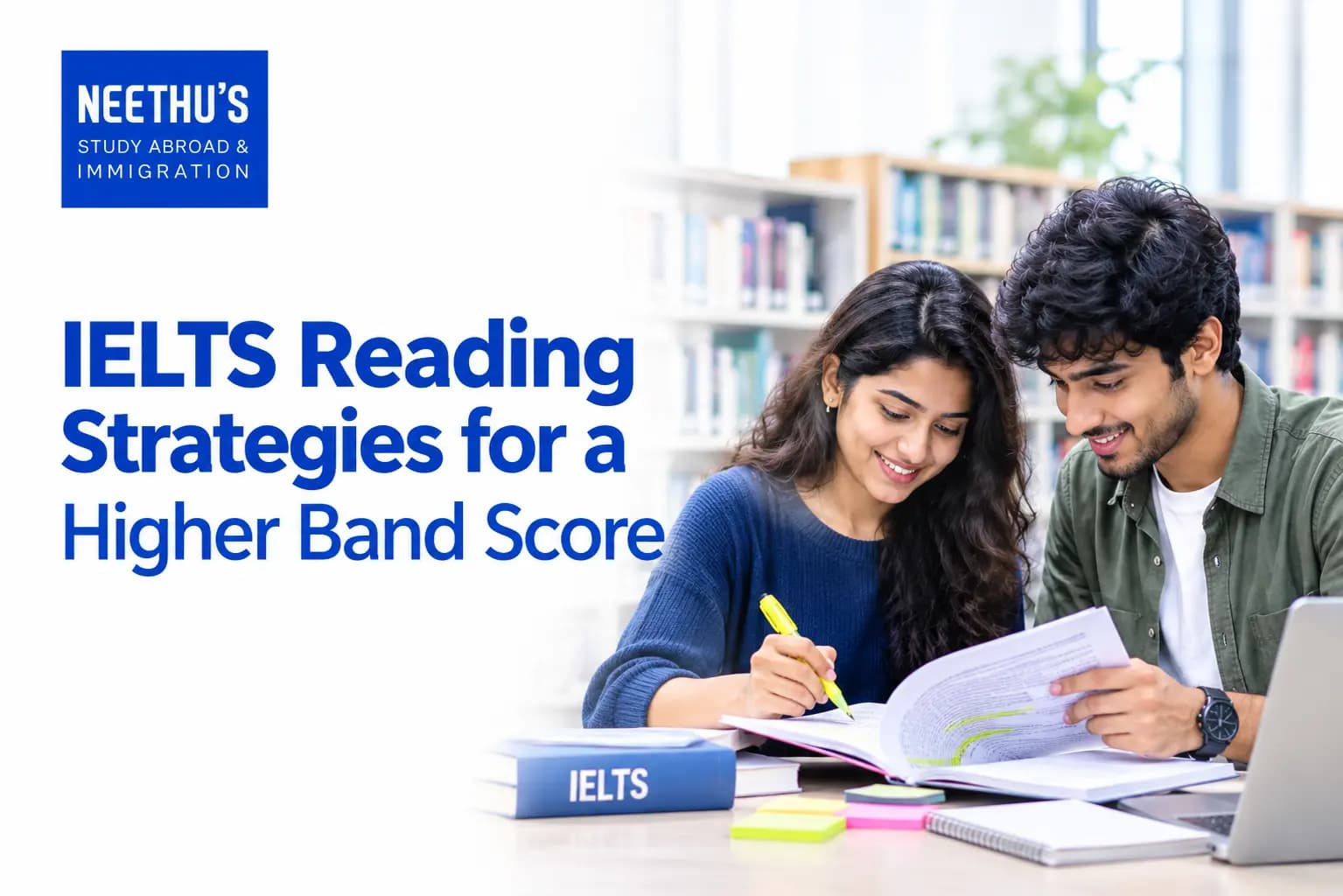
The IELTS Reading test evaluates how well candidates understand written information, interpret ideas, and identify relevant details within a limited period. While some students find the passages manageable, others struggle to finish all the questions on time. The difficulty often comes from unfamiliar vocabulary, complex sentence structures, confusing question formats, and the pressure of completing the test within 60 minutes.
Preparing for this section requires a focused approach rather than simply reading more books or articles. Candidates need to develop the ability to locate information quickly, understand the author's message, recognise paraphrased expressions, and make decisions without wasting valuable time. Building these skills gradually through a structured preparation plan can help improve reading performance.
Whether you are taking IELTS Academic or General Training, understanding how to approach the reading section can make your preparation more productive. The following techniques can help you strengthen your comprehension skills and work towards your desired score.
Before beginning intensive preparation, understand what the Reading section involves. Candidates must answer 40 questions within 60 minutes, making time management an important part of the examination.
The IELTS Academic Reading test contains three passages that may explore subjects such as science, history, technology, culture, or social developments. The General Training Reading test includes materials related to daily life, workplace situations and general topics, with a variety of short and longer texts.
The examination may contain the following question formats:
Multiple-choice questions
True, False, Not Given
Yes, No, Not Given
Matching headings
Matching information
Sentence completion
Summary completion
Short-answer questions
Each question format requires a different reading skill. Understanding the instructions and practising each type separately before attempting complete tests can help you develop confidence and accuracy.
One of the common difficulties candidates face is attempting to understand every sentence before answering questions. This approach can consume too much time, especially when passages contain unfamiliar words or complicated explanations.
Instead, begin with a quick overview of the passage. Read the title, introductory section, headings, and opening lines of paragraphs. Look for clues that reveal the subject and how the information is organised.
This process, known as skimming, helps you understand the general direction of the text without concentrating on every detail. You may identify that one paragraph introduces a problem, another discusses its causes, and a later section examines possible solutions.
Having this general understanding makes it easier to return to the appropriate paragraph when searching for answers. Skimming should therefore be part of your initial reading approach rather than an attempt to memorise the entire passage.
Scanning is a technique that involves looking through a passage to find particular information. It can help you identify answers related to dates, names, numbers, locations, examples, and specific facts.
When reading a question, identify the words or concepts that are likely to appear in the relevant part of the passage. Then move through the text quickly until you find information that appears related. Once you locate a possible answer, read the surrounding sentences to check whether the information is correct.
The IELTS examination frequently uses alternative expressions rather than repeating the exact words from the question. Therefore, scanning requires you to recognise similarities in meaning, not just matching vocabulary.
For instance, a question referring to an increase in production may be answered by a passage describing a rise in manufacturing output. Understanding these connections can help you locate answers more efficiently.
A strong vocabulary can help candidates understand passages that discuss unfamiliar subjects. It also helps them recognise answers when the wording of a question differs from the information in the text.
During your preparation, collect new words, expressions and synonyms from the reading materials you use. Learn their meanings in context rather than memorising definitions without examples.
Consider the following expressions:
|
Expression in the question |
Similar meaning in the passage |
|
A major development |
A significant advancement |
|
Reduced considerably |
Declined substantially |
|
Financial difficulties |
Economic challenges |
|
A growing concern |
An increasingly serious issue |
|
Achieved success |
Became successful |
Recognising these language variations can help you understand the relationship between questions and passages.
You can develop this skill by reading newspaper reports, educational articles, magazines and other English-language materials. Make a habit of identifying alternative expressions for familiar words and phrases.
True, False and Not Given questions test whether you can accurately compare statements with the information in the passage. These questions require careful reading because small differences in wording can change the meaning.
True: The statement reflects what the passage says.
False: The statement conflicts with the information in the text.
Not Given: The passage does not establish whether the statement is true or false.
For example, if a passage states that a museum introduced free admission on Sundays, a question claiming that the museum offers free admission every day would be False if the text clearly states that the offer applies only to Sundays.
However, if the passage mentions free admission on Sundays without explaining whether other days have an admission charge, a statement about admission on other days may be Not Given.
Do not rely on what you think is likely to happen in real life. Your decision must be based on the information provided in the passage.
Matching headings questions can become easier when you focus on the purpose of each paragraph. The objective is to select the heading that best represents the central message, not simply one that contains words found in the passage.
After reading a paragraph, summarise its meaning mentally in a few words. Ask yourself what the writer is trying to communicate. Is the paragraph introducing an idea, explaining a process, presenting evidence, comparing two approaches or discussing a limitation?
Then compare your understanding with the available headings. Avoid choosing an option that describes only a single example or minor point. The correct heading generally reflects the broader message of the paragraph.
Practising this technique can improve your ability to understand the structure and purpose of written texts.
Candidates need to answer 40 questions within one hour, so managing time effectively is essential. Spending several minutes on a single difficult question can affect your ability to complete the remaining tasks.
A possible time distribution is:
|
Passage |
Time allocation |
|
Passage 1 |
17 minutes |
|
Passage 2 |
20 minutes |
|
Passage 3 |
23 minutes |
|
Total |
60 minutes |
You can modify this schedule depending on your reading speed and the difficulty of the passages. The goal is to maintain a steady pace throughout the examination.
If you are unable to answer a question after a reasonable amount of time, move to the next one. Returning to difficult questions later is usually more productive than getting stuck on a single problem. Remember to fill in every answer before the test finishes because incorrect answers do not carry a separate penalty.
Consistent preparation can help you develop the skills required for the IELTS Reading test. However, practising full-length tests every day is not necessarily the most effective way to improve. You should also focus on specific skills and question types.
Your IELTS reading practice routine can include reading an article, identifying its main ideas, answering a few questions, and reviewing the vocabulary. You can also practise one question format at a time, particularly if you find matching headings, summary completion or True, False, Not Given questions difficult.
Include both timed and untimed exercises in your preparation. Untimed sessions allow you to understand passages carefully and examine mistakes, while timed activities help you develop speed and concentration.
After completing each exercise, review the answers and identify the reasons behind your mistakes. This will help you understand whether you need to improve vocabulary, comprehension, question interpretation or time management.
Students preparing for overseas education may also consult the Best study abroad consultants in Kerala to learn about IELTS score requirements, university application procedures, and admission timelines for their chosen destinations.
Small mistakes can affect your final Reading score, so pay attention to the instructions and the information provided in the passage.
Trying to understand every word: Focus on the meaning relevant to the question instead of translating the entire passage.
Overlooking answer instructions: Check the word limits for sentence completion and short-answer questions.
Making unsupported conclusions: Do not select answers based on your personal opinions or general knowledge.
Ignoring qualifying words: Expressions such as all, some, only, most and never can alter the meaning of a statement.
Failing to analyse mistakes: Reviewing incorrect answers can help you avoid repeating the same errors.
Keeping track of your performance across practice tests can help you recognise which question formats require additional attention.
IELTS Reading passages can cover a wide range of topics, and candidates may encounter subjects they have never studied before. Reading materials from different fields can help you become more comfortable with unfamiliar vocabulary, ideas and writing styles.
Choose articles about environmental issues, scientific discoveries, education, history, social behaviour, business and technology. Try to understand the central argument, identify supporting information and recognise how the writer develops the topic.
You can also practise writing short summaries of articles you read. Summarising encourages you to identify the most important information and improves your ability to distinguish central ideas from minor details.
Gradually introduce timed reading exercises as you become more comfortable with the materials. This can help you apply your comprehension skills more effectively under examination conditions.
Improving your IELTS Reading score involves developing a combination of comprehension, vocabulary, concentration, and time management skills. Familiarity with question formats and a clear approach to finding information can help you avoid unnecessary mistakes during the examination.
The most useful IELTS reading tips include practising skimming and scanning, learning paraphrased expressions, carefully interpreting statements, and reviewing incorrect answers. These techniques are most effective when incorporated into a consistent preparation routine.
Rather than simply completing more tests, focus on understanding your mistakes and improving the skills that affect your performance. With regular practice, patience, and a well-planned approach, you can develop stronger reading abilities and work towards achieving a higher IELTS band score.
1. How can I improve my IELTS Reading band score?
You can improve your IELTS Reading score by practising different question types, developing vocabulary, learning skimming and scanning techniques, and completing timed reading exercises. Reviewing mistakes after each practice test can help you identify areas that need improvement.
2. How much time is given for the IELTS Reading test?
Candidates have 60 minutes to answer 40 questions in the IELTS Reading section. Effective time management is important to ensure that you attempt all the questions within the allotted time.
3. What is the best strategy for IELTS Reading?
A combination of skimming, scanning, keyword identification and careful reading is effective. Skim passages to understand the main ideas, scan for specific details and read relevant sections carefully before selecting your answers.
4. How can I solve IELTS Reading questions faster?
Identify keywords in the questions, locate relevant sections using scanning and avoid reading the entire passage repeatedly. Practising under timed conditions can also help improve your speed and efficiency.
5. How can I prepare for True, False, Not Given questions?
Compare each statement with the information in the passage. Choose True when the statement agrees with the text, False when it contradicts the text and Not Given when the passage does not provide sufficient information to determine the answer.
6. Is vocabulary important for IELTS Reading?
Yes, vocabulary is essential for understanding passages and recognising paraphrased information. Learning synonyms, collocations and expressions in context can help you identify answers even when the wording differs from the questions.
7. How many reading passages are there in IELTS Academic?
The IELTS Academic Reading test contains three passages and 40 questions. The texts cover a variety of subjects and assess different reading comprehension skills.
8. How often should I practise IELTS Reading?
It is advisable to practise reading skills regularly, ideally every day or several times a week. Combining individual question-type exercises with full-length timed mock tests can help you improve gradually.
9. Can I achieve a high IELTS Reading score without reading every word?
Yes. You do not need to understand every word in a passage to answer the questions correctly. Skimming for the main idea, scanning for details, and carefully reading relevant sections can help you complete the test more efficiently.
10. What should I do if I cannot find an answer during the IELTS Reading test?
Avoid spending too much time on a difficult question. Move to the next one, complete the questions you can answer confidently, and return to the difficult question if time permits. Always attempt to answer every question before the test ends.